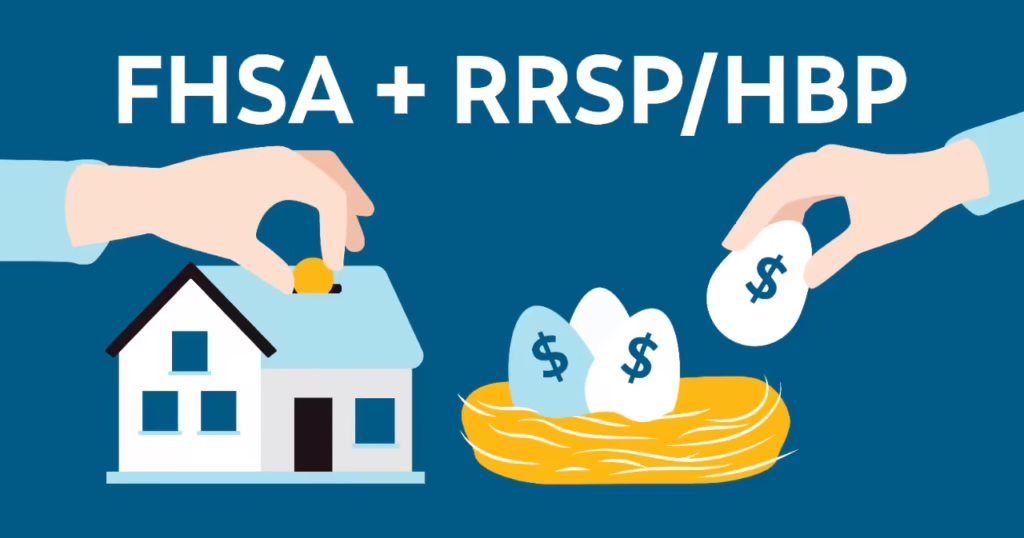
If you’re deciding between FHSA vs RRSP first home Canada options in 2026, you’re not alone—and the stakes are higher than you might think. Here’s a surprising fact: using both accounts strategically could give you up to $100,000 in tax-advantaged savings — or $200,000 as a couple for your down payment. That’s a game-changer for first-time buyers in today’s market. In this guide, you’ll learn exactly how each account works, which one fits your situation better, and how to maximize your savings before you buy. Let’s break down the Home Buyers Plan vs FHSA 2026 debate once and for all.
What Is the FHSA and How Does It Work for First-Time Homebuyers?
The First Home Savings Account (FHSA) launched in April 2023 and quickly became one of the most powerful tools for Canadian first-time buyers. It combines the best features of both the RRSP and TFSA into one account designed specifically for buying your first home.
FHSA Contribution Limits and Tax Benefits
You can contribute up to $8,000 per year to your FHSA, with a lifetime maximum of $40,000. Every dollar you contribute is tax-deductible, just like an RRSP. If you’re in a 30% tax bracket, an $8,000 contribution saves you $2,400 on your tax bill.
Here’s where it gets even better: when you withdraw money from your FHSA to buy a qualifying home, you pay zero tax on the withdrawal. That’s right—the growth is completely tax-free, and there’s no repayment required. This “double tax advantage” is why The FHSA’s double tax advantage — deductible contributions AND
tax-free withdrawals — makes it the most powerful registered
account for first-time buyers Canada has ever introduced.
Who Qualifies for the FHSA?
To open an FHSA, you must be a Canadian resident between 18 and 71 years old. Most importantly, you can’t have lived in a home you owned (or that your spouse owned) at any time in the year you open the account or the previous four calendar years. You also can’t have previously owned a qualifying home.
Once you open an FHSA, you have 15 years to use the funds—or until you turn 71, whichever comes first. If you don’t buy a home, you can transfer the balance to your RRSP without affecting your contribution room, or withdraw it (though withdrawals are taxable if not used for a home purchase).
💡 Pro Tip: Open your FHSA TODAY even if you only deposit $100.
The 15-year clock starts from account opening — not from when
you max it out. Waiting one year costs you $8,000 of contribution
room permanently.
How Does the RRSP Home Buyers Plan Work in 2026?
The RRSP Home Buyers Plan (HBP) has been around since 1992, making it a familiar option for many Canadians. It lets you “borrow” from your own RRSP to put toward a down payment—but the rules are quite different from the FHSA.
Home Buyers Plan Withdrawal Limits
As of 2024, the HBP allows you to withdraw up to $60,000 from your RRSP tax-free for a home purchase. If you’re buying with a spouse or partner who also qualifies, you can each withdraw $60,000, giving you $120,000 in combined purchasing power.
Like the FHSA, your original RRSP contributions were tax-deductible. However, there’s a critical difference: the HBP is essentially a loan from yourself that must be repaid.
The Repayment Requirement You Can’t Ignore
Here’s where many first-time buyers get caught off guard. After you use the HBP, you must repay the full amount to your RRSP over 15 years, starting the second year after your withdrawal. That means if you withdraw $60,000, you’ll need to repay at least $4,000 per year.
Miss a payment? The CRA adds the missed amount to your taxable income for that year. For someone in a 30% tax bracket, missing a $4,000 repayment means an unexpected $1,200 tax bill. This repayment obligation can strain your budget during those expensive early years of homeownership when you’re also paying for maintenance, furniture, and potentially higher utility costs.
For a deeper understanding of RRSP strategies, check out our guide on maximizing your RRSP contributions.
💡 Pro Tip: Set up automatic annual RRSP contributions right
after closing to cover your HBP repayment. Treat it like a bill.
Missing even one year means the CRA adds that amount to your
taxable income — an unexpected tax bill during an already
expensive year of homeownership.
FHSA vs RRSP First Home Canada: Complete Comparison
Choosing between the FHSA or RRSP for down payment savings depends on several factors. This comparison table breaks down the key differences to help you decide which account—or combination of accounts—works best for your situation.
| Feature | FHSA | RRSP Home Buyers Plan |
|---|---|---|
| Maximum Withdrawal | $40,000 (lifetime limit) | $60,000 per person |
| Annual Contribution Limit | $8,000 | 18% of income, max $32,490 (2025) |
| Tax Deduction on Contributions | Yes | Yes |
| Tax on Qualifying Withdrawal | None | None |
| Repayment Required | No | Yes, over 15 years |
| Investment Growth | Tax-free forever | Taxable when eventually withdrawn in retirement |
| Time Limit to Use Funds | 15 years from account opening | No time limit (as long as funds are in RRSP) |
| Can Use with Spouse | Yes ($80,000 combined) | Yes ($120,000 combined) |
Real Example — Toronto Couple, 2026:
Both partners, age 32, combined
income $140,000:
FHSA (Partner A): $40,000
FHSA (Partner B): $40,000
HBP (Partner A): $30,000
HBP (Partner B): $30,000
Total Down Payment: $140,000
On an $800,000 home = 17.5% down
(Close to avoiding CMHC insurance!)
Tax refunds from FHSA contributions:
~$24,000 total over 5 years
(30% bracket × $8,000 × 5 years × 2)
That’s $24,000 back from CRA to reinvest or add to your down payment! 🍁
As you can see, the FHSA wins on simplicity—no repayment, fully tax-free growth. But the HBP offers higher withdrawal limits, which matters if you’ve been contributing to your RRSP for years and have a substantial balance.
Which Account Should You Choose for Your Down Payment?
The best account for first home Canada savings depends on your specific timeline, income, and existing savings. Let’s walk through the decision step by step.
Step 1: Assess Your Timeline
If you’re planning to buy within the next one to three years, open an FHSA immediately if you haven’t already. You can contribute $8,000 this year plus carry forward unused room from previous years (up to $8,000 maximum carryforward). Even if you can only save for two years, that’s potentially $16,000-$24,000 in your FHSA.
If your timeline is five years or more, you have time to maximize your FHSA at $40,000 before exploring other options. This longer runway lets compound growth work in your favour—especially if you invest in diversified ETFs through providers like Questrade or Wealthsimple.
Buying in 1-2 years:
→ Keep FHSA in HISA (EQ Bank 4%+) or short-term GICs — protect your capital
Buying in 3-5 years:
→ Conservative ETF (XGRO/VGRO) inside FHSA — some growth with moderate risk
Buying in 5+ years:
→ Growth ETF (XEQT/VEQT) inside FHSA — maximize tax-free growth
Step 2: Consider Your Existing RRSP Balance
Already have significant RRSP savings? You might want to use both accounts. Someone with $50,000 in their RRSP and a maxed-out $40,000 FHSA could potentially access $90,000 for their down payment—enough for nearly 20% down on a $450,000 home.
However, if your RRSP balance is small, prioritize the FHSA. Why? Every dollar grows tax-free in the FHSA and comes out tax-free. RRSP money withdrawn through the HBP needs repayment, and any growth on those funds will eventually be taxed in retirement.
Step 3: Evaluate Your Post-Purchase Cash Flow
This is crucial. After buying your home, will you have room in your budget for HBP repayments on top of your mortgage, property taxes, insurance, and maintenance? Many first-time buyers underestimate these costs.
If money will be tight, lean toward the FHSA. No repayment means no financial stress if unexpected expenses pop up—like a furnace replacement or emergency repairs.
For help creating a realistic homebuying budget, read our first-time homebuyer budget guide.
Smart Strategies When Using Both FHSA and RRSP
Here’s the good news: you don’t have to choose just one. The CRA allows you to use both your FHSA and the RRSP Home Buyers Plan for the same home purchase. This strategy can significantly boost your down payment.
Maximize the FHSA First
Because the FHSA has no repayment requirement and offers fully tax-free growth, prioritize it. Aim to contribute the full $8,000 annually until you hit the $40,000 lifetime maximum. Even if you’re also contributing to an RRSP, direct your “first home savings” specifically to the FHSA.
Use HBP for the Gap
If $40,000 isn’t enough for your target down payment, tap into your RRSP through the HBP. For example, if you need $70,000 down and have $40,000 in your FHSA, you’d only need $30,000 from the HBP—meaning your repayment would be a manageable $2,000 per year over 15 years.
Don’t Forget CMHC Insurance Thresholds
In Canada, you need at least 20% down to avoid CMHC mortgage insurance. On a $500,000 home, that’s $100,000. By combining a maxed FHSA ($40,000) with a healthy HBP withdrawal ($60,000), a single buyer can reach that threshold and save thousands in insurance premiums over the life of their mortgage.
💡 Pro Tip: CMHC insurance on a $500,000 home with 10% down
adds ~$13,500 to your mortgage. By combining FHSA ($40,000) +
HBP ($60,000) to reach 20% down, you save that entire amount —
more than covering several years of RRSP repayments.
Watch for Common Mistakes
One major error? Opening an FHSA too late. The sooner you open the account, the more contribution room you accumulate. Even if you can only deposit $100 right now, opening the account starts your 15-year clock and builds carryforward room.
Another mistake is forgetting the 90-day RRSP seasoning rule. Money must be in your RRSP for at least 90 days before you can withdraw it under the HBP. Plan ahead so you don’t miss your closing date.
💡 Pro Tip: If you’re buying in spring 2027, make your RRSP contribution by January 2027 at the latest — not February
or March. Many buyers miss this and can’t use their HBP funds
at closing.
Major banks like TD, RBC, BMO, Scotiabank, and CIBC all offer both FHSA and RRSP accounts—often with promotional offers for first-time homebuyers. Compare fees and investment options before choosing where to open your accounts.
Key Takeaways
- The FHSA allows up to $40,000 in tax-deductible contributions with completely tax-free withdrawals for your first home—no repayment required.
- The RRSP Home Buyers Plan lets you withdraw up to $60,000 but requires full repayment over 15 years, or the amount becomes taxable income.
- You can legally use both accounts for the same home purchase, potentially accessing up to $100,000 as a single buyer or $200,000 with a qualifying spouse.
- Open your FHSA as early as possible to start accumulating contribution room, even if you can only deposit a small amount initially.
- Prioritize the FHSA over the HBP whenever possible because of its superior tax treatment and no repayment obligation.
- Remember the 90-day RRSP seasoning rule before making an HBP withdrawal to avoid delays in your home purchase.
Frequently Asked Questions
Can I use both FHSA and RRSP Home Buyers Plan together?
Yes, you can use both accounts for the same qualifying home purchase. The CRA allows first-time buyers to withdraw from their FHSA (up to $40,000) and use the RRSP Home Buyers Plan (up to $60,000) simultaneously. This means a single buyer could potentially access $100,000 in tax-advantaged savings for their down payment. Just ensure you meet the eligibility requirements for each program separately.
Which is better for a down payment FHSA or RRSP?
For most first-time buyers, the FHSA is the better choice because it offers tax-free growth and tax-free withdrawals with no repayment required. The RRSP HBP can be a good supplement if you need more than $40,000 or already have substantial RRSP savings. However, the HBP’s mandatory 15-year repayment schedule can strain your budget during expensive early homeownership years. Prioritize maxing out your FHSA before turning to the HBP.
Do I have to repay FHSA like the Home Buyers Plan?
No, the FHSA does not require any repayment. When you withdraw funds from your FHSA to purchase a qualifying first home, the money is yours to keep permanently—no strings attached. This is one of the biggest advantages of the FHSA over the RRSP Home Buyers Plan, which requires you to repay the full withdrawal amount over 15 years. It’s why many financial advisors consider the FHSA the best account for first home Canada savings.
Understanding FHSA vs RRSP first home Canada options is essential for making the smartest financial decision on your path to homeownership. The FHSA generally offers superior tax benefits and flexibility, but combining it with the Home Buyers Plan can maximize your purchasing power. Whichever route you choose, start saving early and take full advantage of these powerful tax-sheltered accounts. For more strategies on building wealth as a Canadian, explore our other financial planning guides on Getwealthy.
Get free Canadian money tips every week
TFSA updates, CRA changes, mortgage strategies — straight to your inbox every Thursday. No spam, unsubscribe anytime.
The GetWealthy editorial team writes plain-English guides to Canadian personal finance, based on official CRA, FINTRAC and government sources and reviewed every year.
Disclaimer: This article is for informational and educational purposes only and does not constitute financial, tax, or legal advice. Always consult a qualified financial advisor or tax professional for personalized advice.