If you’re thinking about whether to withdraw RRSP to pay mortgage Canada homeowners facing 2026 renewals, you’re not alone—and the stakes are high. With the Bank of Canada holding the policy rate at 2.25% and five-year fixed mortgages making up 40% of all Canadian mortgages, millions of homeowners are watching their payments jump at renewal. Here’s a startling reality: draining $100,000 from your RRSP could cost you $30,000 to $50,000 in immediate taxes, plus decades of lost compound growth. In this guide, you’ll learn exactly when cashing out makes sense, when it doesn’t, and smarter alternatives to consider.
Should You Withdraw RRSP to Pay Mortgage Canada Homeowners Are Asking in 2026?

The short answer for most Canadians: probably not. While eliminating mortgage debt feels liberating, the math rarely works in your favour when you factor in taxes, lost tax-sheltered growth, and your retirement security. Let’s break down why this decision is more complex than it appears.
The Real Cost of RRSP Withdrawals
When you withdraw from your RRSP outside of retirement, the CRA treats that money as regular income. This means your withdrawal gets stacked on top of your salary, potentially pushing you into a higher tax bracket. For a homeowner earning $90,000 annually in Ontario, a $100,000 RRSP withdrawal could mean paying over 43% in combined federal and provincial taxes on a significant portion of that withdrawal.
Your financial institution will also withhold tax immediately: 10% on withdrawals up to $5,000, 20% on $5,001 to $15,000, and 30% on amounts over $15,000. But here’s the catch—this withholding often isn’t enough. You’ll likely owe more when you file your tax return, creating an unpleasant surprise the following April.
💡 Pro Tip: If you’re determined to use RRSP funds, the ONLY good time is a year when your income is very low: parental leave, sabbatical, between jobs, or early retirement before CPP/OAS start. Drawing $30K from RRSP when your only other income is $20K means paying just 20-25% in taxes — vs. 43%+ while working. Same RRSP money, half the tax bill.
The Compound Growth You’re Sacrificing
Money inside your RRSP grows tax-free until withdrawal. If you’re 50 years old and withdraw $100,000 today, you’re not just losing $100,000—you’re losing what that money would have become. At a modest 6% average annual return, that $100,000 would grow to approximately $320,000 by age 70. That’s $220,000 in growth you’ll never see, plus you’ve permanently lost that contribution room forever.
When RRSP Withdrawal for Mortgage Payoff Might Make Sense
There are limited scenarios where using RRSP funds for your mortgage could work:
If you’re already retired or have very low income this year, your marginal tax rate might be low enough that withdrawals are less painful. If you’re in the 20% bracket now but were in the 43% bracket when you contributed, you’re actually coming out ahead on the tax arbitrage—though you still lose future growth.
Another scenario: if you have serious cash flow concerns and your mortgage payment at renewal would consume an unsustainable portion of your income. Financial survival trumps optimization. But even then, partial withdrawals or other strategies usually beat draining your entire RRSP.
How Does Using RRSP to Pay Down Mortgage Renewal Compare to Other Options?
Before you cash out RRSP for mortgage 2026 payments, consider the alternatives. Each option has different tax implications, impacts on your retirement, and effects on your overall financial security.
Option 1: Extend Your Amortization
If your mortgage payment is jumping significantly at renewal, ask your lender about extending your amortization period. Going from 15 years remaining to 25 years can dramatically reduce monthly payments. Yes, you’ll pay more interest over time, but you keep your retirement savings intact. Many lenders, including RBC, TD, and Scotiabank, offer this flexibility at renewal.
Option 2: Use Your TFSA Instead
Unlike RRSP withdrawals, TFSA withdrawals are completely tax-free. If you’ve been maxing out your TFSA (the 2026 contribution limit is $7,000, with a lifetime maximum around $109,000 for someone eligible since 2009), this is a much more tax-efficient source of funds for mortgage paydown. Plus, you get that contribution room back the following January.
💡 Pro Tip: If you have both TFSA and RRSP, here’s the ideal order for mortgage paydown:
1. TFSA first (tax-free, room restored)
2. Non-registered savings (no RRSP impact)
3. Partial RRSP in a low-income year only
4. Full RRSP withdrawal — LAST resort
Never treat RRSP as a “savings account” for short-term goals. It’s retirement insurance — protect it.
Option 3: Make a Lump Sum Payment from Savings
Most mortgage contracts allow annual lump sum payments of 10% to 20% of the original principal without penalty. Check your renewal statement carefully—as required by Canadian regulations, it must clearly show your remaining principal, interest rate, and any applicable fees. Using non-registered savings for a lump sum payment at renewal can reduce your balance without the tax hit.
Option 4: Refinance and Consolidate High-Interest Debt
If you’re carrying credit card debt at 19% to 21% interest alongside your mortgage, focusing your extra cash on that debt first makes more mathematical sense. Some homeowners refinance to roll high-interest debt into their mortgage at much lower rates, then redirect the freed-up cash flow toward accelerated mortgage payments.
Comparison: RRSP Withdrawal vs. TFSA Withdrawal vs. Keeping Investments
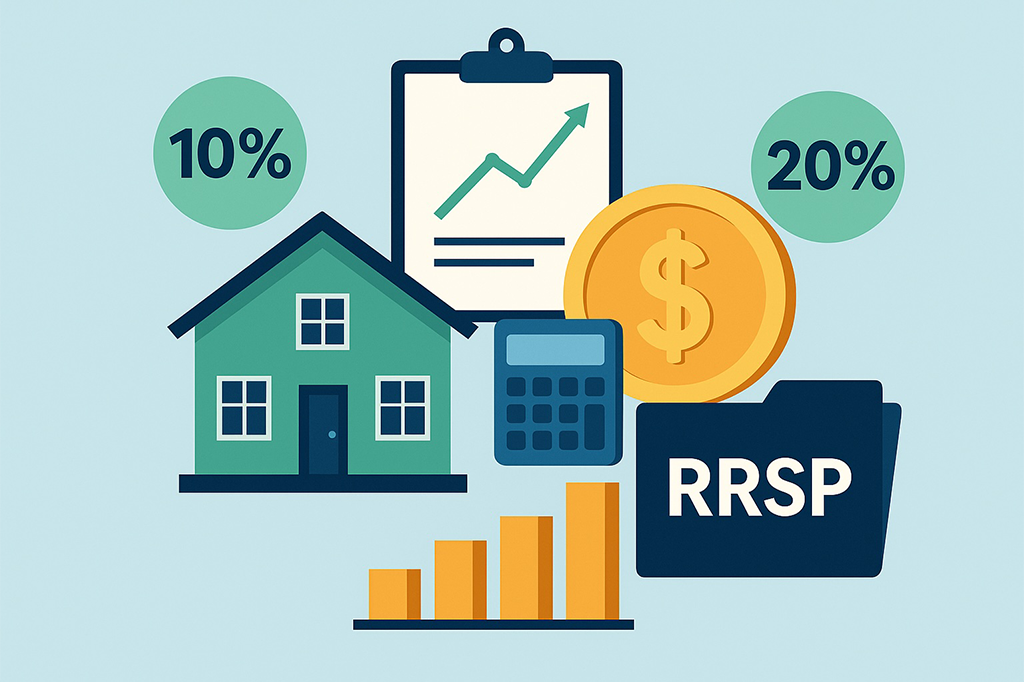
This table compares three approaches for a Canadian homeowner considering using $100,000 to pay down their mortgage at renewal. The numbers assume a 2026 mortgage rate of approximately 4.5% and an Ontario resident in the $90,000 income bracket.
| Feature | RRSP Withdrawal | TFSA Withdrawal | Keep Investments Growing |
|---|---|---|---|
| Immediate Tax Impact | $30,000–$45,000 tax bill | $0 (completely tax-free) | $0 |
| Net Amount for Mortgage | $55,000–$70,000 after tax | $100,000 (full amount) | $0 (no paydown) |
| Lost Contribution Room | Permanent—never recovered | Restored January 1 next year | None |
| Impact on Retirement Income | Significant reduction in future funds | Moderate—TFSA is flexible | Preserved growth potential |
| Effect on Government Benefits | May reduce OAS/GIS in retirement | No effect on benefits | RRSP withdrawals affect benefits later |
| 20-Year Opportunity Cost (6% return) | ~$220,000 lost growth | ~$220,000 (but can rebuild) | $0—investments continue compounding |
As you can see, TFSA withdrawals are far more efficient if you have the funds available. For more details on maximizing your tax-free savings, check out our guide on TFSA investment strategies.
How to Evaluate Whether to Cash Out RRSP for Mortgage 2026 Renewal
Before making this irreversible decision, follow these steps to ensure you’re making the right choice for your situation.
Step 1: Calculate Your True After-Tax Withdrawal Amount
Don’t assume you’ll get the full RRSP amount for your mortgage. Use a Canadian income tax calculator (the CRA website has one, or try tools from Wealthsimple or EQ Bank) to estimate your total tax bill based on your employment income plus the proposed withdrawal. A $100,000 withdrawal might only net you $55,000 to $70,000 depending on your province and income level.
Step 2: Compare Your Mortgage Rate to Expected Investment Returns
According to CIBC’s analysis on RRSP vs. mortgage decisions, the comparison depends heavily on whether your investment returns exceed your mortgage interest rate. With current 5-year fixed rates range from 4.09% (best available) to 4.89% (major banks), and historical long-term equity returns averaging 6% to 8%, keeping money invested often wins mathematically—especially when you factor in the RRSP’s tax-deferred growth.
Step 3: Assess Your Retirement Timeline
If you’re 55 or older and planning to retire within 10 years, your RRSP has less time to recover from a large withdrawal. However, if retirement is close, you might also be in a lower tax bracket soon, making it smarter to wait and withdraw then. The Bank of Canada’s July 2025 analysis shows that five-year fixed-rate mortgages make up 40% of all Canadian mortgages, meaning many people renewing now have 5+ years before their next renewal—time your investments could use to grow.
Step 4: Consult a Fee-Only Financial Planner
This decision involves complex interactions between tax planning, retirement projections, and debt management. A fee-only financial planner (one who doesn’t earn commissions) can model your specific situation. The cost—typically $1,500 to $3,000 for a comprehensive plan—is tiny compared to the potential five or six-figure impact of getting this decision wrong.
💡 Pro Tip: Ask your financial planner specifically to model “RRSP meltdown” scenarios — a strategy where you withdraw from RRSP early at a low tax rate to fund TFSA, reducing future mandatory RRIF withdrawals. For many Canadians near retirement, this planned early withdrawal saves tens of thousands in OAS clawback and RRIF taxes. It’s counterintuitive but often brilliant.
Common Mistakes When Considering RRSP Withdrawal for Mortgage Payoff
Avoid these costly errors that Canadian homeowners frequently make when weighing this decision.
Mistake 1: Draining All Liquid Assets
As Ratehub.ca warns, using all your liquid assets to pay off your mortgage can leave you financially exposed. Emergencies happen—job loss, medical expenses, home repairs. If you’ve emptied your RRSP and something goes wrong, you may end up borrowing at much higher interest rates (credit cards, lines of credit) to cover expenses. Always maintain an emergency fund of 3 to 6 months’ expenses outside your mortgage payoff plans.
Mistake 2: Ignoring the Impact on OAS and GIS
Large RRSP withdrawals in retirement can trigger OAS clawbacks. In 2026, OAS for those 65+ is approximately $743.05 per month, but it gets reduced if your income exceeds around $90,000. If you drain your RRSP now, you’ll have less retirement income later—but if you keep a large RRSP and withdraw heavily in retirement, you might lose government benefits. This requires careful planning; check out our guide on avoiding OAS clawbacks for detailed strategies.
Real OAS Clawback Math (2026):
Threshold: $93,454 (2025 income)
If your 2025 income = $110,000:
Excess: $110,000 – $93,454 = $16,546
Clawback: $16,546 × 15% = $2,482/year = ~$207/month reduced from OAS
If your 2025 income = $140,000:
Excess: $140,000 – $93,454 = $46,546
Clawback: $46,546 × 15% = $6,982/year = ~$582/month — nearly full OAS gone!
This is why large RRSP withdrawals in retirement are so dangerous. A one-time $100K RRSP withdrawal at 67 could cost you $15,000 in OAS benefits that year alone.
Mistake 3: Forgetting About Timing at Renewal
If you’re planning to make a lump sum payment and potentially switch lenders, timing is critical. As Ratehub.ca notes, you’ll want to ensure your payment and transfer line up with your renewal date. Making a large payment just before renewal, then switching lenders, can create complications. Coordinate with both your current and new lender to ensure smooth processing.
Mistake 4: Not Considering Partial Withdrawals
It doesn’t have to be all or nothing. If you’re determined to use RRSP funds, consider withdrawing a smaller amount that keeps you in a lower tax bracket. Withdrawing $20,000 per year over several years is far more tax-efficient than withdrawing $100,000 at once, even if it means paying down your mortgage more gradually.
Key Takeaways
- Withdrawing $100,000 from your RRSP could cost $30,000 to $45,000 in immediate taxes, plus you permanently lose that contribution room and decades of tax-sheltered growth.
- TFSA withdrawals are tax-free and contribution room is restored the following January—making them a far better source of funds for mortgage paydown if available.
- With the Bank of Canada’s policy rate at 2.25% and mortgage rates around 4.5% to 5%, keeping investments growing at 6% to 8% often beats paying down mortgage debt mathematically.
- Consider alternatives like extending your amortization, making smaller lump sum payments from non-registered savings, or paying down high-interest debt first.
- Large RRSP withdrawals can trigger OAS clawbacks in retirement (starting around $90,000 income) and reduce GIS eligibility, affecting your long-term financial security.
- Always consult a fee-only financial planner before making irreversible decisions involving five or six figures—the planning cost is minimal compared to potential tax savings.
Frequently Asked Questions
How much tax will I pay if I withdraw $100K from my RRSP to pay my mortgage?
You’ll likely pay between $30,000 and $50,000 in taxes on a $100,000 RRSP withdrawal, depending on your province and other income. The withdrawal is added to your regular income for the year, so if you’re already earning $90,000, much of that $100,000 will be taxed at your highest marginal rate—often 43% or more in provinces like Ontario. Your financial institution will withhold 30% immediately, but you’ll probably owe additional tax when you file your return.
Is it smarter to keep my RRSP growing or eliminate mortgage debt at renewal?
For most Canadians, keeping your RRSP invested is the smarter choice. If your investments earn an average 6% to 8% annually and your mortgage rate is 4.5% to 5%, you’re coming out ahead by staying invested—especially since RRSP growth is tax-deferred. The exception is if you’re in a low tax bracket now (lower than when you contributed) and won’t need the money for retirement, or if mortgage payments would cause genuine financial hardship. A financial advisor can model your specific numbers.
Can I withdraw from my RRSP without triggering a huge tax bill in Canada?
Yes, but only in specific circumstances. The Home Buyers’ Plan allows first-time buyers to withdraw up to $60,000 tax-free (as of 2024 rules) for a home purchase, but this doesn’t apply to paying down an existing mortgage. If you’re retired or have very low income in a particular year, withdrawals are taxed at lower rates. Alternatively, spacing smaller withdrawals over multiple low-income years can keep you in lower tax brackets. There’s no way to make large RRSP withdrawals completely tax-free while you’re still earning a full salary.
Deciding whether to withdraw RRSP to pay mortgage Canada homeowners face at renewal is one of the biggest financial decisions you’ll make. For most people, the tax hit and lost growth make it a poor choice—but your situation is unique. Before making any moves, crunch the numbers carefully, explore alternatives like TFSA withdrawals or amortization extensions, and consider consulting a professional. For more strategies on navigating your 2026 mortgage renewal, explore our complete mortgage renewal guide here on Getwealthy.
Get free Canadian money tips every week
TFSA updates, CRA changes, mortgage strategies — straight to your inbox every Thursday. No spam, unsubscribe anytime.
Certified Financial Planner (CFP) and Chartered Investment Manager (CIM) with over 17 years of experience in Canadian personal finance. Spent 10+ years at one of Canada's Big Five banks, the last 7 focused exclusively on high-net-worth clients. Every guide is written with the same depth I bring to real client work — Canada-specific, CRA-verified, and always free.
Disclaimer: This article is for informational and educational purposes only and does not constitute financial, tax, or legal advice. Always consult a qualified financial advisor or tax professional for personalized advice.