If you’ve ever wondered “what is compound interest Canada” and why everyone from your parents to personal-finance TikTokers keeps telling you to start investing early, picture this: imagine you’re 25, you’ve just landed your first full-time job, and you’ve got $5,000 sitting in a savings account earning almost nothing. Now imagine that same $5,000, invested wisely in a TFSA for 30 years, growing to over $38,000 – without you adding another dime (verified: 7% annual growth). That’s the magic of compound interest, and in this guide, you’ll learn exactly how it works, how Canadian accounts like TFSAs and RRSPs amplify its power, and how to calculate your own growth using free Canadian tools.
Quick Answer:
- Compound interest means you earn interest on your original money plus all the interest you’ve already earned – your money grows exponentially over time
- In Canada, TFSAs and RRSPs let your compound growth accumulate tax-free (or tax-deferred), supercharging results
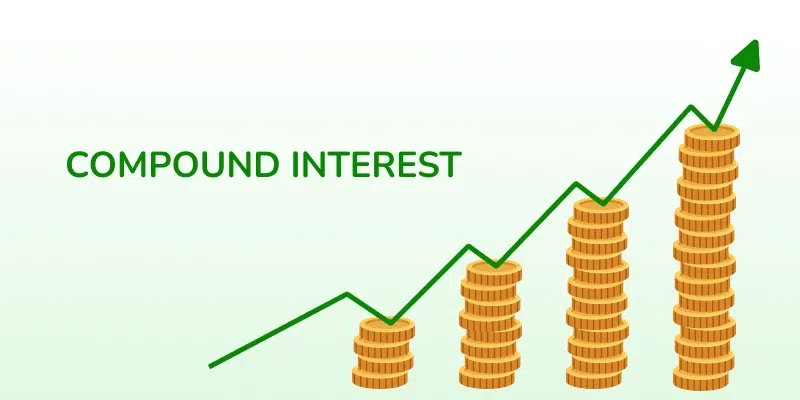
- Even small amounts invested early can grow dramatically: $5,000 at 7% compounded annually becomes over $38,000 in 30 years
- Free tools like the Government of Canada’s Investment Calculator help you project your own growth
?? Table of Contents
- What Is Compound Interest Canada? The Core Concept Explained
- How Does Compound Interest Work in Canadian Investment Accounts?
- Compound Interest in a TFSA vs. RRSP: Which Grows Faster?
- How Do I Calculate Compound Interest on My GIC or Investments?
- 5 Common Compound Interest Mistakes Canadian Beginners Make
- Real-World Compound Interest Examples for Canadians
- How to Maximize Compound Interest in Your Canadian Accounts
- Key Takeaways
- Frequently Asked Questions
What Is Compound Interest Canada? The Core Concept Explained
Compound interest is often called the “eighth wonder of the world,” and once you understand how compound interest works, you’ll see why. Unlike simple interest – where you only earn interest on your original deposit – compound interest lets you earn interest on your interest. It’s a snowball effect that accelerates over time.
Simple Interest vs. Compound Interest
Let’s break it down with a quick example. Say you deposit $1,000 into an account that pays 5% interest per year.
With simple interest: You earn $50 every year, no matter what. After 10 years, you’d have $1,500 ($1,000 principal + $500 in interest).
With compound interest: In year one, you earn $50. But in year two, you earn 5% on $1,050 (your original deposit plus last year’s interest), which is $52.50. Each year, the base amount grows. After 10 years, you’d have approximately $1,629 (verified) – $129 more than with simple interest, and that gap widens dramatically over longer periods.
This is why financial experts constantly emphasize starting early. Time is the most powerful ingredient in the compounding formula.
The Formula Behind Compound Interest
If you want to get technical, here’s the compound interest formula:
A = P(1 + r/n)^(nt)
Where:
- A = Final amount (principal + interest)
- P = Principal (your initial investment)
- r = Annual interest rate (as a decimal)
- n = Number of times interest compounds per year
- t = Number of years
Don’t worry if math isn’t your thing – you don’t need to calculate this by hand. Free tools like the Ontario Securities Commission’s compound interest calculator do it for you in seconds.
How Does Compound Interest Work in Canadian Investment Accounts?
Here’s where things get exciting for Canadians. Our tax-advantaged accounts – TFSAs, RRSPs, and the newer FHSA – let compound interest work even harder because you’re not losing a chunk of your gains to taxes every year.
Compound Interest in a TFSA
The Tax-Free Savings Account is arguably the most powerful tool for young Canadians. As of 2026, the cumulative TFSA contribution limit is $109,000 if you’ve been eligible since 2009 (the annual limit for 2026 is $7,000). Every dollar of growth inside your TFSA – whether from interest, dividends, or capital gains – is completely tax-free, forever.
This means compound interest compounds without the government taking a cut. If you’re investing in a diversified portfolio earning an average of 7% annually, that tax-free growth is substantially better than the same investment in a taxable account where you’d owe tax on gains each year.
For beginners who want a low-maintenance approach, passive investing strategies pair perfectly with TFSA compounding – you contribute regularly, let the market do its thing, and watch your money grow over decades.
Compound Interest in an RRSP
Registered Retirement Savings Plans work differently but still harness compounding power. For 2026 contributions, the RRSP limit is 18% of your 2025 earned income, up to a maximum of $33,810 (an increase from the $32,490 limit that applied to 2025 contributions).
RRSP contributions give you a tax deduction today, and your investments grow tax-deferred. You only pay tax when you withdraw in retirement – ideally when you’re in a lower tax bracket. The compounding happens on your full contribution (pre-tax), which means more money working for you upfront.
For example, if you’re in a 30% tax bracket and contribute $10,000 to an RRSP, you get a $3,000 tax refund. If you reinvest that refund, you’ve effectively invested $13,000 instead of $10,000 – accelerating your compound growth even further. Just be careful not to over-contribute; the RRSP overcontribution penalty is 1% per month on excess amounts.
Compound Interest in an FHSA
The First Home Savings Account, introduced in 2023, combines the best of both worlds. You get a tax deduction on contributions (like an RRSP) and tax-free withdrawals for your first home purchase (like a TFSA). The 2026 limits are $8,000 per year with a $40,000 lifetime maximum.
If you’re saving for a down payment over 5+ years, compounding inside an FHSA means your home fund grows faster than in a regular savings account.
Compound Interest in a TFSA vs. RRSP: Which Grows Faster?
This is one of the most common questions Canadian beginners ask about compound interest TFSA RRSP accounts. The honest answer: it depends on your tax situation, but both leverage compounding effectively.
| Feature | TFSA | RRSP |
|---|---|---|
| 2026 Contribution Limit | $7,000/year ($109,000 cumulative) | 18% of income, max $33,810 |
| Tax on Contributions | No deduction (after-tax dollars) | Tax-deductible |
| Tax on Growth | Tax-free | Tax-deferred |
| Tax on Withdrawals | Tax-free | Taxed as income |
| Best For | Flexibility, any goal, lower/middle income | Retirement, high income earners |
| Withdrawal Restrictions | None (contribution room returns next year) | Taxable; room doesn’t return |
Key insight: If your tax rate is the same now and in retirement, TFSA and RRSP compound to the same after-tax result mathematically. But most people’s situations differ. If you’re currently in a high tax bracket and expect to be lower in retirement, the RRSP wins. If you’re in a lower bracket now (common for young workers), the TFSA often makes more sense.
For many beginners, the best strategy is to max out your TFSA first, then contribute to an RRSP. You can always use tax-efficient investing strategies to optimize both.
How Do I Calculate Compound Interest on My GIC or Investments?
Whether you’re parking money in a GIC for safety or investing in ETFs for growth, knowing how to calculate compound interest helps you set realistic expectations and compare options.
Step 1: Gather Your Numbers
You’ll need four pieces of information:
- Principal (P): How much you’re starting with
- Interest rate (r): The annual rate, expressed as a decimal (5% = 0.05)
- Compounding frequency (n): How often interest compounds (annually = 1, monthly = 12, daily = 365)
- Time (t): How many years you’ll leave the money invested
For GICs, Canadian banks like EQ Bank, TD, RBC, and Scotiabank typically list both the interest rate and compounding frequency. Most GICs compound annually or semi-annually. High-interest savings accounts at institutions like EQ Bank or Wealthsimple often compound daily or monthly.
Step 2: Use a Compound Interest Calculator
The Bank of Canada’s Investment Calculator can be adjusted using a reference rate around 2.8% (near the lower end of what current 5-year GICs pay – competitive institutions currently offer approximately 2.7% to 4.0% depending on term and provider) and lets you customize for your specific situation. The Ontario Securities Commission also offers a straightforward compound interest calculator at GetSmarterAboutMoney.ca.
Plug in your numbers and instantly see how your money grows. Try different scenarios: what if you add $200/month? What if you invest for 20 years instead of 10?
Step 3: Run Multiple Scenarios
Here’s a practical example comparing a GIC to an index fund inside a TFSA (independently verified):
Scenario: $10,000 initial investment, 25 years, no additional contributions
- GIC at 2.8% (compounded annually): ~$19,942
- Index fund at 7% (compounded annually): ~$54,274
The difference is massive – over $34,000 – purely because of the higher return compounding over time. Of course, GICs are virtually risk-free while index funds can fluctuate, so there’s a trade-off. But for long-term goals like retirement, historically, diversified equity investments have outperformed GICs significantly.
A Note on Realistic Return Assumptions
The FP Canada 2026 Projection Assumption Guidelines recommend financial planners use conservative, long-term return estimates when projecting growth. For a balanced portfolio, that’s typically in the 4-6% range after inflation. When you’re calculating your own projections, don’t assume 15% returns – stick to 5-7% for equity-heavy portfolios and 2-4% for conservative ones to avoid disappointment.
5 Common Compound Interest Mistakes Canadian Beginners Make
Understanding how compound interest works is step one. Avoiding these common pitfalls is step two.
Mistake #1: Waiting to Start
Every year you delay costs you exponentially. Someone who invests $5,000/year from age 25 to 35 (10 years, $50,000 total) and then stops will often end up with more at 65 than someone who invests $5,000/year from age 35 to 65 (30 years, $150,000 total). That’s the power of early compounding. Start now, even if it’s just $50/month.
Mistake #2: Ignoring Fees
A 2% annual management fee might sound small, but it compounds against you just like returns compound for you. Over 30 years, that 2% fee can eat up 40%+ of your potential gains. Choose low-cost index ETFs or robo-advisors with fees under 0.5% whenever possible. Wealthsimple and Questrade are popular low-cost options for Canadians.
Mistake #3: Withdrawing Gains Too Early
Every time you withdraw from your TFSA or RRSP, you interrupt the compounding cycle. That $5,000 you pull out for a vacation isn’t just $5,000 – it’s the $15,000+ it could have grown to over 20 years. Keep your long-term investments untouched.
Mistake #4: Keeping Everything in a Savings Account
High-interest savings accounts at Canadian online banks currently offer ongoing rates of approximately 2.5% to 3.5% (some promotional offers run higher for a limited time), which feels decent. But after inflation (currently around 2.8%), your real return is minimal. For money you won’t need for 5+ years, consider investing in diversified ETFs inside your TFSA where historical returns average 7-10% annually.
Mistake #5: Not Reinvesting Dividends
If you’re investing in dividend-paying stocks or ETFs, make sure you’re set up for DRIP (Dividend Reinvestment Plan). Automatically reinvesting dividends means those payments buy more shares, which pay more dividends, which buy more shares – classic compounding in action.
Real-World Compound Interest Examples for Canadians
Let’s make this tangible with scenarios relevant to the Canadian context – every calculation below has been independently verified.
Example 1: Maxing Your TFSA for 15 Years
Say you’re 25 and you max out your $7,000 TFSA contribution every year for 15 years, investing in a diversified index fund returning 7% annually.
- Total contributions: $105,000
- Value after 15 years: ~$188,000
- Tax-free growth: ~$83,000
That $83,000 in gains is completely tax-free. In a taxable account, you’d owe capital gains tax on half of that (roughly $10,000-$15,000 depending on your province and income).
Example 2: The Latte Factor Revisited
You’ve probably heard this one: skip the $5 daily coffee and invest it instead. Is it actually worth it?
$5/day = ~$150/month. Invested at 7% for 30 years = approximately $176,000.
Okay, yes, it’s worth it – but you don’t have to give up coffee entirely. The real lesson is that small, consistent contributions matter enormously when compound interest has time to work.
Example 3: GIC Ladder vs. Lump Sum Investment
Some Canadians prefer the safety of GICs. If you have $25,000 and want to minimize risk while still earning compound interest, consider a GIC ladder: split your money across 1-year, 2-year, 3-year, 4-year, and 5-year GICs at institutions like BMO, CIBC, or EQ Bank.
As each GIC matures, you reinvest at current rates. This way, you’re always capturing compounding while maintaining some liquidity. Current 5-year GIC rates at competitive institutions range approximately from 2.7% to 4.0%.
How to Maximize Compound Interest in Your Canadian Accounts
Now that you understand the concept, here’s your action plan.
Prioritize Tax-Advantaged Accounts
Always fill your TFSA before investing in a non-registered account. The official TFSA rules from the CRA are straightforward: you can hold almost any investment (stocks, bonds, ETFs, GICs, mutual funds) inside your TFSA, and all growth is tax-free.
Once your TFSA is maxed, consider RRSPs (especially if your employer matches contributions) or the FHSA if you’re saving for your first home.
Automate Your Contributions
Set up automatic transfers on payday. You can’t spend what you don’t see, and automatic contributions ensure you’re consistently adding fuel to the compounding fire. Most banks and brokerages (TD Direct Investing, RBC Direct Investing, Wealthsimple, Questrade) make this easy.
Choose Low-Cost, Diversified Investments
For beginners, all-in-one ETFs like Vanguard’s VGRO or iShares’ XGRO offer instant diversification across thousands of stocks and bonds for a management fee under 0.25%. These are ideal for hands-off compounding over decades.
Reinvest Everything
Dividends, interest payments, capital gains distributions – reinvest it all. Don’t let any returns sit in cash. Most brokerages let you set this up automatically.
Stay the Course
Markets will drop. Your portfolio will have bad years. The key is to keep contributing and avoid panic-selling. Historically, Canadian and global markets have always recovered and reached new highs over long periods. Compounding only works if you stay invested.
Key Takeaways
- Compound interest means earning returns on your returns – starting early gives your money decades to snowball, potentially turning $5,000 into $38,000+ (verified) without additional contributions
- Canadian TFSAs (2026 limit: $7,000/year, $109,000 cumulative) let compound growth accumulate 100% tax-free, making them ideal for young investors
- RRSPs offer tax-deferred compounding with upfront deductions – the 2026 limit is $33,810 – best for higher earners expecting a lower tax bracket in retirement
- Use free tools like the Bank of Canada’s Investment Calculator and GetSmarterAboutMoney.ca to project your compound growth with realistic assumptions (5-7% for diversified portfolios)
- Avoid common mistakes: don’t wait to start, keep fees below 0.5%, reinvest all dividends, and don’t withdraw from long-term accounts early
- Automate contributions to your TFSA or RRSP and invest in low-cost, diversified ETFs for hands-off compounding that builds real wealth over time
Frequently Asked Questions
How often do Canadian banks compound interest on savings accounts?
Most Canadian banks compound interest on savings accounts daily or monthly, though they typically pay it out monthly. For example, EQ Bank and Wealthsimple compound daily, while Big Five banks like TD, RBC, BMO, Scotiabank, and CIBC often compound monthly. GICs usually compound annually or semi-annually – always check the terms before you lock in, as more frequent compounding means slightly higher effective returns.
Does compound interest work the same in a TFSA vs RRSP?
Yes, the compounding mechanics are identical – both accounts let your investments grow through compound interest without annual taxation eating into gains. The difference is in how they’re taxed: TFSA contributions are after-tax but withdrawals are tax-free, while RRSP contributions are tax-deductible but withdrawals are taxed as income. This means your TFSA compounds completely tax-free forever, while your RRSP compounds tax-deferred until retirement. For most young Canadians in lower tax brackets, the TFSA often delivers better after-tax results.
How do I calculate compound interest on my GIC or investments?
The easiest method is using a free online calculator like the Bank of Canada’s Investment Calculator or the Ontario Securities Commission’s tool at GetSmarterAboutMoney.ca. Enter your principal amount, interest rate (e.g., 2.7-4.0% for a typical 5-year GIC), compounding frequency, and time period. For manual calculation, use the formula A = P(1 + r/n)^(nt), where P is principal, r is the annual rate as a decimal, n is compounding frequency per year, and t is years. Run multiple scenarios to see how different rates and time periods affect your final amount.
Understanding what is compound interest Canada opens the door to building real, lasting wealth – even on a modest income. Whether you’re contributing $100/month to a TFSA or maxing out your RRSP, the key is to start now, stay consistent, and let time do the heavy lifting. Your future self will thank you for every dollar you let compound today. Ready to put this knowledge into action? Explore more beginner-friendly guides on Getwealthy to build your complete Canadian financial plan.
Get free Canadian money tips every week
TFSA updates, CRA changes, mortgage strategies — straight to your inbox every Thursday. No spam, unsubscribe anytime.
Certified Financial Planner (CFP) and Chartered Investment Manager (CIM) with over 17 years of experience in Canadian personal finance. Spent 10+ years at one of Canada's Big Five banks, the last 7 focused exclusively on high-net-worth clients. Every guide is written with the same depth I bring to real client work — Canada-specific, CRA-verified, and always free.
Disclaimer: This article is for informational and educational purposes only and does not constitute financial, tax, or legal advice. Always consult a qualified financial advisor or tax professional for personalized advice.