What is diversification investing, and why does every financial expert insist it’s the key to protecting your money? If you’ve been searching for a clear answer, you’re in the right place. Diversification is one of the most powerful tools Canadian investors have to manage risk — yet many beginners with just one or two investments unknowingly put their entire financial future at stake. In this guide, you’ll learn exactly what diversification means, how it works in the Canadian context, the different ways to spread your investments across asset classes, sectors, and geographies, and how to build a properly diversified portfolio without overcomplicating things.
Quick Answer:
- Diversification means spreading your investments across different asset classes (stocks, bonds, real estate), sectors (tech, healthcare, energy), and geographic regions to reduce overall portfolio risk
- A well-diversified Canadian portfolio typically includes 25–30 individual stocks minimum, or a single all-in-one ETF can provide instant diversification across thousands of holdings
- Diversification doesn’t eliminate risk or guarantee returns, but it smooths out volatility and protects you from any single investment tanking your entire portfolio
What Is Diversification Investing and Why Does It Matter?

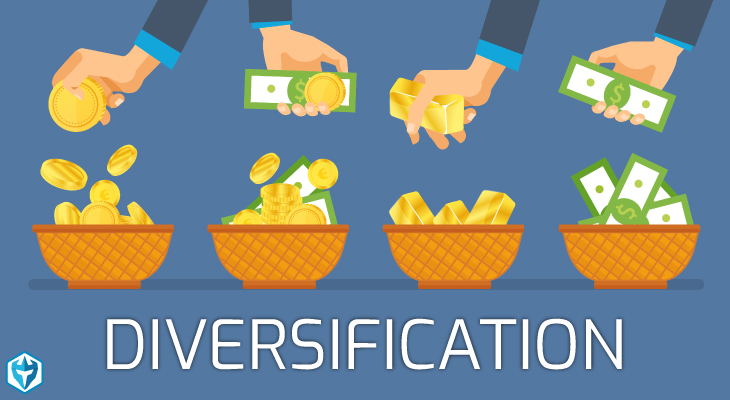
Diversification involves spreading investments across asset classes, sectors, and geographies to manage overall risk and reduce portfolio concentration. Think of it like not putting all your eggs in one basket — except the basket is your financial future and the eggs are your hard-earned savings.
When you own only one or two investments, your entire portfolio rises and falls based on those specific holdings. If you’ve put all your money into a single Canadian bank stock, for example, your wealth depends entirely on how that one company performs. If that bank faces unexpected problems — a scandal, regulatory issues, or an economic downturn that hits financial institutions hard — your entire portfolio suffers.
The Core Principle Behind Diversification
The fundamental idea is simple: different investments don’t all move in the same direction at the same time. When Canadian oil stocks decline because of falling energy prices, healthcare stocks might hold steady or even rise. When the Toronto Stock Exchange struggles, international markets might outperform. When stocks overall have a rough year, bonds might provide stability.
By owning a mix of investments that respond differently to economic conditions, you create a portfolio where gains in some areas can help offset losses in others. This doesn’t mean you’ll never lose money — you absolutely can. But diversification helps prevent catastrophic losses from any single investment going wrong.
Why Canadian Investors Need to Think Beyond Canada
Here’s something many Canadian beginners don’t realize: Canada represents only about 3% of the global stock market. Yet many Canadians hold 50% or more of their equity investments in Canadian stocks — a phenomenon called “home country bias.”
The Canadian market is also heavily concentrated in just three sectors: financials (banks and insurance companies), energy (oil and gas), and materials (mining). If you only own Canadian stocks, you’re essentially making a big bet on these three industries, while missing out on sectors that barely exist here, like large-scale technology companies.
This is why portfolio diversification Canada strategies almost always include significant international exposure — particularly to the U.S. market, which offers access to tech giants, healthcare innovators, and consumer companies that simply don’t have Canadian equivalents.
How Does Diversification Actually Reduce Risk in Your Portfolio?
Understanding how to diversify investments requires grasping a concept called correlation. Correlation measures how closely two investments move together. When two investments have high positive correlation, they tend to rise and fall at the same time. When they have low or negative correlation, they move independently or even in opposite directions.
Effective diversification means combining investments with low correlation to each other. Here’s how this works in practice.
Asset Class Diversification
The broadest level of diversification involves spreading money across different types of investments:
Stocks (Equities): Ownership stakes in companies. Higher growth potential, but also higher volatility. Over the long term, stocks have historically delivered the highest returns of any major asset class.
Bonds (Fixed Income): Loans you make to governments or corporations. Lower growth potential than stocks, but typically less volatile. Bonds often rise when stocks fall, making them valuable portfolio stabilizers.
Real Estate: Direct property ownership or Real Estate Investment Trusts (REITs). Provides income through rent and potential appreciation. Behaves differently than stocks and bonds.
Cash and Cash Equivalents: High-interest savings accounts, GICs, and money market funds. Lowest returns but virtually no risk of loss. Useful for emergency funds and short-term goals.
Geographic Diversification
Spreading investments across different countries and regions protects you from problems specific to one economy. A Canadian-only portfolio suffered badly during the 2015–2016 oil price collapse, while investors with U.S. and international exposure fared much better.
Most Canadian financial experts recommend holding significant portions of your equity allocation outside Canada. A common split might be 30% Canadian stocks, 40% U.S. stocks, and 30% international developed and emerging markets.
Sector Diversification
Within your stock holdings, owning companies across different industries adds another layer of protection. The eleven standard market sectors are:
- Financials
- Energy
- Materials
- Industrials
- Consumer Discretionary
- Consumer Staples
- Healthcare
- Information Technology
- Communication Services
- Utilities
- Real Estate
Each sector responds differently to economic conditions. Consumer staples (think grocery stores and household products) tend to hold up well during recessions because people still need to eat and clean their homes. Consumer discretionary companies (luxury goods, travel) often struggle during tough times. Technology stocks might boom during periods of innovation but crash when interest rates rise sharply.
Asset Allocation Basics: Building Your Diversified Foundation
Asset allocation basics start with one key decision: what percentage of your portfolio should be in stocks versus bonds and other asset classes? This is actually the most important investment decision you’ll make — research suggests asset allocation determines about 90% of portfolio returns over time.
The Role of Your Time Horizon
Your asset allocation should depend primarily on when you’ll need the money. If you’re investing in a registered account like an RRSP for retirement that’s 30 years away, you can afford to hold mostly stocks because you have time to recover from market downturns. If you’re saving for a home down payment you’ll need in two years, you want minimal stock exposure because you can’t risk a market crash right before you need the money.
Here’s a general framework based on time horizon:
- 10+ years until you need the money: 80–100% stocks, 0–20% bonds
- 5–10 years: 60–80% stocks, 20–40% bonds
- 3–5 years: 40–60% stocks, 40–60% bonds
- Less than 3 years: Minimal stocks, primarily bonds, GICs, and high-interest savings
Risk Tolerance Matters Too
Time horizon isn’t everything. Your personal comfort with volatility matters. Some people can watch their portfolio drop 30% and stick to their plan without flinching. Others panic-sell at the first sign of trouble, locking in losses at the worst possible time.
Be honest with yourself. If you’d lose sleep over a major market decline, holding a more conservative allocation — even if your time horizon technically supports more aggressive investing — might help you stay the course when markets get rocky.
Comparing Diversification Strategies: Individual Stocks vs. ETFs vs. All-in-One Funds
Canadian investors have several ways to achieve diversification. Each approach has trade-offs in terms of cost, simplicity, and control. Understanding these options helps you choose the right strategy for your situation.
| Feature | Individual Stocks | Index ETFs | All-in-One ETFs |
|---|---|---|---|
| Minimum for diversification | $50,000+ (25–30 stocks) | $5,000–$10,000 | As little as $100 |
| Time required | High (research + monitoring) | Moderate (periodic rebalancing) | Very low (automatic) |
| Annual fees (MER) | $0 (but trading costs) | 0.05%–0.25% | 0.20%–0.25% |
| Control over holdings | Complete | Moderate (choose ETFs) | Limited (preset allocation) |
| Rebalancing | Manual (complex) | Manual (simpler) | Automatic |
| Best for | Experienced investors | Engaged DIY investors | Beginners, hands-off investors |
For most Canadian beginners with 1–3 investments who worry about portfolio concentration, all-in-one ETFs or a simple combination of 2–4 broad index ETFs offers the best balance of diversification, low cost, and simplicity. You can purchase these through major Canadian brokerages like Wealthsimple, Questrade, or the big banks (TD, RBC, BMO, Scotiabank, CIBC).
How to Diversify Investments: A Step-by-Step Approach for Canadians
Ready to build a diversified portfolio? Here’s a practical process for Canadian investors starting with limited investments who want to spread their risk properly.
Step 1: Assess Your Current Holdings
Before making changes, understand what you currently own. Log into your investment accounts and list every holding. For each one, note:
- What type of asset is it? (Stock, ETF, bond, mutual fund, GIC)
- What sector does it represent?
- What country or region?
- What percentage of your total portfolio?
If you find that one stock represents 50% of your portfolio, or all your holdings are Canadian financial companies, you’ve identified concentration risk that needs addressing.
Step 2: Determine Your Target Asset Allocation
Based on your time horizon and risk tolerance, decide on your target mix of stocks and bonds. For a 35-year-old investing for retirement in their TFSA (contribution limit of $7,000 per year, with a cumulative lifetime limit of approximately $109,000 as of 2026), an 80/20 or 90/10 stock-to-bond allocation often makes sense.
Within your stock allocation, consider geographic targets. A reasonable starting point for Canadian investors might be:
- 25–33% Canadian equities
- 35–45% U.S. equities
- 20–30% International developed and emerging markets
This gives you meaningful Canadian exposure (including favourable tax treatment on Canadian dividends) while avoiding excessive home country bias. If you’re deciding which account to invest in first, your asset allocation should remain consistent across accounts, though tax-efficient placement of different assets matters.
Step 3: Choose Your Implementation Method
Based on the comparison above, select the approach that fits your portfolio size, time commitment, and expertise:
For simplicity: Choose a single all-in-one ETF that matches your target stock/bond allocation. Options include Vanguard’s VBAL (60/40), VGRO (80/20), or VEQT (100% equity), or iShares equivalents like XBAL, XGRO, and XEQT. One purchase gives you instant diversification across thousands of global holdings.
For more control at low cost: Build a simple portfolio of 3–4 index ETFs: one Canadian equity ETF, one U.S. equity ETF, one international equity ETF, and one bond ETF. This requires occasional rebalancing but offers flexibility to tilt your allocation.
For experienced investors with larger portfolios: Individual stocks can work, but you’ll need at least 25–30 different companies across multiple sectors and geographies to achieve adequate diversification.
Step 4: Execute Your Plan
If you’re moving from a concentrated portfolio to a diversified one, you have two approaches:
All at once: Sell concentrated positions and immediately reinvest in your diversified portfolio. Simpler, but may trigger capital gains tax in non-registered accounts.
Gradually: Keep existing holdings but direct all new contributions to underweight areas until you reach your target allocation. Slower but potentially more tax-efficient. If you want to rebalance without triggering capital gains, this gradual approach works well.
Step 5: Monitor and Rebalance Periodically
Over time, different investments will grow at different rates, causing your allocation to drift from your targets. If stocks have a great year, they might grow from 80% to 88% of your portfolio, leaving you with more risk than intended.
Check your allocation once or twice per year. If any asset class has drifted more than 5% from its target, rebalance by selling some of the overweight positions and buying underweight ones — or simply direct new contributions to underweight areas.
Common Diversification Mistakes Canadian Investors Make
Even well-intentioned investors make diversification errors. Avoiding these common mistakes can significantly improve your portfolio’s risk-adjusted returns.
Mistake 1: Fake Diversification
Owning five different Canadian bank stocks isn’t diversification — it’s concentration disguised as variety. The same applies to holding multiple technology ETFs or owning shares in several companies that all operate in the same sector.
True diversification requires investments that behave differently from each other. Owning TD, RBC, BMO, Scotiabank, and CIBC gives you five holdings that will all move in similar directions based on the same factors: interest rates, Canadian economic health, and financial sector regulations.
Mistake 2: Over-Diversification
Yes, it’s possible to over-diversify. If you own 15 different ETFs with overlapping holdings, you’re creating unnecessary complexity without additional risk reduction. You’re also likely paying more in fees across multiple products than you would with a simpler approach.
After a certain point — roughly 25–30 stocks or a few well-chosen ETFs — additional holdings add minimal diversification benefit. Keep it simple.
Mistake 3: Ignoring Correlations During Crises
During major market crashes, correlations between asset classes tend to spike. Assets that normally behave independently suddenly fall together. This happened in 2008 and again in March 2020.
This doesn’t mean diversification is useless — diversified portfolios still fell less than concentrated ones during these crises and recovered faster. But don’t expect diversification to completely protect you during severe market stress. It reduces risk; it doesn’t eliminate it.
Mistake 4: Neglecting Your Full Financial Picture
When thinking about diversification, consider your entire financial situation — not just your investment accounts. If you work in the oil industry and hold significant company stock, adding energy ETFs to your portfolio increases your overall exposure to the energy sector. If your career income already depends on oil prices, you might want to underweight energy in your investments.
Similarly, if you own a home in Canada, you already have significant real estate exposure. You may not need to add REITs to your portfolio unless you want exposure to different types of properties or geographic markets.
Key Takeaways
- Diversification means spreading investments across different asset classes, sectors, and geographic regions — you need all three types to truly reduce portfolio risk
- Canadian investors should typically hold 67–75% of their equity allocation outside Canada to avoid dangerous home country bias in a market representing only 3% of global stocks
- A single all-in-one ETF can provide adequate diversification across thousands of holdings for as little as 0.20–0.25% in annual fees — ideal for beginners with limited capital
- Your TFSA (with its $7,000 annual limit in 2026) and RRSP ($33,810 maximum for 2026, 18% of your 2025 earned income) are excellent places to build diversified long-term portfolios with tax-sheltered growth
- Check your portfolio allocation once or twice yearly and rebalance when any asset class drifts more than 5% from your target — this systematic approach removes emotion from investment decisions
- Diversification reduces risk but doesn’t eliminate it; expect your portfolio to decline during market downturns, just less severely than a concentrated portfolio would
Frequently Asked Questions
How many stocks do I need to be properly diversified in Canada?
You need approximately 25–30 individual stocks across different sectors and geographies to achieve adequate diversification. However, most Canadian beginners are better served by index ETFs that hold hundreds or thousands of stocks automatically. A single broad-market ETF like those tracking the S&P 500 or a global index provides more diversification than most individual investors could build on their own.
Can one ETF give me enough diversification?
Yes, a single all-in-one ETF can provide sufficient diversification for most Canadian investors. Products like Vanguard’s VGRO or VEQT, or iShares’ XGRO or XEQT, hold thousands of stocks and bonds across Canadian, U.S., and international markets in one fund. These ETFs automatically rebalance and provide instant diversification across asset classes, sectors, and geographies — making them an excellent choice for beginners or anyone who wants a simple, low-maintenance approach.
Does diversification actually reduce returns?
Diversification doesn’t necessarily reduce long-term returns — it reduces volatility while maintaining reasonable growth potential. You might miss out on the highest possible returns if one concentrated bet happens to outperform, but you also avoid devastating losses if that bet fails. Research consistently shows that diversified portfolios deliver better risk-adjusted returns over time, meaning you get more return per unit of risk taken. For most investors, this trade-off significantly improves the likelihood of reaching long-term financial goals.
Understanding what is diversification investing is the first step toward building a portfolio that can weather market storms while still growing your wealth over time. By spreading your money across different asset classes, sectors, and geographic regions, you protect yourself from the devastating impact of any single investment going wrong. Whether you choose a simple all-in-one ETF or build a custom portfolio of index funds, the key is getting started with a diversified approach that matches your time horizon and risk tolerance. Ready to learn more about building wealth as a Canadian investor? Explore more guides on Getwealthy to take your next step toward financial security.
Get free Canadian money tips every week
TFSA updates, CRA changes, mortgage strategies — straight to your inbox every Thursday. No spam, unsubscribe anytime.
Certified Financial Planner (CFP) and Chartered Investment Manager (CIM) with over 17 years of experience in Canadian personal finance. Spent 10+ years at one of Canada's Big Five banks, the last 7 focused exclusively on high-net-worth clients. Every guide is written with the same depth I bring to real client work — Canada-specific, CRA-verified, and always free.
Disclaimer: This article is for informational and educational purposes only and does not constitute financial, tax, or legal advice. Always consult a qualified financial advisor or tax professional for personalized advice.