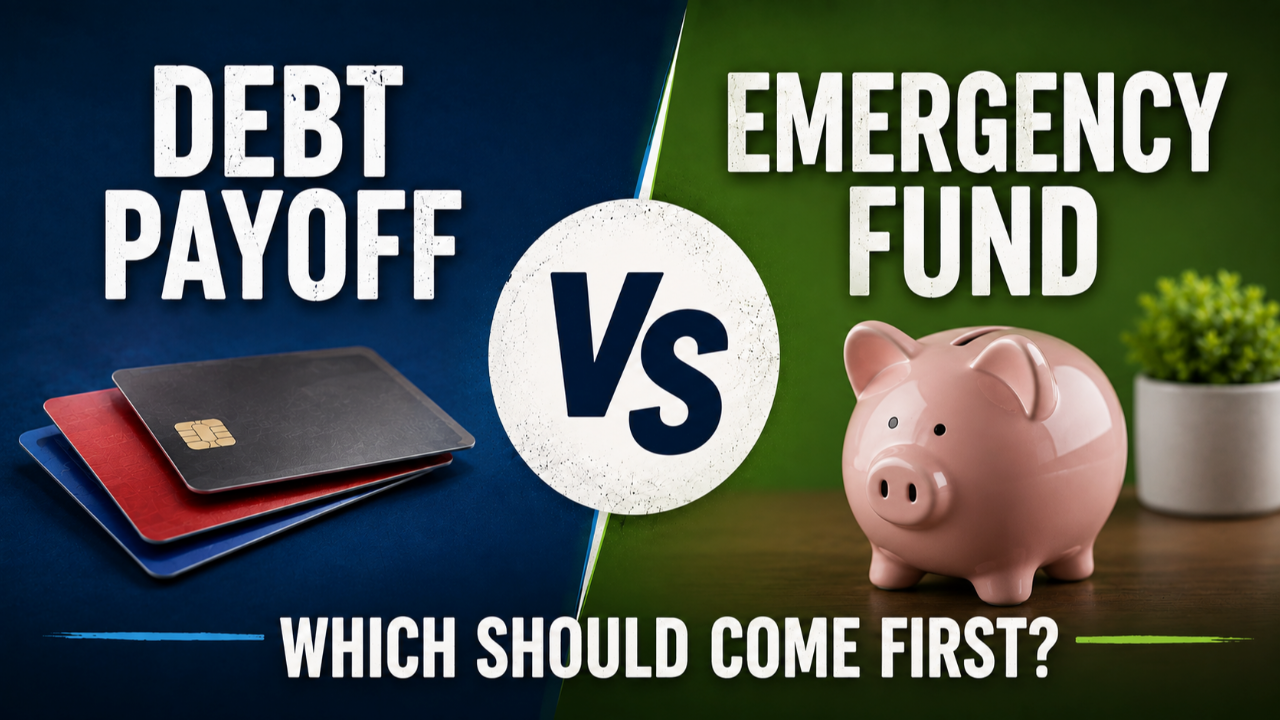
Pay off debt or emergency fund Canada is the fork most households hit when cash is tight and interest is expensive. If you carry credit-card or other high-interest balances and have little or no emergency cash, the wrong order can cost you hundreds of dollars a year—or leave you borrowing again after one car repair. This 2026 decision guide shows a practical Canadian sequence: protect a small starter buffer, keep every minimum payment current, then attack the costliest debt hard before growing a full 3–6 month fund.
Quick Answer
- Do not empty every dollar into debt if one shock would force you back onto credit cards or payday loans.
- Keep all minimums current, then build a starter emergency fund Canada target of about CAD $1,000–$2,000 (or one month of essentials).
- After that cushion exists, use a debt avalanche Canada approach (highest interest first) while you still pay minimums on everything else; grow the fund to 3–6 months of expenses once high-cost debt is gone.
Pro Tip: Since January 1, 2025, Canada’s criminal interest rate has been capped at 35% APR (down from an effective 60%). Most payday loans are carved out and remain under provincial cost rules, so they can still be far more expensive than that cap suggests. If any loan you hold quotes a rate above 35% and is not a licensed payday product, verify the lender’s licensing before you pay another dollar.
Why “All Debt First” or “All Savings First” Usually Fails
Two extreme plans sound simple. Plan A: throw every spare dollar at debt until balances hit zero. Plan B: ignore debt beyond minimums and build a full emergency fund first. Both ignore how Canadian credit products actually work when income dips or a bill spikes.
All-debt-first fails when you have no cash buffer. A broken furnace, dental bill, or unpaid invoice can push you back onto a card that often charges near 20% APR or higher depending on the card (illustrative range—check your statement). You pay down the balance, then rebuild it. Net progress stalls, and late fees or past-due status can damage your credit file.
All-savings-first fails when high-interest balances keep compounding. Parking money in a high-interest savings account while a revolving card grows at a much higher rate is an expensive habit. The Financial Consumer Agency of Canada (FCAC) frames emergency savings as protection against expensive credit after a shock, and debt repayment as a structured plan that starts with staying current—not as a contest between two absolute rules. See FCAC’s guides on setting up emergency funds and paying down debt for the official consumer framing.
The middle path most planners recommend for Canadians with high-cost debt and thin cash is sequential, not binary: stay current → build a small cushion → avalanche the costly debt → expand the fund. That sequence is what this post means by emergency fund vs debt Canada in practice.
What Should You Do First: Starter Fund or High-Interest Debt?
Start with triage, not motivation. List every debt: balance, interest rate (APR), minimum payment, and whether anything is past due. Past-due accounts come first—always. Collections risk, higher rates, and credit-score damage usually outweigh the math of a tidy avalanche spreadsheet.
Next, decide your starter cushion size. For many renters and early-career workers, CAD $1,000–$2,000 in a separate HISA or easy-access TFSA cash sleeve is enough to cover a deductible, a modest car repair, or a short income gap without a new card swipe. If your fixed essentials (rent, food, transit, utilities, minimum debt payments) are high, aim closer to one month of those essentials instead of a flat dollar target.
While you build that starter fund, keep paying at least the minimum on every debt. Skipping minimums to “save faster” is not a strategy—it is a fee and score problem. Once the starter cushion is funded, redirect almost all surplus to the highest-APR balance (avalanche). Keep minimums elsewhere. Only after high-cost revolving debt is gone should you stretch toward a full emergency fund of roughly 3–6 months of expenses, which FCAC-style guidance treats as a common long-term target for absorbing job loss or larger shocks.
Low-interest debt is different. A mortgage, a 0% promotional balance that you will clear before the promo ends, or a low-rate instalment loan usually should not stop you from finishing a starter fund—or later from investing in registered accounts. The painful category is revolving, high-APR credit and payday-style products. Those are why the pay off debt or emergency fund Canada question feels urgent.
If you also want a deeper how-to on sizing and parking the longer-term fund (without reopening the debt debate), use how to build an emergency fund in Canada after you lock this priority order.
Emergency Fund vs Debt Canada: Side-by-Side Comparison
Use this table as a decision map for cash you can free up each month after essentials and minimum payments. It compares three paths Canadians actually debate—not product ads.
| Factor | All debt first (no buffer) | Starter fund, then avalanche | Full 3–6 month fund first |
|---|---|---|---|
| Main goal | Kill balances as fast as possible | Avoid new high-cost borrowing while cutting expensive debt | Maximize cash safety before extra debt payments |
| Shock protection | Weak—one surprise often restarts card use | Moderate—CAD $1,000–$2,000 or ~1 month essentials | Strong—months of expenses covered |
| Interest cost while waiting | Lowest if nothing goes wrong | Slightly higher than all-debt-first for a short build window | Highest if cards keep compounding during a long save |
| Best for | Stable income, reliable backup credit you will not use, very high discipline | Most Canadians with credit-card or payday balances and little cash | No high-APR debt, or debt already at low fixed rates |
| Main risk | Relapse onto 20%+ style revolving credit after a shock | Stopping after the starter fund and never finishing the avalanche | Paying months of high interest that outrun HISA returns |
| What to do with surplus CAD | 100% extra to highest APR after minimums | Fund cushion first, then 100% extra to highest APR | Build fund to target, then accelerate debt or invest |
The middle column is the default recommendation in this guide. It is not “ignoring debt.” It is refusing to finance emergencies at credit-card rates while you pretend a spreadsheet victory is permanent.
How Does a Debt Avalanche Canada Plan Work With a Small Buffer?

FCAC describes two common repayment styles: pay extra on the highest-interest debt first, or pay extra on the lowest balance first for quick wins. Mathematically, highest interest first (often called avalanche) usually costs less interest over time. Lowest balance first (often called snowball) can feel more motivating. Either works only if every account stays current.
A practical avalanche with a starter emergency fund Canada buffer looks like this:
- Stabilize. Bring past-due accounts current. Call lenders if you need a hardship arrangement—do this before optimizing order.
- Automate minimums. Set calendar or bank reminders so minimums never slip while you focus elsewhere.
- Park the starter cushion. Separate HISA or TFSA cash you will not “accidentally” spend. Label it emergency only.
- Attack the top APR. Every leftover dollar after essentials + minimums + tiny cushion top-ups goes to the highest-rate balance.
- Roll the payment. When that balance hits zero, add its old payment to the next-highest APR. Repeat.
- Expand the fund. After high-cost revolving debt is gone, grow toward 3–6 months of expenses before stretching for aggressive investing goals.
Example (illustrative only): CAD $4,000 on a card near 20% APR, CAD $2,500 on a store card at a similar high rate, CAD $8,000 on a lower-rate personal loan, and CAD $200 of monthly surplus after minimums. You first save until CAD $1,500 sits in emergency cash. Then you point the CAD $200 (plus any windfall) at the costliest card while paying minimums on the rest. You do not raid the CAD $1,500 for a restaurant weekend. You do use it for a sudden CAD $900 brake job so the repair never becomes a new cash advance.
Snowball is still fine if avalanche math will not keep you consistent. A finished plan beats a perfect plan you abandon. Just do not confuse “I feel progress” with “I ignore a 28-day past-due notice.”
Mortgage strategy is a separate conversation. Variable vs fixed pricing and renewal math belong with your home loan, not with card avalanche order—see variable vs fixed mortgage rate Canada 2026 if that is your next decision after consumer debt is under control.
When Should You Pause Extra Debt Payments or Pause the Fund?
Pause extra debt payments (never required minimums) when your starter cushion is empty after a real emergency. Rebuild the cushion first, then resume the avalanche. That is the whole point of the buffer.
Pause growing the fund past the starter level while any revolving balance still carries a painful APR. Earning a few percent in a savings product while paying near 20% on a card is usually a losing trade. Exceptions are rare: legally required retainers, imminent planned expenses already dated, or lender rules that demand proof of reserves for a mortgage application you will complete in weeks—not months of optional hoarding.
Also pause DIY heroics if debt collectors are active, if you cannot cover minimums, or if income is collapsing. In those cases, contact creditors early, check provincial credit-counselling options, and treat survival cash plus negotiated terms as higher priority than blog-order purity.
Tax-season cash needs a clean split. A refund can seed the starter fund or crush the highest APR—pick based on whether the cushion already exists. RRSP contributions that create a refund are useful later; they are not a substitute for stopping 20%-style interest today. When registered-account timing matters for a refund strategy, read how RRSP deductions work for Canadian tax savings after this cash-order decision is settled.
Key Takeaways
- For most Canadians with credit-card or payday-style debt and little cash, build a starter cushion of about CAD $1,000–$2,000 (or one month of essentials) before throwing every spare dollar at balances.
- Keep every minimum payment current; fix past-due accounts before optimizing avalanche vs snowball.
- After the starter fund exists, use a debt avalanche Canada order—highest interest first—to cut total interest cost.
- Treat “often near 20% APR or higher depending on the card” as a warning range to check on your own statements, not as a single official national rate.
- Canada’s criminal interest rate cap fell to 35% APR on January 1, 2025, but most payday loans are exempt and remain governed by provincial cost rules—verify any lender quoting more.
- Grow toward a full 3–6 months of expenses only after high-cost revolving debt is gone (or if you have no high-APR debt).
- Do not raid the emergency sleeve for lifestyle spending; refill it first after any real shock, then resume extra debt payments.
Frequently Asked Questions
Should I pay off debt or build an emergency fund first in Canada?
Build a small starter emergency fund first if you have high-interest debt and almost no cash, then attack the highest-APR balances hard while keeping all minimums current. A full 3–6 month fund usually comes after expensive revolving debt is under control. The goal is to stop financing surprises on credit cards while still ending the interest bleed.
How big should a starter emergency fund Canada target be?
Many households start with CAD $1,000–$2,000 or about one month of essential expenses—whichever better covers a realistic shock without a new card swipe. Raise the target if you have dependents, irregular income, or high deductibles. FCAC-style guidance still points to a larger 3–6 month fund as a longer-term cushion once you are ready.
Is debt avalanche better than debt snowball in Canada?
Debt avalanche (highest interest first) usually costs less interest; snowball (lowest balance first) can be easier to stick with. Both require on-time minimums on every account. Choose avalanche if you will stay consistent; choose snowball if quick wins are the only way you keep going—and switch to avalanche math once momentum is real.
Is there a legal limit on how much interest a lender can charge in Canada?
Yes. The Criminal Code caps the criminal rate of interest at 35% APR as of January 1, 2025, replacing the old 60% effective annual rate. Payday loans are largely carved out of that cap and are regulated provincially instead, which is why their effective cost can still be dramatically higher. If a non-payday lender quotes above 35%, treat that as a red flag and confirm licensing.
Where should I keep the emergency fund while paying debt?
Keep it liquid and separate—typically a high-interest savings account or a cash sleeve inside a TFSA you will not invest in stocks until the debt plan is stable. Speed of access matters more than squeezing the last bit of yield while cards are still expensive. Invest more aggressively only after high-APR debt is gone and your fuller emergency target is funded.
Conclusion
Pay off debt or emergency fund Canada is not a slogan—it is a sequence. Keep minimums current, fund a starter emergency fund Canada cushion so a single bill does not restart the cycle, then run a debt avalanche Canada plan against the costliest balances. When high-interest revolving debt is gone, expand toward 3–6 months of expenses and only then stretch for bigger investing goals. Review your own APRs and essential costs in CAD this month, pick the middle-path order, and automate the first transfer.
Get free Canadian money tips every week
TFSA updates, CRA changes, mortgage strategies — straight to your inbox every Thursday. No spam, unsubscribe anytime.
Certified Financial Planner (CFP) and Chartered Investment Manager (CIM) with over 17 years of experience in Canadian personal finance. Spent 10+ years at one of Canada's Big Five banks, the last 7 focused exclusively on high-net-worth clients. Every guide is written with the same depth I bring to real client work — Canada-specific, CRA-verified, and always free.
This article is for educational purposes only and is not legal, tax, or personalized financial advice. Interest rates, fees, and product terms vary by lender and province. Verify details with your financial institution, a qualified advisor, or official Government of Canada / FCAC resources before acting.