Keeping cash in a savings account Canada-wide has become one of the most common—and costly—financial mistakes I see. For three years, I watched my $50,000 sit in a Big Six bank savings account earning a measly 0.5% interest while inflation quietly devoured my purchasing power. With Canada’s Consumer Price Index averaging 2.8% in March 2026, my “safe” money was actually losing nearly $1,000 in real value every single year. In this post, you’ll discover exactly how much money you’re bleeding by leaving cash idle, where to put it instead, and the simple moves that could have saved me thousands.
How Much Money Is Cash Sitting in Savings Losing You in Canada?

Let’s do some uncomfortable math. If you have $50,000 in a typical Big Six bank savings account earning 0.5% to 1% interest, you’re making between $250 and $500 per year. Sounds okay until you factor in inflation.
With inflation running at 2.8% as of March 2026, your $50,000 needs to grow by $1,400 just to maintain its purchasing power. At 0.5% interest, you’re earning $250—leaving you $950 short. Over three years, that’s roughly $2,850 in lost purchasing power. Your money isn’t growing; it’s shrinking.
The Real Cost of Playing It “Safe”
Here’s what my $50,000 could have done over those three years with different approaches:
- Big Six savings account (0.5%): Earned ~$756 in interest, lost ~$2,850 to inflation. Net loss: approximately $2,094 in purchasing power.
- High-interest savings account (4%): Earned ~$6,243 in interest, beating inflation by roughly $3,393.
- GIC ladder (4.5% average): Earned ~$7,050, beating inflation by approximately $4,200.
- Balanced TFSA portfolio (6% average return): Earned ~$9,551 tax-free, beating inflation by roughly $6,700.
The difference between the worst and best option? Nearly $9,000 over just three years. And that gap compounds dramatically over time.
Why the Bank of Canada Rate Matters to Your Savings
The Bank of Canada has held its policy interest rate at 2.25% since late 2025, with consecutive holds in January, March, April, and June 2026. This means high-interest savings accounts and GICs are offering decent returns right now—far better than the 0.5% your Big Six bank is paying on a standard account.
Cash management bills currently yield around 2.3%, which gives you a benchmark for what “risk-free” money should be earning. If your savings account pays less than inflation, you’re not being conservative—you’re being careless with your wealth. Understanding how to protect your assets against rising costs is essential in this environment.
Where Should You Put Cash Instead of a Savings Account in Canada?
The good news? You have excellent options that don’t require becoming a stock market expert or taking on uncomfortable risk. The key is matching your money to your timeline.
For Money You Need Within 1-2 Years
High-interest savings accounts from institutions like EQ Bank offer rates between 3% and 3.5% on an ongoing basis — dramatically better than Big Six banks. Some institutions offer short-term promotional rates up to 4.5%, but always verify the ongoing rate after the promotion ends.. Your money stays fully liquid, protected by CDIC insurance up to $100,000 per institution.
GICs (Guaranteed Investment Certificates) offer even higher rates if you can lock your money away. One-year GICs at competitive online banks currently pay approximately 3.0% to 3.65% — well above the Big Six savings account rate and above inflation for most Canadians. Verify current rates at Ratehub.ca before committing, as GIC rates change weekly.
For Money You Won’t Touch for 3+ Years
This is where registered accounts become powerful. Your TFSA isn’t just a savings account—it’s an investment vehicle where all growth is completely tax-free. For 2026, the contribution limit is $7,000, with cumulative lifetime room reaching $109,000 for anyone eligible since 2009.
Inside your TFSA, you can hold:
- Index ETFs tracking the Canadian or global markets
- Dividend-paying stocks
- GICs (yes, you can hold GICs in a TFSA)
- Bond funds for more conservative exposure
The magic of the TFSA is that when your investments grow, so does your future contribution room. Turn $50,000 into $70,000 through market gains, withdraw it all, and you get $70,000 of contribution room back. For more on tax-efficient account strategies, check out our guide on non-registered vs registered accounts.
For First-Time Home Buyers
If you’re saving for your first home, the First Home Savings Account (FHSA) offers the best of both worlds: tax-deductible contributions like an RRSP and tax-free withdrawals like a TFSA. You can contribute $8,000 per year up to a $40,000 lifetime limit. This is hands-down the best place for your down payment savings.
Savings Account vs. TFSA vs. GIC: Where Does Your $50K Belong?
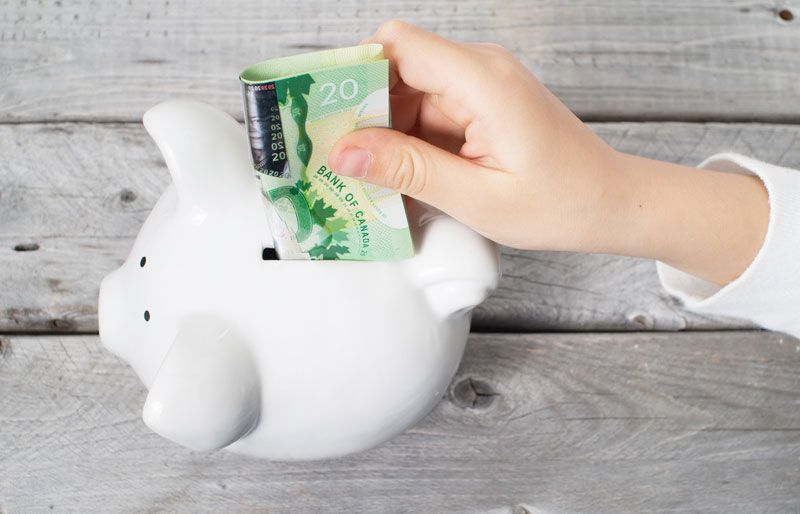
Choosing the right place for your money depends on when you need it and how much volatility you can stomach. Here’s a direct comparison to help you decide:
| Feature | Big Six Savings Account | High-Interest Savings Account | GIC (1-Year) | TFSA (Invested) |
|---|---|---|---|---|
| Typical Interest/Return Rate | 0.5% – 1% | 3% – 4.5% | 3.0% – 3.65% | 5% – 8% (historical average) |
| Liquidity | Instant access | Instant access | Locked until maturity | Withdrawable anytime |
| CDIC Insurance | Yes, up to $100K | Yes, up to $100K | Yes, up to $100K | Depends on holdings |
| Tax Treatment | Fully taxable interest | Fully taxable interest | Fully taxable interest | 100% tax-free growth |
| Risk Level | None | None | None (if held to maturity) | Market risk |
| Beats Inflation (2.8%)? | No | Yes | Yes | Typically yes |
| Best For | Emergency float only | Short-term savings | Known expenses in 1-5 years | Long-term wealth building |
The bottom line: A Big Six savings account should hold only your immediate emergency float—perhaps one to two months of expenses for quick access. Everything else deserves better.
How to Move Your Cash from Savings to Smarter Options: Step-by-Step
Feeling paralyzed about what to do with your cash is normal. Here’s the exact process I wish I’d followed three years ago.
Step 1: Calculate Your True Emergency Fund Need
Most Canadians need three to six months of essential expenses in truly liquid savings—not three to six months of income. Calculate your must-pay bills: rent or mortgage, utilities, insurance, groceries, minimum debt payments. If that totals $4,000 per month, you need $12,000 to $24,000 liquid, not $50,000.
Keep this emergency fund in a high-interest savings account at EQ Bank, Tangerine, or another online bank paying 3%+. This is your “sleep at night” money.
Step 2: Max Out Your Registered Accounts
Before putting a single dollar in taxable investments, fill your tax-advantaged buckets:
- FHSA (if you’re a first-time buyer): $8,000 per year, tax-deductible going in, tax-free coming out for a home purchase.
- TFSA: $7,000 for 2026, up to $109,000 lifetime room. All growth is tax-free forever.
- RRSP: 18% of earned income up to $33,810 for 2025 contribution room. Best if your income is higher now than it will be in retirement.
If you’re unsure how much room you have, log into your CRA My Account—it’s all there.
💡 Pro Tip: Open your FHSA as soon as possible — even if you don’t contribute right away. The FHSA’s 15-year participation clock starts from the date you OPEN the account, not when you contribute. Opening it today, even with $1, gives you up to 15 years to use those tax-deductible contributions.
Step 3: Choose Your Investment Approach Inside Registered Accounts
You don’t need to pick stocks. The simplest approach for most Canadians:
- Conservative (low risk tolerance): GICs or a bond ETF inside your TFSA. You’ll earn 4-5% tax-free with minimal volatility.
- Balanced (moderate risk): An all-in-one ETF like VBAL or XBAL that automatically balances stocks and bonds.
- Growth (higher risk tolerance, long timeline): An all-in-one equity ETF like VEQT or XEQT for 100% stocks globally diversified.
Platforms like Wealthsimple and Questrade make this incredibly simple with no commissions on ETF purchases. If you’re interested in income-generating investments, explore our analysis of the best Canadian dividend stocks for 2026.
Step 4: Build a GIC Ladder for Medium-Term Goals
If you have money you’ll need in two to five years—say, for a car, a wedding, or a home renovation—a GIC ladder protects you from both inflation and market risk.
Take $20,000 and split it:
- $5,000 in a 1-year GIC
- $5,000 in a 2-year GIC
- $5,000 in a 3-year GIC
- $5,000 in a 4-year GIC
Each year, when one matures, you either use it or reinvest in a new 4-year GIC. This gives you regular access while locking in higher rates on the longer terms.
💡 Pro Tip: Hold your GIC ladder inside your TFSA whenever possible. GIC interest is fully taxable at your marginal rate in a non- registered account — potentially 40%+ in Ontario. Inside a TFSA, every dollar of GIC interest is yours tax-free. A 3.5% GIC inside a TFSA effectively equals a 5.8%+ taxable equivalent at a 40% marginal rate.
Common Mistakes When Keeping Cash in a Savings Account Canada
I made several errors beyond just accepting low interest rates. Here are the traps to avoid:
Mistake 1: Treating Your TFSA Like a Savings Account
The biggest wealth-building mistake Canadians make is using their TFSA for cash savings. Most Big Six banks default TFSA contributions into a savings account paying under 1%. You’re wasting tax-free room on taxable-level returns.
Your TFSA should hold investments that generate the highest potential returns because those gains will never be taxed. Cash belongs in a regular HISA.
💡 Pro Tip: When you open a TFSA at a bank, they default it to a savings account. To hold ETFs or GICs from other institutions, you need a “self-directed TFSA” — available through brokerages like Wealthsimple, Questrade, or TD Direct Investing. This one setup step unlocks the full power of tax-free investing.
Mistake 2: Keeping Too Much Cash “Just in Case”
Fear drives us to over-save in liquid accounts. But there’s a cost to excessive caution. Every dollar beyond your true emergency fund need is a dollar losing purchasing power or missing growth opportunities.
Be honest: What’s the realistic worst case you’re preparing for? Job loss? Most Canadians qualify for Employment Insurance, which buys time. Medical emergency? We have universal healthcare. The “just in case” pile is often larger than any realistic need.
Mistake 3: Ignoring Inflation Because You Can’t See It
Inflation is invisible theft. Your bank balance still says $50,000, so it feels like your money is safe. But that $50,000 bought a certain lifestyle three years ago—groceries, gas, housing costs. Today, that same $50,000 buys noticeably less.
At 2.8% inflation, your money loses about half its purchasing power every 30 years if it’s not growing. That’s real wealth destruction hiding behind stable account balances.
Mistake 4: Analysis Paralysis Leading to Inaction
The fear of making the wrong investment choice leads many Canadians to make no choice at all. But doing nothing is a choice—and it’s often the worst one.
Start small. Move $5,000 to a HISA today. Open a TFSA with a robo-advisor and contribute $500. You can optimize later. Imperfect action beats perfect inaction every time.
Key Takeaways
- With inflation at 2.8% and Big Six savings accounts paying 0.5-1%, your $50,000 loses roughly $950 in purchasing power annually by sitting in a standard savings account.
- High-interest savings accounts at online banks pay 3-4.5%—immediately beating inflation with zero risk and full liquidity.
- Your TFSA ($7,000 limit for 2026, up to $109,000 lifetime room) is an investment vehicle, not a savings account—use it for growth assets to maximize tax-free compounding.
- Keep only three to six months of essential expenses truly liquid; anything beyond that should be working harder in GICs, TFSAs, or your FHSA.
- The Bank of Canada rate sits at 2.25% as of June 2026—GICs and HISAs offer competitive returns right now, making this an ideal time to move idle cash.
- A simple GIC ladder or all-in-one ETF in a registered account can earn $5,000-$9,000 more than a savings account over three years on a $50,000 balance.
Frequently Asked Questions
How much money am I losing by keeping cash in a regular savings account?
You’re losing approximately 1.5% to 2% per year in real purchasing power. With inflation at 2.8% and typical Big Six savings rates at 0.5-1%, a $50,000 balance loses around $700 to $950 annually after accounting for the gap between what you earn and what inflation takes. Over three years, that’s roughly $2,100 to $2,850 in lost purchasing power—money that silently disappears without your account balance ever dropping.
Should I move my savings to EQ Bank or stay with my Big Six bank?
For your emergency fund, moving to a high-interest savings account at EQ Bank or a similar online bank almost always makes sense — the rate difference (0.5% vs 3%+) on $20,000 means $500+ more per year with zero added risk. Both are CDIC insured. The only reason to keep cash at a Big Six bank is convenience — if you’re constantly moving money between accounts, the branch access might be worth the rate penalty. But if your emergency fund sits untouched for months, move it and earn more risk-free.
Is it better to invest extra cash or keep it liquid in 2026?
It depends entirely on your timeline. For money you’ll need within one to three years, keep it liquid in a high-interest savings account or short-term GIC—both beat inflation in 2026 without market risk. For money you won’t touch for three-plus years, investing in a diversified TFSA portfolio historically outperforms cash by 3-5% annually. The Bank of Canada’s steady 2.25% rate makes GICs particularly attractive right now for medium-term goals where you want guarantees.
How much cash should I actually keep in savings vs investing?
Keep three to six months of essential living expenses in a high-interest savings account as your emergency fund—this typically means $12,000 to $24,000 for most Canadian households, not your entire savings. Any cash beyond this emergency buffer should be deployed into registered accounts like your TFSA (up to $109,000 lifetime room) or FHSA (if saving for a home), or into GICs for medium-term goals. The goal is ensuring every dollar has a job: emergency protection, short-term goals, or long-term growth.
Keeping cash in a savings account Canada-style—earning next to nothing at a Big Six bank—was my $50,000 mistake, and I hope you’ll learn from it. The real cost isn’t just missed returns; it’s the years of compound growth you can never recover. Whether you choose a high-interest savings account, a GIC ladder, or a properly invested TFSA, the important thing is to act now. Your future self will thank you for every dollar you put to work today. Explore more strategies to grow and protect your wealth right here on Getwealthy.
Get free Canadian money tips every week
TFSA updates, CRA changes, mortgage strategies — straight to your inbox every Thursday. No spam, unsubscribe anytime.
Certified Financial Planner (CFP) and Chartered Investment Manager (CIM) with over 17 years of experience in Canadian personal finance. Spent 10+ years at one of Canada's Big Five banks, the last 7 focused exclusively on high-net-worth clients. Every guide is written with the same depth I bring to real client work — Canada-specific, CRA-verified, and always free.
Disclaimer: This article is for informational and educational purposes only and does not constitute financial, tax, or legal advice. Always consult a qualified financial advisor or tax professional for personalized advice.