Understanding closing costs Canada first-time buyer expenses is crucial before you sign on the dotted line—because the sticker price of your home is just the beginning. Here’s a number that shocks most buyers: closing costs in Canada typically range from 1.5% to 4% of your home’s purchase price, meaning a $600,000 home could cost you an extra $9,000 to $24,000 on closing day. In this guide, you’ll learn exactly what fees to expect in 2026, how costs vary by province (especially home closing costs Ontario 2026), hidden costs buying house Canada that catch people off guard, and smart strategies to reduce your out-of-pocket expenses.
How Much Are Closing Costs for a First-Time Buyer in Canada?
Let’s cut straight to the numbers. For most first-time buyers in Canada, closing costs fall between 1.5% and 4% of the purchase price. On a $500,000 home, that’s $7,500 to $20,000. On a $750,000 home in a competitive market like Toronto or Vancouver, you’re looking at $11,250 to $30,000.
The wide range exists because closing costs depend heavily on your province, the type of property, your down payment size, and whether you qualify for any first-time buyer exemptions. Let’s break down exactly where your money goes.
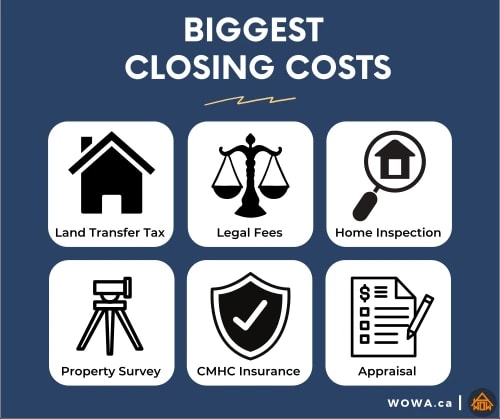
Land Transfer Tax
This is typically your biggest closing cost. Every province (except Alberta and Saskatchewan, which charge smaller transfer fees) levies a land transfer tax when property changes hands. In Ontario, you’ll pay 0.5% on the first $55,000, 1% on $55,001 to $250,000, 1.5% on $250,001 to $400,000, 2% on $400,001 to $2,000,000, and 2.5% on anything above that.
Toronto buyers get hit twice—the city charges its own Municipal Land Transfer Tax on top of Ontario’s provincial tax. On a $700,000 Toronto home, combined land transfer taxes total approximately $22,950 before any rebates.
The good news? First-time buyers in Ontario can claim a rebate of up to $4,000 on provincial land transfer tax, and Toronto offers an additional rebate of up to $4,475. That’s $8,475 back in your pocket if you qualify.
Pro Tip: Ontario’s land transfer tax rebate is automatic — your lawyer applies it on closing day. You don’t need to apply separately to the CRA.
Legal Fees
You’ll need a real estate lawyer to handle the transaction, review documents, conduct title searches, and register your mortgage. Expect to pay $1,500 to $2,500 for legal fees and disbursements in 2026. Some lawyers charge flat fees, while others bill hourly. Always get a quote upfront that includes all disbursements like title insurance, registration fees, and courier costs.
Title Insurance
Title insurance protects you against issues with the property’s title, such as unknown liens, encroachments, or fraud. Most lenders require it. A one-time premium typically costs $300 to $600 for a residential property. Your lawyer usually arranges this through providers like FCT, Stewart Title, or Chicago Title Canada.
Home Inspection
While technically a pre-purchase cost, a home inspection is essential and often overlooked in closing cost calculations. A standard inspection runs $400 to $600, with additional tests for radon, mold, or septic systems costing extra. Never skip this step—it can save you tens of thousands in surprise repairs.
What Hidden Costs Catch First-Time Buyers Off Guard in Canada?
Beyond the obvious expenses, hidden costs buying house Canada often derail carefully planned budgets. These are the fees that don’t show up in most online calculators but absolutely show up on your bank statement.
CMHC Mortgage Insurance
If your down payment is less than 20%, you’ll pay mortgage default insurance through CMHC, Sagen, or Canada Guaranty. This isn’t optional—it’s legally required. The premium ranges from 2.8% to 4% of your mortgage amount, depending on your down payment percentage.
For example, on a $500,000 home with a 5% down payment ($25,000), you’d have a $475,000 mortgage. At a 4% insurance premium, that’s $19,000 added to your mortgage balance. While this gets rolled into your mortgage rather than paid upfront, it increases your monthly payments and total interest paid.
Property Tax Adjustment
If the seller has prepaid property taxes beyond your closing date, you’ll reimburse them for those days. This adjustment can be several hundred to over a thousand dollars, depending on timing and property tax rates in your municipality.
Utility Adjustments and Deposits
Similar to property taxes, you may need to reimburse the seller for prepaid utilities like water or heating oil. Some utility companies also require deposits from new homeowners, especially if you don’t have an established credit history with them.
Immediate Repairs and Essentials
Your new home might need immediate purchases: locks changed for security (budget $200-$500), window coverings for privacy, appliances the seller didn’t include, or urgent repairs identified during inspection. Smart buyers keep a $2,000 to $5,000 cushion for these surprises.
Moving Costs
Professional movers in Canada charge $500 to $2,000+ depending on distance and volume. Even DIY moves involve truck rentals, packing supplies, and possibly time off work. Check out our guide on moving costs in Canada for detailed budgeting tips.
Closing Costs Comparison: Ontario vs. British Columbia vs. Alberta
How much are closing costs in Canada? The answer varies dramatically by province. Here’s how the three most expensive housing markets compare for a $600,000 home purchase by a first-time buyer with 10% down.
| Cost Category | Ontario (Toronto) | British Columbia (Vancouver) | Alberta (Calgary) |
|---|---|---|---|
| Provincial Land Transfer Tax | $8,475 (after $4,000 rebate) | $10,000 (no exemption – home exceeds $525,000) | $0 (no LTT) |
| Municipal Land Transfer Tax | $4,000 (Toronto, after rebate) | $0 | $0 |
| Property Transfer Tax/Fees | Included above | Included above | ~$362 (land titles fee) |
| Legal Fees | $1,800-$2,200 | $1,500-$2,000 | $1,200-$1,800 |
| Title Insurance | $350-$500 | $300-$450 | $300-$400 |
| Home Inspection | $500-$600 | $450-$600 | $400-$550 |
| Estimated Total Closing Costs | $15,125-$17,775 | $10,250-$11,050 | $2,262-$3,112 |
As you can see, home closing costs Ontario 2026—especially in Toronto—are significantly higher than other provinces, primarily due to double land transfer taxes. Alberta buyers enjoy the lowest closing costs in Canada, with no provincial land transfer tax at all.
How Can First-Time Buyers Reduce Closing Costs in Canada?
You can’t eliminate closing costs entirely, but smart planning can save you thousands. Here’s your step-by-step strategy for minimizing expenses.
Step 1: Claim Every First-Time Buyer Rebate Available
First-time buyers have access to valuable tax rebates and credits that directly reduce closing costs. In Ontario, claim the Land Transfer Tax Rebate (up to $4,000 provincial, plus $4,475 municipal in Toronto). British Columbia offers a First Time Home Buyers’ Program that can eliminate property transfer tax entirely on homes up to $500,000, with partial exemptions up to $525,000.
Don’t forget the federal First-Time Home Buyers’ Tax Credit (HBTC), which provides up to $1,500 in tax relief on your next return. While this doesn’t reduce closing day costs directly, it helps recoup expenses.
Step 2: Use Your FHSA for Maximum Tax Advantage
The First Home Savings Account (FHSA) lets you contribute $8,000 per year (up to $40,000 lifetime) and withdraw tax-free for a qualifying home purchase. Unlike the RRSP Home Buyers’ Plan, FHSA withdrawals never need to be repaid. If you’ve been contributing since the FHSA launched, you could have up to $32,000 in tax-free savings by 2026.
You can also combine the FHSA with the Home Buyers’ Plan, withdrawing up to $60,000 from your RRSP (the limit increased from $35,000 in 2024). Learn more in our FHSA vs. RRSP comparison for first-time buyers.
Step 3: Negotiate Closing Date Strategically
Closing at the end of the month reduces the interest adjustment you’ll owe. If you close on December 30th instead of December 15th, you’ll pay interest for fewer days before your first regular mortgage payment kicks in. This can save $200 to $500 depending on your mortgage size and rate.
Step 4: Shop Around for Services
Don’t just accept the first quote. Get three quotes for legal services, compare home inspection prices, and ask your mortgage broker about lenders who offer closing cost credits. Some lenders, including TD, RBC, and BMO, occasionally offer cashback mortgages or closing cost promotions—though always calculate whether a slightly higher interest rate makes this worthwhile.
Common Closing Cost Mistakes to Avoid
Here are the most common closing cost mistakes first-time buyers make, these are the most expensive mistakes we see first-time buyers make with closing costs.
Mistake 1: Underestimating the Total Amount
Many buyers budget 1-2% for closing costs when they should budget 3-4%, especially in Ontario. Running short means scrambling for funds at the worst possible time, potentially jeopardizing your purchase. Always overestimate and keep funds liquid in a high-interest savings account at EQ Bank or Wealthsimple until closing.
Mistake 2: Forgetting About Cash Flow Timing
Your lawyer needs closing funds as certified cheques or wire transfers—not a promise that money is coming. If you’re using FHSA or RRSP withdrawals, initiate them 2-3 weeks before closing. If you’re receiving gift money from family, have it deposited at least 30 days before your mortgage closes, as lenders may question recent large deposits.
Mistake 3: Not Reading the Statement of Adjustments
Your lawyer will prepare a Statement of Adjustments showing exactly what you owe on closing day, including all adjustments for prepaid property taxes, utilities, and condo fees. Review this document carefully at least 3-5 days before closing. Errors happen, and catching them early prevents closing day chaos.
Mistake 4: Ignoring Post-Closing Costs
Your first property tax bill, home insurance premium, utility setup fees, and immediate repairs all hit within weeks of closing. Budget an additional 1-2% of your home’s value for the first few months of ownership. For more on ongoing homeownership costs, read our guide on the true cost of homeownership in Canada.
Key Takeaways
- Budget 3-4% of your home’s purchase price for closing costs—that’s $18,000 to $24,000 on a $600,000 home.
- Land transfer tax is typically your biggest expense; Ontario first-time buyers can claim up to $8,475 in combined rebates (provincial + Toronto municipal).
- Alberta has the lowest closing costs in Canada due to having no land transfer tax.
- Use your FHSA ($8,000/year contribution limit) combined with the RRSP Home Buyers’ Plan ($60,000 limit) to maximize tax-free savings for your purchase.
- Keep closing funds liquid and accessible at least 2-3 weeks before your closing date to avoid last-minute scrambles.
- Budget an extra $2,000-$5,000 beyond calculated closing costs for immediate move-in expenses and surprises.
Frequently Asked Questions
Closing Costs in Canada 2026: How Much Should You Budget?
First-time home buyers in Canada should expect to pay 1.5% to 4% of the purchase price in closing costs. On a $500,000 home, that’s approximately $7,500 to $20,000. The exact amount depends heavily on your province, with Ontario (especially Toronto) having the highest costs due to land transfer taxes, while Alberta has the lowest. First-time buyer rebates can reduce these costs by several thousand dollars.
What closing costs are tax deductible in Canada?
Most closing costs on a primary residence are not tax deductible in Canada. However, if you’re purchasing a rental property, you can deduct legal fees, land transfer taxes, and other closing costs as part of your adjusted cost base, reducing capital gains when you sell. The First-Time Home Buyers’ Tax Credit provides up to $1,500 in tax relief but isn’t technically a deduction—it’s a non-refundable tax credit.
Can I roll closing costs into my mortgage in Canada?
You cannot directly roll traditional closing costs (like legal fees or land transfer tax) into your mortgage in Canada. However, CMHC mortgage insurance premiums are automatically added to your mortgage balance. Some lenders offer cashback mortgages that provide funds at closing to help cover costs, though these typically come with higher interest rates. Your best strategy is saving specifically for closing costs in an FHSA or high-interest savings account.
Now that you understand closing costs Canada first-time buyer expenses inside and out, you’re better prepared than most Canadians entering the 2026 housing market. Remember: the key is budgeting conservatively, claiming every rebate available, and keeping your closing funds accessible well before your closing date. Ready to keep building your homebuying knowledge? Explore more expert guides on Getwealthy to make your first home purchase a financial success.
Get free Canadian money tips every week
TFSA updates, CRA changes, mortgage strategies — straight to your inbox every Thursday. No spam, unsubscribe anytime.
Certified Financial Planner (CFP) and Chartered Investment Manager (CIM) with over 17 years of experience in Canadian personal finance. Spent 10+ years at one of Canada's Big Five banks, the last 7 focused exclusively on high-net-worth clients. Every guide is written with the same depth I bring to real client work — Canada-specific, CRA-verified, and always free.
Disclaimer: This article is for informational and educational purposes only and does not constitute financial, tax, or legal advice. Always consult a qualified financial advisor or tax professional for personalized advice.