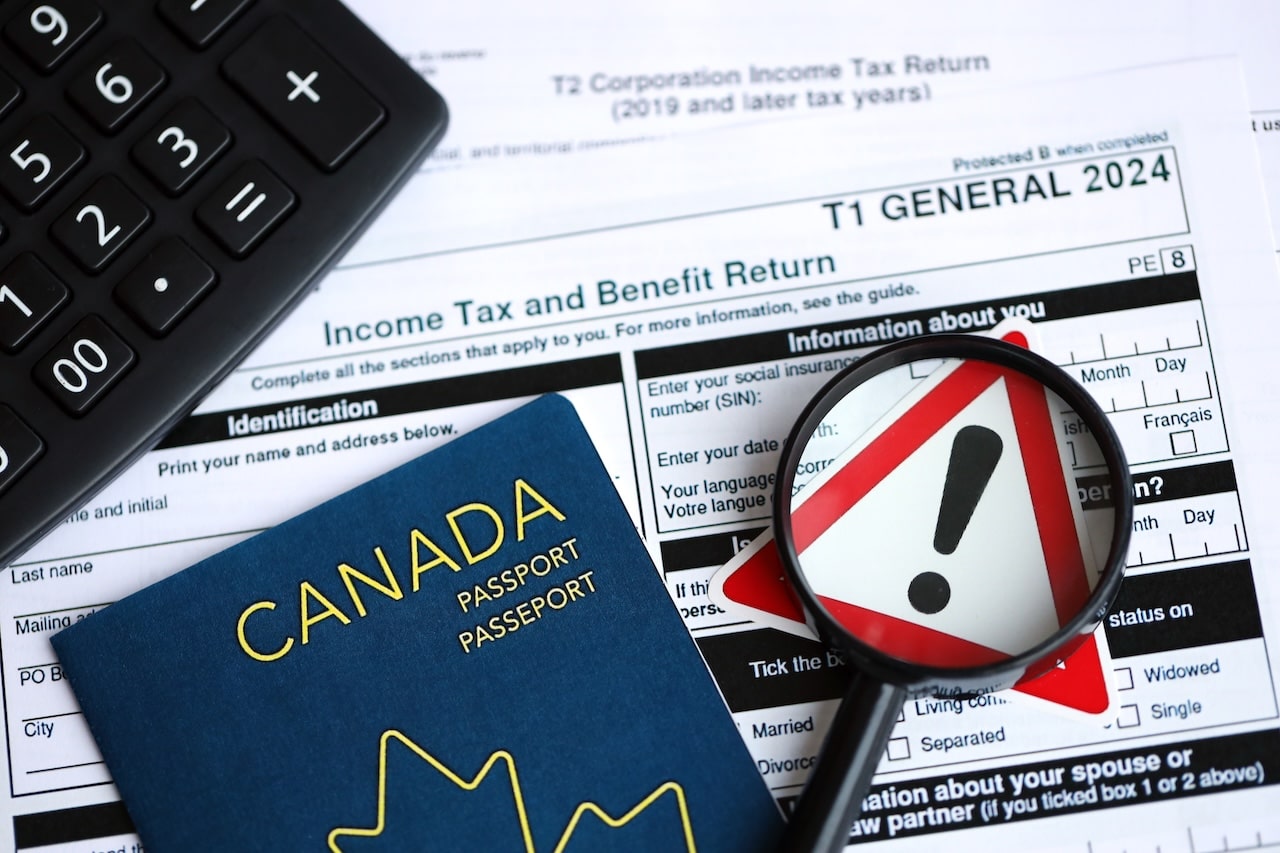
Understanding CRA audit red flags could save you thousands of dollars and countless hours of stress. Each year the Canada Revenue Agency reviews and audits a large number of returns, and self-employed Canadians, landlords and people with complex returns draw more scrutiny than salaried employees whose income is fully reported on slips. In this guide, you’ll learn exactly what triggers a CRA audit in Canada, the warning signs that put you on CRA’s radar, and practical steps to protect yourself while staying fully compliant with Canadian tax law.
What Are the Most Common CRA Audit Red Flags?
The CRA uses sophisticated computer systems to flag returns that deviate from expected patterns. While random audits happen, most reviews stem from specific triggers that raise suspicion. Knowing these CRA audit red flags helps you file accurately and avoid unnecessary scrutiny.
Income That Doesn’t Match CRA Records
The CRA receives copies of your T4s, T5s, and other income slips directly from employers, banks, and financial institutions. If your reported income doesn’t match their records, you’ll almost certainly hear from them. This includes forgetting to report that part-time job income, missing interest from your EQ Bank savings account, or overlooking dividends from your Wealthsimple Trade account. Even small discrepancies of $500 or less can trigger automated letters requesting clarification.
Unusually High Deductions Compared to Your Income
Claiming $30,000 in business expenses on $40,000 of self-employment income immediately raises questions. The CRA compares your deductions to others in your industry and income bracket. If your home office expense claims dwarf those of similar professionals, expect potential review. This doesn’t mean you shouldn’t claim legitimate deductions—just ensure you have documentation for every dollar.
Repeated Losses in Your Business
Reporting business losses year after year signals to CRA that your “business” might actually be a hobby. The tax code allows you to deduct losses from a legitimate business, but if your side hustle selling crafts loses money every year for five consecutive years, the CRA may question whether you have a reasonable expectation of profit. They could reclassify your business as a hobby and disallow those deductions retroactively.
Large Charitable Donations Relative to Income
Donating 40% of your $50,000 income to charity isn’t impossible, but it’s statistically unusual and will likely trigger a closer look. The CRA pays special attention to donation tax shelter schemes and inflated charitable receipts. Always donate through registered charities and keep official receipts showing the exact amount you contributed.
⚠️ New CRA Audit Priorities in 2026:
1. Real Estate Flipping: Building or buying a new property and selling quickly while claiming principal residence exemption is under heavy CRA scrutiny.
2. Cryptocurrency: Gains and losses on crypto sales and trades must be reported. The CRA has used court orders to obtain customer information from crypto platforms, and international crypto-asset reporting rules are being phased in.
3. Gig Economy Income: Uber, Airbnb, Etsy, Fiverr — all must be declared. Since the 2024 calendar year, digital platform operators must report sellers’ income to the CRA each January.
4. Short-Term Rentals: Since January 1, 2024, you can’t deduct expenses for a short-term rental that operates where short-term rentals are prohibited or that doesn’t have the required licence or registration. Large rental losses that offset employment income also draw attention.
How Do Self-Employed Canadians Trigger CRA Audits?
Self-employed individuals and small business owners face heightened scrutiny because they have more opportunities to underreport income or overstate expenses. Understanding what triggers a CRA audit Canada for entrepreneurs helps you stay compliant while maximizing legitimate deductions.
Cash-Heavy Businesses
If you run a restaurant, salon, or any business where cash transactions are common, the CRA pays extra attention. They know cash income is easier to hide, so they look for lifestyle indicators that don’t match reported income. Driving a BMW while reporting $35,000 annually from your contracting business invites questions. The CRA also conducts net worth assessments, comparing your assets and spending to your declared income over time.
💡 Pro Tip: The CRA uses “net worth assessments” to compare your lifestyle to your declared income.
If you own a luxury car, take expensive vacations, or have significant assets — but report low income — expect questions. Your lifestyle is evidence.
Home Office and Vehicle Expense Claims
These are among the most commonly audited deductions for self-employed Canadians. To claim home office expenses, you must use a dedicated space regularly and exclusively for business, or it must be where you primarily meet clients. Vehicle expenses require a detailed logbook showing business versus personal kilometres. Claiming 90% business use on a vehicle you also drive your kids to hockey practice in raises immediate red flags.
💡 Pro Tip: Take photos of your dedicated workspace every year before filing. Include a measuring tape showing the dimensions. This visual evidence can be invaluable if CRA questions your home office percentage.
Inconsistent GST/HST Reporting
If your income tax return shows $150,000 in revenue but your GST/HST filings suggest only $120,000 in sales, the CRA will notice this discrepancy immediately. Your records across all tax filings must align. Similarly, if you’re earning over $30,000 annually and haven’t registered for GST/HST, you’re breaking the law and creating audit risk. Check out our guide on GST/HST for small businesses for more details on staying compliant.
CRA Audit Warning Signs: Random Audits vs Targeted Reviews
Not all CRA reviews are the same. Understanding the difference helps you know what to expect and how to respond appropriately.
| Factor | Random Audit | Targeted Audit | Desk Review |
|---|---|---|---|
| How You’re Selected | Computer randomly selects your return | Specific red flags or tips trigger review | Minor discrepancy noticed in filing |
| Scope of Review | Comprehensive review of entire return | Focused on specific deductions or income | Limited to one or two items |
| Documentation Required | All receipts, records for tax year | Specific records related to flagged items | Receipts for questioned claims only |
| Typical Duration | 3-6 months | 2-4 months | 4-8 weeks |
| Likelihood of Assessment Change | Higher (thorough review) | High (they’re looking for something) | Moderate (often resolved with proof) |
Random audits happen to verify overall compliance across the tax system. Targeted audits occur when something specific about your return—or a tip from someone—prompts investigation. Desk reviews are less intensive and typically involve the CRA requesting receipts for a particular deduction you claimed.
How to Avoid CRA Audit Problems: A Step-by-Step Approach
While you can’t completely eliminate audit risk, following these steps dramatically reduces your chances of problems and ensures you’re prepared if a review does occur. Learning how to avoid CRA audit issues is really about proper record-keeping and honest reporting.
Step 1: Keep Meticulous Records Throughout the Year
Don’t wait until tax time to organize your finances. Use accounting software like QuickBooks, Wave, or FreshBooks to track income and expenses in real-time. Keep digital copies of all receipts—the CRA accepts scanned documents if the original information is clearly legible. Keep records for at least six years from the end of the tax year they relate to. The CRA can normally reassess an individual’s return within three years of the original notice of assessment, and longer in some situations, such as misrepresentation. For RRSP contributions (up to $33,810 for 2026), TFSA deposits (up to $7,000 annually), or FHSA contributions ($8,000 per year), keep all contribution receipts organized by year.
Step 2: Report All Income—Even Small Amounts
That $800 you earned from freelance work? Report it. The $200 in interest from your savings account? Report it. The CRA receives information about your income from multiple sources, and failing to report even small amounts creates discrepancies that computers flag instantly. If you receive a T4A, T5, or any other tax slip, assume the CRA already knows about that income.
Step 3: Claim Only Legitimate Deductions You Can Prove
Every deduction you claim should pass this test: if a CRA auditor asked you to prove this expense tomorrow, could you? If not, reconsider claiming it. This applies to everything from business meals (keep receipts with notes about who attended and the business purpose) to home office expenses (measure your workspace and calculate the legitimate percentage of your home used for business). For guidance on maximizing legitimate deductions, see our complete guide to tax deductions for self-employed Canadians.
Step 4: File on Time and Respond Promptly to CRA Inquiries
Late filing attracts attention and results in penalties of 5% of your balance owing plus 1% for each additional month late, up to 12 months. If you receive any letter from the CRA requesting information, respond by the deadline stated. Ignoring CRA correspondence or missing deadlines escalates simple reviews into full audits and can result in arbitrary assessments where the CRA estimates your tax owing—usually not in your favour.
⚠️ Enforcement update: Since 2024, the CRA can issue a notice of non-compliance if you don’t comply with a request for information or documents. It carries a penalty of $50 a day, up to $25,000.
Respond to ALL CRA requests immediately.
Step 5: Consider Professional Help for Complex Situations
If you have multiple income sources, rental properties, significant investments, or a growing business, working with a certified accountant or tax professional pays for itself. They know current CRA audit warning signs and can structure your affairs to minimize audit risk while ensuring you claim every legitimate deduction. Many accountants also offer audit protection services where they’ll represent you if the CRA comes calling.
Step 6: Check Your Slips Before You File
Before filing, sign in to CRA My Account and open your tax information slips. Compare every T4, T4A, T5 and T3 the CRA has on file with what you’re reporting, and add any income from platforms or foreign accounts that doesn’t come with a slip. Matching programs compare your return to these slips automatically, so a missed slip is one of the most common reasons for a reassessment letter.
Step 7: Keep a Contemporaneous Vehicle Log
Vehicle claims are among the most frequently denied because many taxpayers can’t back up their business-use percentage. Record the date, destination, purpose and kilometres of each business trip as it happens, not months later. After you’ve kept a full-year log once, the CRA lets you use a shorter sample period in later years if your usage stays similar.
Common Mistakes That Increase Your CRA Audit Risk
Beyond the major red flags, several common errors put taxpayers on CRA’s radar unnecessarily. Avoiding these mistakes is essential when learning how to avoid CRA audit problems.
Mixing Personal and Business Expenses
Using one credit card for both personal shopping and business purchases creates chaos in your records and makes it harder to prove legitimate business expenses during an audit. Open a separate business bank account and credit card. This simple step makes bookkeeping easier and provides cleaner documentation if questions arise. Major banks like TD, RBC, BMO, Scotiabank, and CIBC all offer small business accounts with reasonable fees.
Rounding Numbers Suspiciously
💡 Pro Tip: Use actual receipts and accounting software like Wave (free) or QuickBooks. Real expenses always have specific numbers. If your expenses look too “round,” it signals to CRA that you’re estimating —
not documenting.
Claiming the Same Expense Twice
This happens more often than you’d think, especially when multiple people work on your taxes or when you switch accountants. Review your return carefully to ensure you haven’t claimed vehicle expenses both as a business deduction and as an employment expense, or counted the same receipt under two different categories. These duplications trigger automated flags and suggest either carelessness or intentional inflation.
Ignoring Industry Norms
The CRA knows approximately what expenses look like for different industries. If you’re a freelance writer claiming $15,000 in travel expenses while most writers in your income bracket claim $2,000, you’ll stand out. This doesn’t mean you can’t claim legitimate higher expenses, but be prepared to explain and document why your situation differs from the norm.
Key Takeaways
- Self-employed Canadians, landlords and people with complex returns draw more CRA scrutiny than salaried employees—keep records for at least six years.
- Income mismatches between your return and CRA’s records (T4s, T5s, T4As) trigger automatic flags, so report every dollar including small freelance jobs and bank interest.
- High deductions relative to your income, repeated business losses, and large charitable donations compared to earnings are major CRA audit red flags that invite scrutiny.
- Separate business and personal finances completely, use accounting software, and avoid round numbers that suggest estimated rather than documented expenses.
- File on time to avoid the late-filing penalty (5% of the balance owing plus 1% for each full month late, up to 12 months), and always respond promptly to CRA correspondence to prevent escalation.
- Consider working with a tax professional if you have complex finances—their fees often pay for themselves through legitimate deductions and audit protection.
- If you discover an error before the CRA contacts you, correct it with a change request, or look into the Voluntary Disclosures Program for more serious omissions.
Frequently Asked Questions
What triggers a CRA audit in Canada?
The most common triggers include unreported income, deductions that seem too high for your income level, repeated business losses, large charitable donations, and discrepancies between your tax return and information slips the CRA receives from employers and financial institutions. Cash-heavy businesses, home office claims, and vehicle expense deductions also receive extra scrutiny. The CRA uses computer algorithms to compare your return against statistical norms for your industry and income bracket, flagging outliers for potential review.
How do I know if CRA is auditing me?
The CRA will contact you by mail with a formal letter stating you’ve been selected for a review or audit. The letter will specify what tax years are being examined, what records you need to provide, and the deadline for your response. You may also receive a phone call from a CRA auditor after the initial letter, but they will always send written confirmation. Never provide personal information to someone claiming to be from CRA without verifying through official channels—check the number on canada.ca and call back directly.
Can claiming too many deductions trigger a CRA audit?
Yes, claiming deductions that are unusually high compared to your income or industry norms is one of the most common CRA audit red flags. This doesn’t mean you should avoid claiming legitimate deductions—it means you must have documentation to support every claim. If your business expenses consume 80% of your revenue while similar businesses average 40%, expect the CRA to ask questions. Keep detailed records including receipts, contracts, and logs that prove your deductions are real and business-related.
Does the CRA use AI or automated screening to pick returns?
The CRA uses automated risk-assessment and matching tools to compare returns with information slips, third-party data and patterns for similar taxpayers, and to decide which files a person should review. It doesn’t publish exactly how its models work, so the practical defence is the same: report all income and keep documents for every claim.
What should I do if the CRA contacts me after filing?
Don’t ignore it. Many letters are simply requests to support one or two claims. Confirm the letter is genuine through My Account or the official phone number on canada.ca, send the documents by the deadline, and ask for more time if you need it. Get professional help if the request covers several years or a full audit.
Understanding CRA audit red flags empowers you to file confidently while minimizing your risk of unwanted scrutiny. The key is honest reporting, thorough documentation, and staying within reasonable norms for your industry and income level. By keeping organized records and claiming only legitimate deductions you can prove, you’ll be prepared whether the CRA comes calling or not. For more strategies to optimize your taxes legally and protect your finances, explore our other tax guides on Getwealthy.
Get free Canadian money tips every week
TFSA updates, CRA changes, mortgage strategies — straight to your inbox every Thursday. No spam, unsubscribe anytime.
Certified Financial Planner (CFP) and Chartered Investment Manager (CIM) with over 17 years of experience in Canadian personal finance. Spent 10+ years at one of Canada's Big Five banks, the last 7 focused exclusively on high-net-worth clients. Every guide is written with the same depth I bring to real client work — Canada-specific, CRA-verified, and always free.
Disclaimer: This article is for informational and educational purposes only and does not constitute financial, tax, or legal advice. Always consult a qualified financial advisor or tax professional for personalized advice.