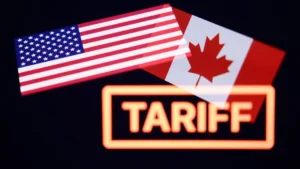
Defensive investing in Canadian sectors 2026 has become an urgent question for investors — and the timing couldn’t be more relevant. On August 22, 2026, the United States imposed 50% tariffs on approximately $20 billion of Canadian goods after trade talks collapsed, and Prime Minister Mark Carney announced dollar-for-dollar retaliatory measures taking effect September 8. This isn’t hypothetical volatility anymore; it’s here. In this post, you’ll discover which Canadian sectors genuinely offer shelter, which ones now carry unexpected tariff exposure, and how to position your portfolio for what comes next.
Quick Answer:
- Utilities and telecommunications remain genuinely defensive — both operate almost entirely within Canada with no direct tariff exposure
- Consumer staples now require careful screening: while groceries remain essential, dairy processors like Saputo face direct 50% tariff exposure on U.S.-bound products
- Canadian utility stocks historically decline meaningfully less than the broader market during downturns, making them portfolio anchors
- Use registered accounts like your TFSA ($7,000 annual limit) or RRSP ($33,810 for 2026) to hold dividend-paying defensive stocks tax-efficiently
Why Are Canadian Investors Prioritizing Defensive Investing Right Now?

Late 2026 has moved from “uncertain” to “actively disrupted.” Understanding the current environment is essential before making allocation decisions.
The Trade War Is No Longer Hypothetical
On July 20, 2026, President Trump signed three Presidential Proclamations under Section 338 of the Tariff Act of 1930, imposing 50% tariffs on a broad range of Canadian goods. Originally scheduled for August 19, the tariffs were delayed to August 22 for final negotiations — which collapsed on August 21.
The tariffs now in effect cover approximately $20 billion annually, roughly 5% of Canadian exports to the U.S. Importantly, energy, potash, fish, critical minerals, and steel/aluminum are exempt from these particular measures.
Carney announced Canada will retaliate “dollar for dollar” starting September 8, 2026, targeting U.S. steel, dairy, appliances, agricultural equipment, pulp and paper, and electronics.
For investors, this creates a two-sided consideration: Canadian exporters in affected categories face revenue pressure, while Canadian companies importing from the retaliated U.S. sectors face rising input costs starting in September.
What Makes a Sector “Defensive”?
Defensive sectors share three characteristics that make them resilient during downturns:
Inelastic demand: People need electricity, groceries, and phone service regardless of economic conditions. You’re not cancelling your hydro bill during a recession.
Stable cash flows: These companies generate predictable revenue because their products and services are essential, translating into consistent dividends.
Lower beta: Defensive stocks typically have a beta below 1.0, meaning they move less dramatically than the overall market.
A fourth criterion matters more than usual in 2026: minimal cross-border trade exposure. A company can meet all three traditional criteria and still be vulnerable if a meaningful share of its revenue crosses the border.
Which Three Canadian Sectors Offer the Best Defensive Protection?
Let’s examine each sector — including how the current tariff environment changes the picture.
Sector 1: Canadian Utilities — The Cleanest Defensive Play
Utilities remain the strongest defensive option for Canadian investors in late 2026, and the trade war strengthens rather than weakens this case. Companies like Fortis Inc., Hydro One, and Emera provide electricity and natural gas to Canadians who have no choice but to keep paying their bills — and their revenue is almost entirely domestic.
Why utilities shine in downturns:
Canadian utilities operate under regulated frameworks that guarantee reasonable returns on infrastructure investments. When Fortis builds a transmission line or Hydro One upgrades its grid, provincial regulators allow them to earn a set return on that capital. This regulatory protection creates a profit floor that doesn’t exist in cyclical sectors.
Consider Fortis Inc., Canada’s largest investor-owned utility. The company has increased its dividend for 52 consecutive years — through recessions, market crashes, and global pandemics. It reached the 50-year milestone in 2023 and has continued the streak since, most recently with a 4.1% quarterly increase. Fortis has also announced a $28.8 billion five-year capital plan targeting 7% annualized rate base growth, with dividend growth guidance of 4–6% annually through 2030.
Current dividend yields in the Canadian utility sector generally run in the 3.5% to 4.5% range — Fortis itself yields roughly 4.5% at recent prices, while the broader utilities sector average sits closer to 3.75%. This provides meaningful income while you wait out volatility, though it’s more modest than some sources suggest.
Trade war exposure: Minimal. Utilities sell domestically to domestic customers.
Sector 2: Consumer Staples — Defensive, But Screen Carefully Now
This is where 2026 requires more nuance than the standard playbook suggests.
The traditional case: Consumer staples companies sell products Canadians buy week after week. Loblaw Companies Limited dominates Canadian grocery retail (Loblaws, No Frills, Shoppers Drug Mart). Metro Inc. and Empire Company (Sobeys, Farm Boy, FreshCo) round out the grocery oligopoly. These companies benefit from a simple reality: Canadians need to eat.
The grocery sector also benefits from inflation pass-through capability. When input costs rise, retailers can adjust shelf prices relatively quickly — pricing power that discretionary retailers lack.
⚠️ The 2026 complication: Not all consumer staples are equally insulated. Saputo Inc. (SAP.TO), one of Canada’s largest dairy processors, faces direct 50% tariff exposure on U.S.-bound products — dairy was explicitly named in the U.S. proclamations. Premium Brands and other food producers with meaningful U.S. export businesses face similar pressure.
Meanwhile, domestic grocery retailers (Loblaw, Metro, Empire) are far better positioned — they sell to Canadians in Canada. However, they’ll face input cost pressure from Canada’s own September 8 retaliatory tariffs on U.S. dairy and agricultural equipment.
The takeaway: “Consumer staples” is no longer a single defensive category in 2026. Domestic-facing retailers remain reasonably defensive; export-oriented food processors have become considerably riskier. Screen individual holdings rather than buying the sector wholesale.
Sector 3: Telecommunications — Genuinely Domestic
Canada’s telecom sector features three dominant players — BCE Inc., Telus Corporation, and Rogers Communications — controlling the vast majority of wireless, internet, and television services nationwide. This oligopolistic structure creates pricing power and cash flow stability.
Why telecom remains defensive:
Your smartphone has become as essential as electricity. Canadians aren’t cancelling wireless plans during recessions; if anything, they use more data while cutting back on dining out and travel. This makes telecom revenue remarkably sticky.
BCE and Telus have offered elevated dividend yields — in some periods reaching the 6.5% to 7.5% range. However, treat unusually high yields as a signal, not just an opportunity. Elevated yields often reflect investor concern about capital expenditure requirements for network buildouts, competitive pressure, and in some cases questions about dividend sustainability. Verify current yields and payout ratios directly before investing, and consider whether a yield well above sector norms reflects genuine value or genuine risk.
Trade war exposure: Minimal. Telecom services are domestic by nature.
Comparison: Canadian Defensive Sectors for Late 2026
| Feature | Utilities | Consumer Staples (Domestic Retail) | Telecommunications | Energy (Cyclical Comparison) |
|---|---|---|---|---|
| Typical Dividend Yield (2026) | 3.5% – 4.5% | 2.5% – 4.0% | Elevated (verify current levels and sustainability) | 3.0% – 8.0% (variable) |
| Historical Beta | 0.4 – 0.6 | 0.5 – 0.7 | 0.6 – 0.8 | 1.3 – 1.8 |
| Recession Performance | Typically declines meaningfully less than market | Typically declines less than market | Moderately less decline | Often exceeds market decline |
| Dividend Growth Stability | Very High (Fortis: 52 years) | High | Moderate | Low (cuts common) |
| Interest Rate Sensitivity | High (bond-like) | Low | Moderate | Low |
| Direct Tariff Exposure | Minimal | Low for retailers; HIGH for dairy/food exporters | Minimal | Exempt from new tariffs |
| Capital Appreciation Potential | Low-Moderate | Moderate | Low-Moderate | High (with high volatility) |
This comparison reveals an important insight: no single defensive sector excels across every metric, and the tariff dimension now differentiates within sectors, not just between them. Utilities offer the lowest volatility but face interest rate sensitivity. Consumer staples require individual screening. Telecommunications delivers income but warrants sustainability checks.
How Should You Shift Your Portfolio Toward Defensive Positioning?

Step 1: Assess Your Current Allocation and Tariff Exposure
Log into your brokerage and calculate what percentage sits in defensive versus cyclical holdings. Then add a second screen: what percentage of your Canadian holdings derive meaningful revenue from U.S. exports in tariff-affected categories?
A balanced defensive allocation for uncertain times typically ranges from 30–50% of equity holdings, depending on your age, risk tolerance, and income needs. If you’re within 10 years of retirement, leaning toward the higher end makes sense.
Step 2: Choose Tax-Efficient Accounts
Where you hold defensive investments matters enormously for after-tax returns.
TFSA strategy: Your $7,000 annual contribution (with a lifetime limit around $109,000 for those eligible since 2009 — confirm via CRA’s official TFSA calculator) grows completely tax-free. Holding dividend payers here means never paying tax on those dividends or capital gains.
RRSP strategy: Contributions reduce current taxable income, and growth compounds tax-deferred. The 2026 contribution limit is $33,810 (18% of your 2025 earned income) — see CRA’s official RRSP deduction page. RRSPs work well if you expect a lower tax bracket in retirement.
Non-registered: Canadian dividends receive preferential treatment through the dividend tax credit here, making this a reasonable home for defensive dividend payers once registered room is used.
Step 3: Implement Gradually Through Dollar-Cost Averaging
Resist dramatic all-at-once shifts. Transition gradually over 3–6 months. If you want to move $50,000 from growth to defensive holdings, consider $8,000–$10,000 per month rather than one large trade. This reduces the risk of buying at temporary highs.
Step 4: Rebalance Quarterly
Market movements will shift your percentages over time. Set calendar reminders to review quarterly. Most Canadian brokerages — including those at TD, RBC, BMO, Scotiabank, and CIBC — provide portfolio analysis tools.
What Mistakes Do Canadian Investors Make With Defensive Sectors?
Mistake 1: Assuming All “Defensive” Sectors Are Tariff-Immune
This is the newest and most relevant error. A dairy processor meets every traditional defensive criterion — essential product, stable demand, reliable dividends — yet faces direct 50% tariff exposure on a meaningful revenue segment. Screen for cross-border revenue, not just sector classification.
Mistake 2: Waiting Too Long to Shift
By the time a recession is officially declared, defensive stocks have typically already outperformed for months. Warning signs worth monitoring include inverted yield curves, declining consumer confidence, rising unemployment claims, and slowing GDP growth — plus, now, the September 8 retaliatory tariff implementation.
Mistake 3: Confusing “Defensive” With “Risk-Free”
Defensive stocks can and do decline during corrections — they simply tend to fall less. The goal is relative outperformance and income stability, not complete downside elimination.
For true capital preservation during extreme uncertainty, consider allocating a portion to cash equivalents like high-interest savings accounts or GICs.
Mistake 4: Ignoring Valuation
Defensive stocks become overvalued when too many investors pile in simultaneously. Check price-to-earnings ratios against historical averages. A utility trading at 25x earnings when its 10-year average is 18x may offer less protection than expected.
Mistake 5: Concentrating in a Single Defensive Sector
Putting your entire defensive allocation into utilities exposes you to sector-specific risks like regulatory changes or interest rate spikes. Spread across utilities, domestic-facing staples, and telecommunications.
Mistake 6: Abandoning Your Strategy Too Early
Markets recover faster than economies. Defensive portfolios often lag during early rebound stages, tempting investors to chase performance prematurely. Stick with your allocation until your original thesis changes — not because of short-term relative underperformance.
Key Takeaways
- The 50% U.S. tariffs took effect August 22, 2026 covering ~$20 billion (about 5% of Canadian exports), with Canada retaliating September 8 — defensive positioning is now responding to an active disruption, not a hypothetical one
- Canadian utilities remain the cleanest defensive play — Fortis has raised its dividend for 52 consecutive years and has minimal cross-border exposure
- Consumer staples now require screening: domestic grocery retailers (Loblaw, Metro, Empire) remain reasonably defensive, but dairy and food exporters like Saputo face direct tariff exposure
- Telecommunications (BCE, Telus, Rogers) is genuinely domestic, though verify current dividend sustainability before chasing elevated yields
- Utility dividend yields run roughly 3.5%–4.5% in 2026 — meaningful income, but more modest than some sources suggest
- Hold defensive dividend stocks in your TFSA ($7,000 annually) or RRSP ($33,810 for 2026) for tax-sheltered compounding
- Implement shifts gradually over 3–6 months rather than making abrupt changes that might catch temporary price peaks
Frequently Asked Questions
What are the best defensive sectors in Canada for late 2026?
Utilities and telecommunications currently offer the cleanest defensive protection because both operate almost entirely within Canada with minimal exposure to the 50% U.S. tariffs that took effect August 22, 2026. Consumer staples remain partially defensive, but require individual screening — domestic grocery retailers like Loblaw and Metro are well-positioned, while dairy processors like Saputo face direct tariff exposure on U.S.-bound products. Energy is also exempt from the new tariffs, though it remains cyclically volatile rather than defensive.
How do Canadian utilities perform during market downturns?
Canadian utilities historically decline meaningfully less than the broader S&P/TSX Composite during downturns, with typical betas of 0.4–0.6 meaning far more muted price swings than growth sectors. This resilience stems from regulated business models that guarantee reasonable returns on infrastructure investments regardless of economic conditions. Utilities also maintain and often increase dividends during recessions — Fortis has raised its dividend for 52 consecutive years through multiple economic cycles, and has guided toward 4–6% annual dividend growth through 2030.
Are consumer staples still a safe defensive sector with the new tariffs?
It depends entirely on the specific company. Domestic-facing grocery retailers (Loblaw, Metro, Empire) remain reasonably defensive since they sell to Canadians in Canada — though they may face input cost pressure from Canada’s September 8 retaliatory tariffs on U.S. dairy and agricultural equipment. However, food producers with meaningful U.S. export businesses — particularly dairy processors like Saputo — face direct 50% tariff exposure since dairy was explicitly targeted in the U.S. proclamations. Screen individual holdings for cross-border revenue rather than treating “consumer staples” as uniformly safe.
Should I shift to defensive stocks before a recession in Canada?
Shifting before a recession is generally more effective than waiting for official confirmation. By the time Statistics Canada confirms a recession, defensive stocks have typically already outperformed for months. Consider moving 20–30% of your portfolio toward defensive holdings when warning signs emerge — slowing GDP growth, rising unemployment, inverted yield curves, or in the current case, active trade disruption. Implement gradually through dollar-cost averaging to avoid buying at temporary peaks.
Mastering defensive investing in Canadian sectors 2026 requires updating the traditional playbook for a genuinely new environment. With 50% tariffs now in effect and Canadian countermeasures arriving September 8, the old assumption that “consumer staples are safe” needs qualification — while utilities and telecommunications look stronger than ever precisely because their revenue never crosses the border. By allocating thoughtfully across genuinely domestic sectors, screening individual holdings for tariff exposure, and using tax-efficient accounts, you’ll build resilience that pays dividends in both stable and turbulent times. Explore more Canadian investment strategies on Getwealthy.
Get free Canadian money tips every week
TFSA updates, CRA changes, mortgage strategies — straight to your inbox every Thursday. No spam, unsubscribe anytime.
Certified Financial Planner (CFP) and Chartered Investment Manager (CIM) with over 17 years of experience in Canadian personal finance. Spent 10+ years at one of Canada's Big Five banks, the last 7 focused exclusively on high-net-worth clients. Every guide is written with the same depth I bring to real client work — Canada-specific, CRA-verified, and always free.
Disclaimer: This article is for informational and educational purposes only and does not constitute financial, tax, or legal advice. Dividend yields and tariff policy are both changing rapidly — verify current figures before investing. Always consult a qualified financial advisor or tax professional for personalized advice.