Diversification is supposed to mean that when one part of your portfolio falls, another part holds up. October 2026 was a good real-world test. The S&P/TSX Composite Index rose about 1.1% for the month, Government of Canada bond yields eased, and gold, the asset many investors treat as a safe haven, fell about 7%. Looking at what moved, and what didn’t, shows which holdings actually spread your risk and which ones just feel safe. This guide uses October’s numbers to explain how to build a diversified portfolio with tools any Canadian investor can use.
Quick Answer
- In October 2026, the TSX rose 1.09% to close at 35,620.03, while spot gold fell about 6.8% for the month, including a 3.63% drop on October 30 alone.
- The 10-year Government of Canada bond yield fell from 3.94% on October 1 to 3.84% on October 29, which means bond prices rose.
- No single asset is always the safe one. Real diversification comes from mixing assets that react differently, holding them in sensible proportions and rebalancing.
What Happened in October 2026?
October showed three asset classes moving in different directions:
| Asset | October 2026 move | Source |
|---|---|---|
| S&P/TSX Composite | +1.09% for the month, closing at 35,620.03 | Morningstar / Dow Jones Market Data |
| Spot gold (US$) | About −6.8% for the month; −3.63% on October 30, to about $3,876 | Market data |
| 10-year Government of Canada bond yield | 3.94% (Oct 1) to 3.84% (Oct 29) | Bank of Canada |
The month wasn’t smooth. The TSX fell 1.74% on October 30 alone, its steepest one-day drop in nearly six months, as technology and mining stocks, including gold miners, slid. It still finished the month higher. Gold hit its lowest level in more than a year that day, as a sharp selloff in technology and AI stocks pushed some investors to sell safe-haven assets to raise cash. Meanwhile, the Bank of Canada raised its policy rate to 2.50% on October 28, yet longer-term bond yields still drifted lower over the month.
The lesson isn’t “sell gold” or “buy stocks.” One month tells you very little about future returns. The lesson is that assets people group together as “safe” can behave very differently, and a portfolio that leans on just one of them is less diversified than it looks.
Why Didn’t Gold Protect Investors?
Gold has a reputation as a hedge against market stress and inflation, and sometimes it plays that role. But it’s also a volatile asset with no cash flow, and its price can swing sharply after a big run-up. October showed another weakness: in a sudden selloff, investors sometimes sell gold along with everything else to raise cash, so it may fall exactly when you want it to hold.
An investor who had moved a large share of savings into gold for safety would have seen a loss in a month when a plain Canadian equity index fund gained. That doesn’t make gold useless. A small allocation can still add something different. The point is sizing: a “safe haven” that can drop 7% in a month is not a substitute for cash or high-quality bonds. Our guide to gold ETFs in Canada explains how investors typically hold gold and the costs involved.
The TSX’s own concentration
October also highlighted a quieter issue: the TSX isn’t as diversified as many Canadians assume. Financials, energy and materials, including gold miners, make up a large share of the index. When gold fell on October 30, the miners helped pull the whole index down. Holding only Canadian stocks means your “stock” bet is partly a bet on banks, oil and metals, and partly a bet on gold.
What Are Real Diversifiers?
A real diversifier is an asset that tends to respond differently from the rest of your portfolio, for reasons you understand. For most Canadian investors, the building blocks are:
| Building block | Role in the portfolio | Main risk |
|---|---|---|
| Canadian stocks | Growth and eligible dividends | Concentrated in financials, energy and materials |
| U.S. and international stocks | Less reliance on Canada’s big sectors; adds technology, health care and consumer companies | Currency swings and different market cycles |
| High-quality bonds (Government of Canada, investment-grade corporate) | Income, and historically steadier than stocks in many downturns | Prices fall when yields rise, as in 2022 |
| Cash and GICs | Money you need soon and emergencies | Low long-term growth after inflation |
| Small satellites (gold, REITs) | Different drivers from stocks and bonds | Volatile; can fall sharply |
Bonds deserve a closer look after October. When yields fall, existing bond prices rise. The 10-year Canada yield dropped about 0.10 percentage points over the month, giving bond holders a small price gain on top of their interest. Our Canadian bond ETF comparison lays out the main options.
How correlation works in plain English
Correlation measures how often two assets move together. If two assets always rise and fall at the same time, holding both doesn’t reduce your risk much. If they often move differently, combining them smooths the ride.
Correlations change over time. In 2022, stocks and bonds fell together as interest rates jumped, which surprised many investors. In October 2026, gold and stocks moved in opposite directions for most of the month, then fell together on October 30. That’s why you diversify across several asset types instead of relying on one hedge.
How Do I Build a Diversified Portfolio?
A simple, practical approach for most Canadians:
- Start with your timeline. Money you’ll need within one to three years belongs in cash, a high-interest savings account or GICs, not stocks.
- Pick a stock-to-bond mix. A common rule of thumb is more stocks for long timelines and more bonds as you approach the date you need the money. Choose a mix you can stick with in a bad month.
- Spread stocks globally. Canada is a small part of world stock markets. Adding U.S. and international exposure lowers your dependence on a few Canadian sectors.
- Consider an asset allocation ETF. One-ticket ETFs hold thousands of stocks and bonds in a fixed mix and rebalance automatically.
- Keep satellites small. If you want gold, crypto or a single theme, cap it at a share you could see fall sharply without changing your plans.
- Rebalance on a schedule. Once or twice a year, or when a holding drifts far from its target, trim what rose and add to what fell.
An example portfolio
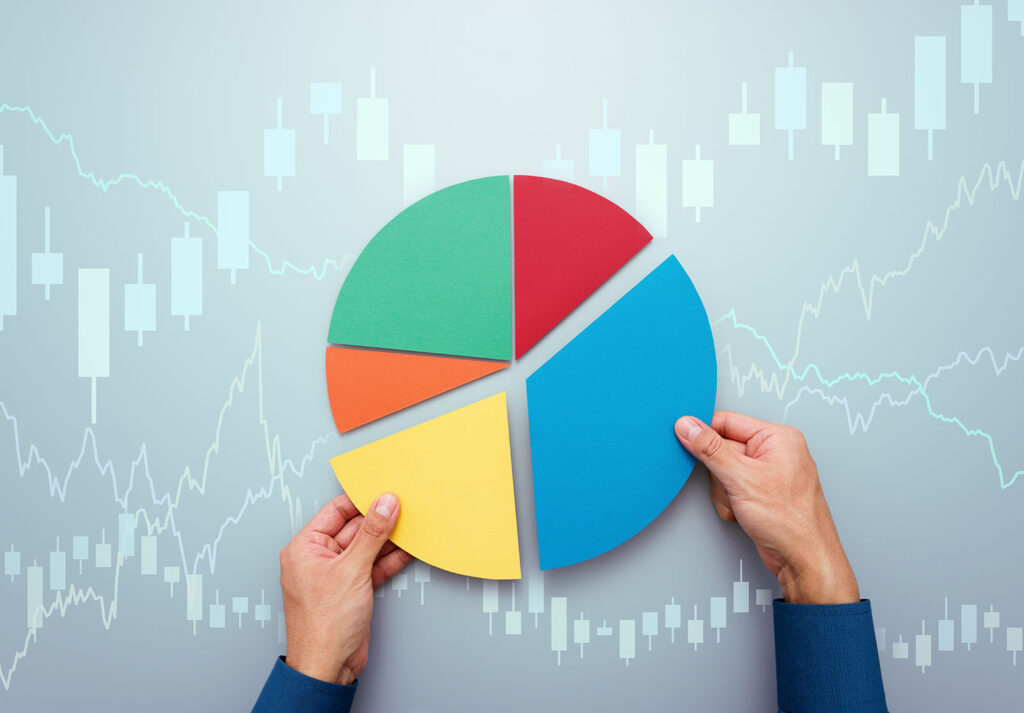
An investor with $100,000 targets 60% stocks, 30% bonds and 10% cash and GICs. Within stocks, they hold one-third each in Canadian, U.S. and international stocks. They also want some gold, capped at 5% and taken from the stock side:
| Holding | Target | Amount |
|---|---|---|
| Canadian stocks | 18.3% | About $18,300 |
| U.S. stocks | 18.3% | About $18,300 |
| International stocks | 18.3% | About $18,300 |
| Gold | 5% | $5,000 |
| High-quality bonds | 30% | $30,000 |
| Cash and GICs | 10% | $10,000 |
| Total | 100% | $100,000 |
If gold fell 7% in a month, as it did in October, this investor’s $5,000 position would drop about $350, or 0.35% of the whole portfolio. That’s the benefit of sizing: the hit is noticeable but not damaging. When a holding moves well away from its target, the investor rebalances by directing new contributions to whatever is under target, which avoids selling and triggering capital gains in a taxable account.
Pro Tip: Write your target mix down, with a rebalancing rule such as “rebalance when any holding is 5 percentage points off target.” A written rule makes it easier to buy what’s down and trim what’s up, instead of reacting to a scary headline like gold’s 3.6% one-day drop.
New to the basics? Our explainer on what diversification means for Canadian investors covers the concepts step by step.
Use the right accounts
Where you hold each asset matters too:
| Asset | Often a good fit | Why |
|---|---|---|
| Bonds and GICs | RRSP or TFSA | Interest is fully taxable in a non-registered account |
| Canadian dividend stocks | Non-registered account or TFSA | Eligible dividends get the dividend tax credit outside registered accounts |
| US-listed ETFs paying US dividends | RRSP | Generally exempt from US withholding tax in an RRSP under the Canada–US tax treaty, but not in a TFSA |
Key Takeaways
- In October 2026, the TSX rose 1.09% while spot gold fell about 6.8%, showing that a popular “safe” asset can fall when stocks rise.
- On October 30, gold and the TSX fell together, a reminder that correlations can change suddenly in a selloff.
- The 10-year Canada bond yield fell from 3.94% to 3.84% over the month, giving bond holders a modest price gain.
- The TSX is concentrated in financials, energy and materials, so Canadian-only stock portfolios are less diversified than they look.
- Core diversifiers for most Canadians are global stocks, high-quality bonds and cash or GICs, with any gold or crypto kept small.
- Rebalance on a schedule, and hold tax-inefficient assets like bonds and GICs in registered accounts when you have room.
Frequently Asked Questions
Did the TSX go up or down in October 2026?
It went up. The S&P/TSX Composite gained 1.09% in October to close at 35,620.03, even after a 1.74% drop on October 30.
Is gold a good diversifier for Canadians?
It can add something different in small amounts, but it’s volatile. Spot gold fell about 6.8% in October 2026, including a 3.63% one-day drop on October 30, so it shouldn’t replace bonds or cash.
Why do bond prices rise when yields fall?
Existing bonds pay a fixed coupon. When new bonds offer lower yields, older bonds with higher coupons become more valuable, so their prices rise.
How often should I rebalance?
Many investors rebalance once or twice a year, or when an asset class drifts several percentage points from its target. Asset allocation ETFs do it automatically.
How much gold should be in a portfolio?
There’s no official answer. Many investors who hold gold keep it to about 5% or less, so a sharp drop, like October’s 7%, has only a small effect on the whole portfolio.
Conclusion
Diversification works best when it’s based on how assets behave, not on their reputation. October 2026 showed a rising TSX, falling bond yields and a sharp drop in gold, a reminder that no single asset is always the safe one. Build a mix of global stocks, high-quality bonds and cash or GICs that matches your timeline, keep speculative holdings small, and rebalance on a schedule. To map your target mix and track progress toward your goals, try the free planner below.
Canadian Money Planner 2026 Edition (free) Budget, savings, debt and goals in one place. Get the free planner.
Official sources: Bank of Canada: Bond yields; Bank of Canada: Policy interest rate.
Get plain-English money tips for Canadians
Join the GetWealthy newsletter and get the free Canadian Money Planner 2026 Edition (PDF). No spam, unsubscribe anytime.
Your one-stop guide to everything Canadians need to know about money. Written by the GetWealthy editorial team, based on official CRA, FINTRAC and government sources and reviewed every year.
Turn what you just read into a plan
The Canadian Money Planner keeps your budget, savings, debt and goals in one place. It's free.
Get the free 2026 Planner
Disclaimer: This article is for informational and educational purposes only and does not constitute financial, tax, or legal advice. Past performance does not guarantee future results. Always consult a qualified financial advisor or tax professional for personalized advice.