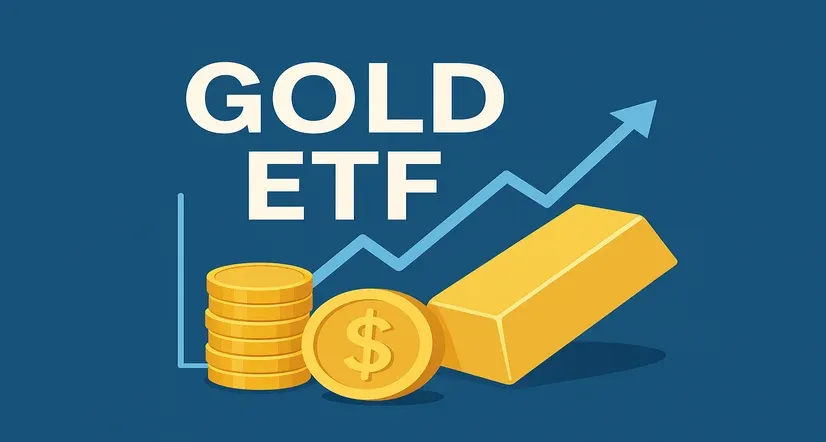
Gold ETFs in Canada give you a simple way to own gold in a TFSA, RRSP, or regular brokerage account without storing bars or coins. After a big multi-year run and a very volatile 2026, many investors are asking how much gold actually belongs in a portfolio. In early October 2026, gold traded near C$5,900 to C$6,000 per ounce, roughly flat for the year, about 20% below its late-January record, but up roughly 170% over five years. That kind of move can tempt you to buy more, or scare you away. This guide compares the main Canadian gold ETFs, their fees, and a sensible way to size your gold allocation.
Quick Answer
- Allocation: Most diversified Canadian investors keep gold at 0% to 10% of their portfolio; about 5% is a common middle ground for a long-term holder.
- Low-cost bullion options in 2026: BMO’s ZGLD and Purpose’s KILO (both about 0.23% MER), the Royal Canadian Mint’s MNT receipts (0.35% fee), and iShares CGL.C (about 0.55% MER).
- Miners are not bullion: Gold miners ETFs swing much more than the metal itself and carry company risk.
Why Are Canadians Buying Gold ETFs in 2026?
Gold has been one of the best-performing assets of the past five years. In Canadian dollar terms, an ounce that cost about C$2,200 in late 2021 traded near C$5,900 to C$6,000 in early October 2026.
It has also been a wild ride in 2026:
| Point in 2026 | Gold price (approx.) | What happened |
|---|---|---|
| Early January | ~US$4,390 | Started the year near C$6,000 |
| January 29 | ~US$5,500 to US$5,600 (record) | All-time high, then a sharp correction of close to 19% |
| July | Below ~US$4,170 | July’s high was the lowest monthly high of the year |
| August 24 | ~US$4,660 (about C$6,500) | A late-summer rebound high |
| Early October | ~C$5,900 to C$6,000 | About 9% below the August high; roughly flat for the year |
Prices based on LBMA fixes and market data; CAD figures are approximate.
Investors usually buy gold for three reasons:
- Diversification: Gold has often moved differently from stocks and bonds, especially during crises.
- Inflation and currency protection: Gold is priced in US dollars and is not tied to any one government’s money supply.
- Fear of a downturn: Trade tensions, high government debt, and geopolitical risk all push some buyers toward hard assets.
The trade-off is that gold pays no interest or dividends. Its only return comes from price changes. Over long periods, broad stock markets have usually beaten gold, because companies grow earnings and pay dividends while gold just sits there. That is why most portfolio builders treat gold as a small diversifier, not a core holding. If you are new to spreading risk, our guide on what diversification means for Canadian investors explains the basics.
Gold’s role in the TSX
Many Canadians already own gold indirectly. Materials stocks, including large gold miners, are a big part of the S&P/TSX Composite Index, and TD Economics credits gold and other materials as a key driver of the TSX’s strong run since early 2025. If you own a Canadian index ETF, you already have some exposure to gold prices through mining companies. Check this before adding a separate gold position, so you do not double up without meaning to.
Which Gold ETFs Can Canadians Buy?
Canadian-listed gold products fall into two groups: those that hold physical bullion, and those that hold shares of gold mining companies. They behave very differently.
Physical gold bullion ETFs
Bullion ETFs and trusts hold real gold in vaults and track the gold price, minus fees. Here are the main Canadian options and their published costs:
| Fund | Issuer | What it holds | Approx. MER / fee | Currency notes |
|---|---|---|---|---|
| BMO Gold Bullion ETF (ZGLD) | BMO | Physical gold bullion | About 0.23% | CAD units, not hedged |
| Purpose Gold Bullion Fund (KILO) | Purpose Investments | Physical gold bullion | About 0.23% | Several unit classes; check which one you buy |
| Canadian Gold Reserves ETRs (MNT) | Royal Canadian Mint | Gold held by the Mint in Ottawa | 0.35% service fee | Exchange-traded receipts, not a standard ETF |
| iShares Gold Bullion ETF (CGL.C / CGL) | iShares (BlackRock) | Physical gold bullion | About 0.55% | CGL.C is unhedged; CGL is hedged to CAD |
Fees matter more than you might expect with gold. Because gold earns no income, the fee comes straight out of your return. Over 20 years, the gap between a 0.23% fund and a 0.55% fund adds up to roughly 6% of your gold position. Always confirm the current MER in the fund’s ETF Facts before you buy, because fees can change.
Pro Tip: With gold, the cheapest fund is usually the best fund. All bullion ETFs track the same metal, so unlike stock ETFs, there is no “better index” to pay up for. Pick a low-fee, unhedged CAD fund, hold it in one account, and stop shopping. Spreading small amounts across ZGLD, KILO, and CGL.C adds complexity without adding diversification.
Hedged vs unhedged
Gold is priced in US dollars. An unhedged fund rises when the US dollar strengthens against the loonie and falls when the loonie strengthens. A CAD-hedged fund removes most of that currency effect, but hedging has its own cost when Canadian interest rates are lower than US rates, as they are in 2026. For most long-term holders, an unhedged fund is simpler, and the US dollar exposure can be a useful diversifier for a Canadian.
Gold miners ETFs
Gold miners ETFs, such as iShares’ XGD, hold shares of mining companies. Miners are a leveraged bet on gold: when gold rises, their profits can rise much faster, and when gold falls, they can drop much more. They also carry business risks that bullion does not, such as cost overruns, mine accidents, and political risk in foreign countries. Miners pay small dividends, while bullion pays nothing. Treat miners as an equity sector bet, not a safe-haven substitute for gold.
| Feature | Bullion ETF | Miners ETF |
|---|---|---|
| Tracks | Gold price, minus fees | Share prices of mining companies |
| Volatility | Moderate | High; often 2x gold’s moves or more |
| Income | None | Small dividends |
| Company risk | None | Costs, mine accidents, politics |
| Role in a portfolio | Diversifier | Sector bet |
How Much of Your Portfolio Belongs in Gold?
There is no official rule, and you will hear very different answers. The ranges below reflect common approaches used by Canadian portfolio managers and model portfolios. Your own number should depend on your goals, time horizon, and how you would feel if gold fell 20% or more, which it did in just a few months in early 2026.
| Gold allocation | Who it suits | What to expect |
|---|---|---|
| 0% | Many diversified investors | A portfolio with Canadian materials stocks already has some gold sensitivity |
| 2% to 5% | A modest diversifier | Small enough that a big drop won’t derail your plan |
| 5% to 10% | Investors worried about inflation, currency risk, or crashes | Noticeable swings in your overall return |
| Above 10% | A concentrated bet | Gold fell sharply from 2011 to 2015 and took years to recover |
A simple example
Say you have a $100,000 portfolio and choose a 5% gold target. You would hold $5,000 in a bullion ETF. If gold rises 30% and stocks are flat, your gold grows to $6,500, or about 6.4% of a $101,500 portfolio. At your yearly check-in, you would sell about $1,425 of gold and buy stocks or bonds to return to 5%. If gold falls instead, you would buy a bit more. This discipline forces you to sell high and buy low, rather than chasing gold after a big run.
Setting a target and rebalancing on a schedule is easier than trying to time gold’s next move. The same approach works for all your holdings, as covered in our systematic investing framework for TSX volatility.
Questions to ask before you buy
- Do you already own gold miners through a Canadian index fund?
- Would you hold through a 20% to 30% drop without selling?
- Are your emergency fund and high-interest debt handled first?
- Are you buying because of a plan, or because the price has been rising?
Where Should You Hold Gold ETFs for Tax?
Where you hold gold can affect how much you keep after tax.
| Account | How gold is taxed | Main drawback |
|---|---|---|
| TFSA | Gains tax-free | Losses can’t be claimed, and lost value shrinks your sheltered savings |
| RRSP | Tax-deferred; withdrawals taxed as income | No special benefit since gold pays no income |
| Non-registered | Capital gains when you sell (50% inclusion); losses claimable | You pay tax on gains, but you control timing |
TFSA
Gold ETFs are qualified TFSA investments. Gains are tax-free, and you can withdraw without tax. The downside is that if gold falls, you cannot claim the capital loss, and the lost value permanently shrinks what you have sheltered. The 2026 TFSA annual limit is $7,000.
RRSP
Gold ETFs can also go in an RRSP. Growth is tax-deferred, and withdrawals are taxed as income later. Because gold produces no income, it gets no special benefit from the RRSP compared with other assets, so many investors keep higher-growth or income-producing assets there instead.
Non-registered account
In a taxable account, gains on a gold ETF are generally treated as capital gains when you sell, and only half of the gain is included in income under current rules. You can also claim capital losses if gold falls. Because bullion ETFs usually pay no distributions, you control when you trigger tax, which makes a non-registered account a reasonable home for gold once your registered accounts are full.
Physical gold vs ETFs
Buying coins or bars from a dealer means paying a spread above the spot price, plus storage and insurance, and selling can involve a discount. For most investors, an ETF is cheaper and easier. Physical gold appeals mainly to people who want to hold the metal outside the financial system, which is a personal choice rather than a cost-saving one.
How to buy a gold ETF step by step
- Choose the account: TFSA, RRSP, or non-registered.
- Pick one bullion fund and stick with it, rather than spreading small amounts across similar products.
- Use a limit order instead of a market order, so you do not pay more than expected if the price jumps during the day.
- Write down your target percentage and the date of your next rebalance.
Watch for trading costs too. Many Canadian discount brokerages now offer commission-free ETF trades, but some still charge per trade or charge for US-listed funds. If you buy a US-listed gold ETF, you will also pay currency conversion costs, which can be 1% to 2% each way at some brokerages. For most Canadians, a Canadian-listed fund in Canadian dollars avoids that problem.
Finally, keep your expectations realistic. Gold can go years without making new highs. If you hold it for diversification, its job is to behave differently from your stocks, not to beat them every year.
Key Takeaways
- Gold traded near C$5,900 to C$6,000 per ounce in early October 2026, roughly flat for the year, about 9% below its August high and around 20% below its January 29 record.
- For most diversified Canadian investors, a gold target of 0% to 10%, often around 5%, is a reasonable range.
- Compare fees: ZGLD and KILO are about 0.23%, MNT charges 0.35%, and CGL.C is about 0.55%; confirm in each fund’s ETF Facts.
- Bullion ETFs track the metal; miners ETFs like XGD are a riskier equity bet that can swing far more than gold.
- Pick a target and rebalance once a year instead of buying after a big price run.
- Gold ETFs fit in a TFSA, RRSP, or taxable account; in a taxable account, gains are capital gains when you sell.
Frequently Asked Questions
Is gold a good investment in Canada in 2026?
Gold can be a useful diversifier, but it is not a guaranteed winner. It has risen sharply over five years, yet in 2026 it hit a record in late January, fell close to 19% within weeks, and was roughly flat for the year by early October. Most investors use it as a small part of a balanced portfolio rather than a main holding.
What is the cheapest gold ETF in Canada?
Among the main Canadian bullion options, BMO’s ZGLD and Purpose’s KILO both have MERs of about 0.23%, making them among the cheapest. MNT’s 0.35% fee is also low. Always check the latest ETF Facts before buying.
Should I buy gold miners or gold bullion?
Buy bullion if you want gold’s price behaviour as a diversifier. Buy miners only if you want a higher-risk equity bet on the gold sector, since miners can rise or fall much more than gold itself.
Can I hold a gold ETF in my TFSA?
Yes. Canadian-listed gold ETFs and exchange-traded receipts are generally qualified TFSA investments. Gains are tax-free, but losses cannot be claimed against other income.
Should I choose a hedged or unhedged gold ETF?
For most long-term Canadian investors, unhedged is simpler and cheaper. Hedging removes the US dollar’s effect on your returns but adds a cost when Canadian interest rates are below US rates, as they are in 2026. A hedged fund such as CGL makes more sense if you specifically want gold’s price movement without currency swings.
Conclusion
Gold ETFs in Canada make it easy and cheap to add gold to any account. After a strong five-year run and a volatile 2026, the smart move is not to guess the next price but to decide on a target that fits your plan, often somewhere between 0% and 10%. Choose a low-fee bullion fund, decide whether you want currency hedging, and rebalance once a year. If you want help building the rest of your portfolio, see our guide to where to invest in uncertain 2026 markets.
Get free Canadian money tips every week
TFSA updates, CRA changes, mortgage strategies — straight to your inbox every Thursday. No spam, unsubscribe anytime.
The GetWealthy editorial team writes plain-English guides to Canadian personal finance, based on official CRA, FINTRAC and government sources and reviewed every year.
Disclaimer: This article is for informational and educational purposes only and does not constitute financial, tax, or investment advice. Fund names are examples, not recommendations; fees and prices change. Always consult a qualified financial advisor for personalized advice.