Most Canadians set up their investment portfolio once and forget it. Then a year later, they check their account and realize their 80/20 stock-bond split has quietly drifted to 90/10—thanks to a bull run in equities. That drift is costing them more risk than they signed up for.
Rebalancing fixes this. It’s the process of selling what’s grown too large and buying what’s shrunk—bringing your portfolio back to your target allocation. Done right, it keeps your risk in check and can even improve long-term returns by systematically selling high and buying low.
Here’s exactly how to do it in Canada in 2026, including which accounts to rebalance first (hint: not all accounts are equal).
Why Should You Learn How to Rebalance Portfolio Canada Investments in 2026?
Rebalancing isn’t just portfolio housekeeping—it’s a proven risk management strategy that keeps your investments aligned with your goals. When markets surge or slump, your carefully chosen asset mix shifts. This “portfolio drift” can expose you to far more risk than you originally intended, or leave you too conservative to meet your retirement targets.
What Is Portfolio Drift and Why Does It Matter?
Portfolio drift happens when market movements change your asset allocation without you doing anything. Let’s say you started 2025 with a balanced 60/40 portfolio (60% stocks, 40% bonds). If Canadian equities gained 15% while bonds stayed flat, your portfolio might now look like 65/35 or even 70/30. That extra equity exposure means more volatility—and potentially bigger losses during the next market downturn.
For Canadians approaching retirement, this drift is especially dangerous. If you’re within five years of leaving work, an unexpected 20% market drop could devastate your timeline. The Bank of Canada’s April 2026 announcement confirmed they’re maintaining current interest rates, with inflation expected to peak around 3% before returning to 2%. This moderate environment makes 2026 a strategic time to review your allocation.
The Real Cost of Not Rebalancing
Ignoring rebalancing doesn’t just increase risk—it can cost you returns. Studies consistently show that disciplined rebalancing can add 0.5% to 1% annually to your long-term returns through the “rebalancing bonus.” This happens because you’re systematically selling high (trimming winners) and buying low (adding to underperformers). Over a 25-year investing career, that bonus could mean tens of thousands of extra dollars in your retirement accounts.
How Often Should Canadian Investors Use a Portfolio Rebalancing Strategy 2026?
There’s no single “correct” rebalancing frequency, but Canadian investors generally choose between three approaches: calendar-based, threshold-based, or a hybrid of both. Your choice depends on your portfolio size, account types, and how hands-on you want to be.
Calendar-Based Rebalancing
This is the simplest approach: you rebalance on a fixed schedule, typically annually or semi-annually. Many Canadians choose January (after TFSA contribution room resets) or their birthday as an easy-to-remember trigger. The advantage is simplicity—you don’t need to monitor your portfolio constantly. The downside is you might miss opportunities to rebalance during major market swings.
Threshold-Based Rebalancing
With this method, you only rebalance when an asset class drifts beyond a predetermined threshold—usually 5% or more from your target. For example, if your target equity allocation is 60% and it hits 65% or drops to 55%, you rebalance. This approach is more responsive to market conditions but requires regular monitoring. Platforms like Wealthsimple and Questrade make it easy to set up alerts when your allocations shift.
The Hybrid Approach
Many financial advisors recommend combining both strategies: check your portfolio quarterly, but only rebalance if allocations have drifted by 5% or more. This prevents over-trading while still catching significant drift. For most Canadian DIY investors with TFSA or RRSP portfolios under $500,000, an annual review with a 5% threshold is perfectly adequate.
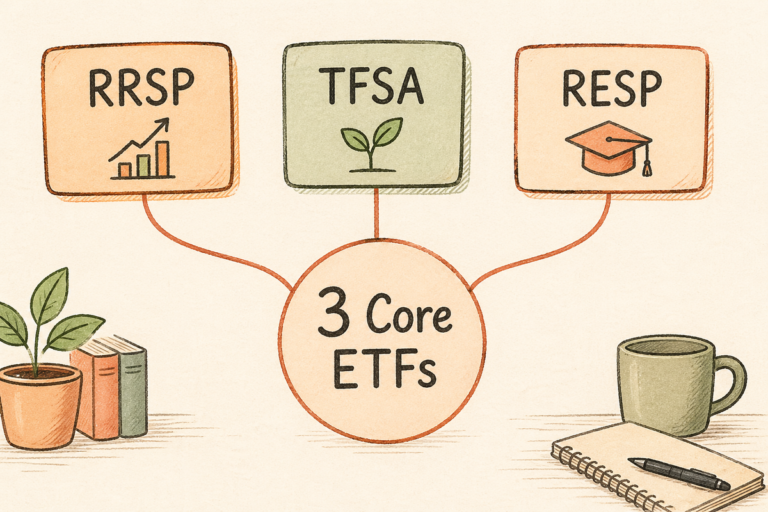
TFSA Portfolio Rebalancing vs. RRSP: Which Account Should You Rebalance First?
Here’s a crucial tax-saving tip that many Canadian investors miss: always prioritize rebalancing in your tax-sheltered accounts first. When you rebalance inside your TFSA or RRSP, you can sell appreciated securities without triggering any capital gains tax. All the money stays within your registered account, and the CRA doesn’t take a cut.
For more details on maximizing your registered accounts, check out our guide on TFSA investment strategies.
💡 Pro Tip: Time your TFSA rebalancing for January 1st when your new $7,000 of contribution room opens. You can add fresh cash to underweight positions instead of selling anything — the most tax-efficient rebalancing method of all.
Why TFSA Portfolio Rebalancing Is Tax-Free
Your TFSA contribution room for 2026 is $7,000, bringing the lifetime maximum to approximately $102,000 if you’ve been eligible since 2009. Inside this account, all growth, dividends, and capital gains are completely tax-free—both while invested and when withdrawn. This makes your TFSA the ideal place to hold your highest-growth (and most volatile) assets, and the perfect account for frequent rebalancing.
When you sell a winning stock in your TFSA to buy bonds, there’s no tax consequence. You simply adjust your allocation and move on. Try that in a non-registered account, and you’ll owe capital gains tax on half your profits at your marginal rate.
💡 Note: The capital gains inclusion rate remains 50% in 2026 after PM Carney cancelled the proposed
increase to 66.67% in March 2025. This makes rebalancing in taxable accounts somewhat less costly
than feared.
RRSP Rebalancing Considerations
Your RRSP offers similar tax-sheltered rebalancing benefits. The 2025 RRSP contribution limit is 18% of your earned income, up to a maximum of $32,490. Inside your RRSP, you can buy and sell freely without immediate tax consequences. The only tax event comes at withdrawal, when the full amount is taxed as income.
One strategic consideration: if you’re planning to use the Home Buyers’ Plan or shift to safer assets as retirement approaches, your RRSP rebalancing decisions should account for your withdrawal timeline.
What About Non-Registered Accounts?
If you’ve maximized your TFSA and RRSP, you likely have non-registered (taxable) investments too. Here, rebalancing gets more complicated. Every sale of an appreciated asset triggers a capital gain, and you’ll owe tax on 50% of that gain at your marginal rate. For Canadians in the highest tax brackets, this can mean losing 25% or more of your gains to taxes.
Instead of selling winners in taxable accounts, consider these alternatives:
- Direct new contributions to underweight asset classes
- Reinvest dividends into lagging positions
- Use tax-loss harvesting to offset unavoidable gains
💡 Pro Tip: Tax-loss harvesting works like this — if your Canadian bond ETF is down 8%, sell it, buy a similar-but-different bond ETF immediately, and claim the capital loss. This offsets gains elsewhere. Just wait 30 days before buying back the original ETF to avoid the “superficial loss” rule.
Comparison: Manual Rebalancing vs. Asset Allocation ETFs for Canadian Investment Diversification
One of the biggest decisions for Canadian DIY investors is whether to rebalance manually or use all-in-one asset allocation ETFs that handle rebalancing automatically. Both approaches have merit, depending on your portfolio size, time commitment, and desire for control. Here’s how they compare for achieving optimal Canadian investment diversification:
| Feature | Manual Rebalancing | Asset Allocation ETFs |
|---|---|---|
| Time Required | 2-4 hours quarterly | Minutes annually |
| Control Over Allocation | Complete customization | Fixed preset allocations (60/40, 80/20, etc.) |
| Management Fee (MER) | 0.05%-0.25% (individual ETFs) | 0.20%-0.25% (all-in-one) |
| Automatic Rebalancing | No—you must do it yourself | Yes—built into the fund |
| Best For | Engaged investors with $100K+ | Hands-off investors, any portfolio size |
| Canadian Options | Individual ETFs from Vanguard, iShares, BMO | VBAL, XBAL, VGRO, XGRO from major providers |
Real Example — After 2025 Volatility:
Started January 2025:
– Canadian Equities: 25%
– U.S. Equities: 25%
– International: 15%
– Bonds: 30%
– Cash: 5%
After 2025 (U.S. stocks +18%, bonds -2%):
– Canadian Equities: 24%
– U.S. Equities: 31% ❌ (+6%)
– International: 14%
– Bonds: 26% ❌ (-4%)
– Cash: 5%
Action needed:
→ Sell 6% U.S. equities in TFSA (no tax!)
→ Buy bonds with proceeds
→ Done in 15 minutes 🍁
Asset allocation ETFs like Vanguard’s VBAL (60% equity/40% bonds) or VGRO (80% equity/20% bonds) have become incredibly popular with Canadian investors. These funds automatically rebalance internally, so you never have to think about it. For investors who want true “set and forget” Canadian investment diversification, they’re hard to beat.
However, if you prefer to tilt your portfolio toward specific sectors (like Canadian dividend stocks using the Dogs of the TSX strategy) or want to minimize foreign withholding taxes in certain accounts, manual rebalancing gives you that flexibility.
How to Rebalance Your Canadian Portfolio: Step-by-Step Guide
Ready to rebalance? Here’s exactly how to do it, whether you’re using Wealthsimple, Questrade, TD Direct Investing, or any other Canadian brokerage. This portfolio rebalancing strategy 2026 approach works for any account type.
Step 1: Document Your Target Asset Allocation
Before you can rebalance, you need to know your target allocation. If you don’t have one written down, now is the time. A common starting point is the “age in bonds” rule: if you’re 40, hold roughly 40% bonds and 60% equities. However, your risk tolerance, retirement timeline, and other income sources (like a defined-benefit pension or expected CPP benefits of up to $1,507.65/month at age 65 in 2026.
Write down your targets. For example:
- Canadian equities: 25%
- U.S. equities: 25%
- International equities: 15%
- Canadian bonds: 30%
- Cash/GICs: 5%
Step 2: Calculate Your Current Allocation
Log into each of your investment accounts (TFSA, RRSP, FHSA, non-registered) and record the current value of each holding. Add everything up to get your total portfolio value, then calculate the percentage each asset class represents.
Most brokerages show this breakdown automatically, but double-check the categories. A “balanced” mutual fund might count as both equities and bonds, so read the fund details.
If you’re also using your FHSA (with its $8,000 annual limit and $40,000 lifetime maximum), include those assets in your overall picture. For more on this account, see our complete FHSA guide for first-time home buyers.
Step 3: Identify the Gaps
Compare your current allocation to your targets. Any asset class that’s more than 5% off target is a candidate for rebalancing. Common situations after 2025’s volatile markets:
- Equities overweight (markets rose, bonds lagged)
- U.S. stocks overweight compared to Canadian stocks
- Bond allocation too low for your risk tolerance
Step 4: Execute Trades in the Right Order
Start with your tax-sheltered accounts (TFSA first, then RRSP). Sell overweight positions and use the proceeds to buy underweight asset classes. If your TFSA and RRSP rebalancing isn’t enough to fix the drift, consider directing new contributions to underweight areas rather than selling in taxable accounts.
Place your trades during market hours for best execution. Most Canadian brokerages charge $0 commissions on ETF trades now, so transaction costs shouldn’t be a concern.
💡 Pro Tip: Place ETF trades between 10am-3pm EST to avoid the opening and closing volatility windows. Early morning and late afternoon spreads on ETFs can be wider, costing you slightly more even on commission-free platforms.
Step 5: Document and Schedule Your Next Review
Record what you did and why. Set a calendar reminder for your next review—quarterly if you’re using threshold-based rebalancing, or annually if you prefer the simple approach. Consistency matters more than perfection.
Common Portfolio Rebalancing Mistakes Canadian Investors Make
Even experienced investors stumble when rebalancing. Avoid these pitfalls to keep your portfolio rebalancing strategy 2026 on track.
Mistake 1: Rebalancing Too Frequently
Checking your portfolio daily and making constant adjustments isn’t rebalancing—it’s market timing in disguise. Over-trading increases costs (even with commission-free brokerages, there are bid-ask spreads) and can lead to emotional decision-making. Stick to your schedule and thresholds.
Mistake 2: Ignoring Tax Consequences
Selling winners in your non-registered account to buy bonds might feel disciplined, but the tax hit can erase years of rebalancing benefits. Always exhaust tax-sheltered rebalancing options first, and consider tax-loss harvesting if you must trade in taxable accounts.
Mistake 3: Forgetting to Rebalance Across All Accounts
Your asset allocation should be viewed holistically across all accounts—TFSA, RRSP, FHSA, and non-registered. Don’t rebalance each account individually to the same allocation. Instead, consider holding tax-inefficient assets (like bonds) in your RRSP and growth assets in your TFSA, then rebalance across the total portfolio.
Mistake 4: Chasing Last Year’s Winners
Rebalancing means trimming winners, not adding to them. If Canadian dividend stocks had a great 2025, rebalancing requires you to sell some—not buy more because they’re “hot.” This discipline is exactly what generates the rebalancing bonus over time.
For more on avoiding emotional investing mistakes, read our guide on behavioural investing pitfalls.
Key Takeaways
- Rebalance inside your TFSA (up to $102,000 lifetime contribution room) and RRSP first to avoid triggering capital gains taxes in non-registered accounts.
- Use a 5% drift threshold combined with annual reviews—this hybrid approach catches significant changes without over-trading.
- Asset allocation ETFs like VBAL or VGRO offer automatic rebalancing for hands-off Canadian investors.
- View your portfolio holistically across all accounts rather than rebalancing each account to identical targets.
- After 2025’s market volatility, many Canadian portfolios have drifted significantly—check yours before summer 2026.
- Direct new contributions to underweight asset classes as a tax-efficient alternative to selling in taxable accounts.
Frequently Asked Questions
How often should I rebalance my portfolio in Canada?
Most Canadian investors should rebalance once or twice per year, or whenever their asset allocation drifts more than 5% from their target. Annual rebalancing in January (when TFSA room resets) is a popular and effective schedule. Over-rebalancing can increase costs and tax consequences without improving returns.
Should I rebalance inside my TFSA or RRSP first to avoid taxes?
Yes, always start with your tax-sheltered accounts. When you rebalance inside a TFSA or RRSP, you can sell appreciated securities without owing any capital gains tax—the CRA only taxes RRSP withdrawals, not internal trades. Concentrate your rebalancing efforts in these accounts and avoid touching taxable accounts whenever possible.
Is now a good time to rebalance with Canadian markets up in 2026?
Yes, 2026 is an excellent time to rebalance precisely because markets have moved significantly. The volatility throughout 2025 likely shifted your portfolio away from its original design, potentially exposing you to more risk than intended. With the Bank of Canada maintaining stable interest rates and inflation came in at 2.4% in March 2026, with upside risks from energy prices and global trade tensions — making it uncertain whether the Bank of Canada will cut further or potentially hike, the current environment offers a strategic opportunity to realign your investments before the next market cycle.
Understanding how to rebalance portfolio Canada investments is one of the most valuable skills you can develop as a DIY investor. By prioritizing tax-sheltered accounts, sticking to a consistent schedule, and avoiding common mistakes, you’ll keep your portfolio aligned with your goals through every market cycle. Whether you choose manual rebalancing or the simplicity of asset allocation ETFs, the key is taking action—don’t let another year of drift put your retirement at risk. Explore more Canadian investing strategies on Getwealthy to build lasting wealth.
Get free Canadian money tips every week
TFSA updates, CRA changes, mortgage strategies — straight to your inbox every Thursday. No spam, unsubscribe anytime.
The GetWealthy editorial team writes plain-English guides to Canadian personal finance, based on official CRA, FINTRAC and government sources and reviewed every year.
Disclaimer: This article is for informational and educational purposes only and does not constitute financial, tax, or legal advice. Always consult a qualified financial advisor or tax professional for personalized advice.