If you’re wondering “should I buy individual stocks Canada” after maxing out your TFSA with ETFs, you’re not alone—but here’s a stat that might surprise you: research shows that fewer than 4% of individual stocks account for all the net gains in the stock market over time. The rest either match the market or lose money. In this guide, you’ll learn why most Canadians struggle with stock picking, when it might make sense to try, and how to limit your risk if you decide to dabble. We’ll cover real 2026 Canadian data, compare ETFs versus individual stocks, and give you a practical framework for making this decision.
Should I Buy Individual Stocks Canada If I’m Already Invested in ETFs?

This is the million-dollar question for Canadian investors in 2026. You’ve done the responsible thing—filled your TFSA with diversified ETFs like VEQT, XEQT, or VFV—and now you’re itching to pick some winners. Maybe you’ve seen friends bragging about gains from Shopify, or you’re tempted by juicy dividends from Canadian bank stocks. But before you dive in, let’s look at what the evidence actually says.
The Research Is Clear: Most Stock Pickers Underperform
According to BMO Nesbitt Burns research from 2026, most individual investors—and even professional fund managers—struggle to consistently beat the market through stock picking or sector timing. The result? Lower returns than simple buy-and-hold diversification strategies, often due to “whipsaw losses” from mistiming entries and exits.
Think about it: you’re competing against hedge funds with billion-dollar research budgets, algorithmic trading systems, and teams of analysts working around the clock. The playing field isn’t level, and the odds aren’t in your favour.
Why ETFs Have Won the Popularity Contest
Index ETFs vs individual stocks Canada is a debate that keeps coming up, and for good reason. ETFs give you instant diversification, lower fees, and protection against any single company blowing up your portfolio. When you own an ETF tracking the S&P/TSX Composite, you own a piece of hundreds of Canadian companies. If one goes bankrupt, your portfolio barely notices.
With individual stocks, one bad earnings report can wipe out 30% of your position overnight. Just ask anyone who held Nortel in 2000 or Valeant in 2015.
How Many Individual Stocks Actually Beat the Index in Canada?
Here’s where things get really interesting. When you look at picking stocks vs ETFs 2026, the data paints a sobering picture for would-be stock pickers.
The Brutal Math of Stock Returns
Long-term studies consistently show that most individual stocks fail to beat Treasury bills over their lifetime. The stock market’s overall gains come from a tiny fraction of superstar performers—companies like Apple, Amazon, or in Canada, Shopify during its heyday. The problem? Identifying these winners in advance is nearly impossible.
If you bought 10 random Canadian stocks, statistically speaking, 6-7 of them would underperform the index over a 10-year period. The one or two winners you might pick would need to dramatically outperform just to break even against the losers.
Survivorship Bias Tricks Your Brain
When you read about successful stock picks, you’re only hearing about the winners. Nobody writes articles about the stocks they bought that went nowhere or lost money. This survivorship bias makes stock picking seem easier than it actually is. For every person who “got in early” on a ten-bagger, there are dozens who bought the next Blackberry or Bombardier.
Index ETFs vs Individual Stocks Canada: A Complete Comparison

Let’s break down the key differences between these two approaches. This comparison table will help you understand what you’re really signing up for with each strategy.
| Feature | Index ETFs | Individual Stocks |
|---|---|---|
| Diversification | Instant (hundreds of holdings) | Must build manually (expensive) |
| Research Required | Minimal—pick broad market ETF | Extensive—financial statements, competitive analysis |
| Time Commitment | 1-2 hours per year | 5-20+ hours per week |
| Fees (MER) | 0.05% to 0.25% typically | $0 trading but hidden costs (spreads, time) |
| Risk of Total Loss | Extremely low | Real possibility per holding |
| Potential for Outperformance | Matches market (minus tiny fees) | Possible but statistically unlikely |
| Emotional Stress | Low—set and forget | High—constant monitoring temptation |
As you can see, index ETFs win on almost every practical measure for the average investor. But that doesn’t mean individual stocks have no place in your portfolio—it just means you need to be strategic about it.
How to Approach Canadian Stock Picking as a Beginner in 2026
If you’re still determined to try your hand at picking stocks, here’s how to do it without blowing up your financial future. This framework is specifically designed for Canadian stock picking beginners who want to scratch the itch without taking catastrophic risks.
Step 1: Establish Your Core Portfolio First
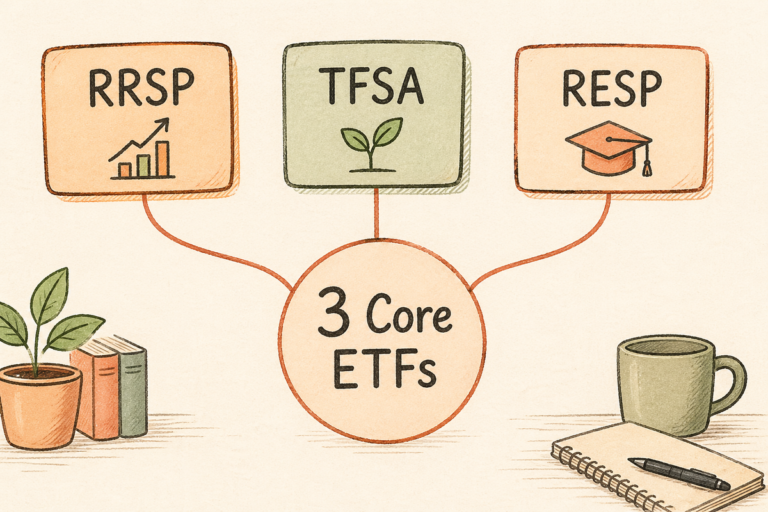
Before buying a single individual stock, make sure your core portfolio is rock solid. This means maxing out your TFSA (up to $102,000 lifetime contribution room as of 2026, with the annual limit at $7,000) with diversified, low-cost ETFs. Consider also maximizing your RRSP if you’re in a higher tax bracket—the 2025 contribution limit was $33,810.
Your core holdings should be boring. Think all-in-one ETFs like VGRO or XBAL, or a simple three-fund portfolio. Check out our guide on the best ETFs for your TFSA for specific recommendations.
Step 2: Create a “Play Money” Allocation
The BMO research is clear: keep individual stock exposure to small tactical tilts of 10-20% of your portfolio, not wholesale reallocations. This means if you have a $100,000 portfolio, limit your individual stock picks to $10,000-$20,000 maximum.
This approach lets you satisfy your curiosity and learn about investing without risking your retirement. If your picks go to zero, you’ve lost some money but your financial future remains intact.
💡 Pro Tip: Before buying any individual stock, write down 3 specific reasons why it will outperform the index. Not “the product seems good” — actual reasons like valuation, competitive moat, or catalyst. If you can’t write 3 solid reasons, don’t buy. This forces you to think like an investor, not a gambler.
Step 3: Focus on Sectors With Structural Tailwinds
If you’re going to pick stocks, at least pick them in sectors with strong fundamentals. The Canadian government’s Build Communities Strong Fund — a $51 billion 10-year infrastructure program launched in April 2026 — creates structural tailwinds for construction, engineering, and logistics companies. The Canadian government’s $115.2 billion infrastructure spending plan creates structural tailwinds for construction materials, engineering services, and logistics companies. Similarly, stable sectors like healthcare and clean technology offer more defensive growth potential.
For example, WELL Health Technologies has been highlighted as a defensive growth play because healthcare demand doesn’t disappear during economic slowdowns. The company is the largest owner/operator of outpatient clinics in Canada and continues growing through acquisitions and technology improvements.
💡 Build Communities Strong Fund (April 2026) — $51 billion over 10 years creates tailwinds for:
✅ Engineering/construction: Stantec (STN), WSP Global (WSP)
✅ Building materials: Stella-Jones (SJ)
✅ Water/wastewater infrastructure
✅ Healthcare construction ($5B dedicated stream)
✅ Indigenous community infrastructure
These are the sectors where structural government spending gives individual stock picks more of a fundamental foundation.
Step 4: Think in Buckets Based on Timeline
As financial experts have been emphasizing in 2026, the better question isn’t “what should I buy?” but rather “when do I need this money?” The longer your timeline, the more volatility you can handle. Money you need in 2 years shouldn’t be in individual stocks—period. Money you won’t touch for 20 years can afford more risk.
Common Mistakes Canadian Stock Pickers Make (And How to Avoid Them)
After years of watching Canadian investors try to beat the market, certain patterns emerge. Here are the most common mistakes and how to sidestep them.
Mistake 1: Confusing a Bull Market With Skill
When the entire market goes up 15%, it’s easy to think you’re a genius because your picks went up 18%. The real test comes during corrections. Did you outperform because of skill, or were you just riding the wave? Most investors discover the humbling answer during their first bear market.
Mistake 2: Overconcentration in Canadian Banks
Yes, TD, RBC, BMO, Scotiabank, and CIBC have been reliable dividend payers for decades. But many Canadian investors end up with 50%+ of their portfolio in just these five stocks. That’s not diversification—that’s a concentrated bet on Canadian financial services. Add in the fact that your job and home value probably also depend on the Canadian economy, and you’ve got a dangerous correlation.
Mistake 3: Ignoring the Hidden Costs
Stock picking isn’t free, even with zero-commission trading on platforms like Wealthsimple or Questrade. The hidden costs include your time (worth money), bid-ask spreads on less liquid stocks, and the opportunity cost of not being in the market while you research your next pick. Factor these in, and your “gains” might not look so impressive.
Mistake 4: Chasing Dividend Yield Without Understanding the Business
A 7% dividend yield looks amazing until the company cuts the dividend and the stock drops 40%. High yields often signal distress, not opportunity. If you’re investing for income, make sure you understand why the yield is high and whether the payout is sustainable.
For a deeper dive into building income from your portfolio, check out our guide on dividend investing in Canada.
💡 Pro Tip: Check the payout ratio before chasing any high yield. A dividend payout above 80-90% of earnings or free cash flow is a yellow flag. BCE was yielding 8%+ before cutting its dividend 54% in May 2025 — exactly the kind of “yield trap” that hurts income investors.
When Individual Stocks Might Actually Make Sense
Despite everything above, there are legitimate reasons some Canadians choose to hold individual stocks. Here’s when it might work for you.
You Work in a Specific Industry
If you’re a software engineer at Shopify or a nurse at a hospital chain, you might have genuine insight into your industry that the average investor lacks. This “informational edge” can sometimes justify small, concentrated positions—though be careful about adding more career risk to your portfolio.
You’re Genuinely Passionate About Investing
Some people love reading financial statements, analyzing competitive moats, and following earnings calls. If this is genuinely your hobby—not just a phase triggered by a bull market—then individual stock picking might bring you joy beyond just returns. Just keep that 10-20% cap in place.
💡 Pro Tip: Track your individual stock picks against XEQT in a spreadsheet for at least 2 years before deciding if you’re actually adding value. Most investors think they’re outperforming until they compare to the index properly (including dividends reinvested, transaction costs, and time spent).
You Want Exposure to Specific Themes
Sometimes there’s no good ETF for a specific investment thesis. For example, if you’re bullish on Canadian outpatient healthcare consolidation, buying WELL Health directly might make more sense than a broad healthcare ETF. Just remember this is a higher-risk approach. Companies like Aritzia, with their strong e-commerce growth and retail expansion, represent similar theme-specific opportunities in the consumer sector.
Key Takeaways
- Keep individual stock exposure to 10-20% maximum of your portfolio—the rest should be in diversified ETFs
- Max out your TFSA ($7,000/year, ~$109,000 lifetime as of 2026) and RRSP with core ETF holdings before buying individual stocks
- Most stock pickers underperform the index over 10+ years—even professional fund managers struggle to beat simple buy-and-hold strategies
- Focus on sectors with structural tailwinds: the Canadian government’s $115.2 billion infrastructure spending plan supports construction, engineering, and logistics
- Think in time-based buckets: only risk money you won’t need for 10+ years in individual stocks
- The hidden costs of stock picking (time, stress, spreads) often eliminate any outperformance
Frequently Asked Questions
Why do most Canadians lose money picking individual stocks?
Most Canadians lose money picking stocks because they’re competing against professional investors with vastly superior resources, they trade too frequently based on emotions, and they succumb to behavioural biases like overconfidence and loss aversion. Research from 2026 confirms that even professional fund managers struggle to consistently beat the market, and individual investors typically do even worse due to poor timing of buys and sells.
Can I hold individual stocks in my TFSA or should I stick to ETFs?
You can absolutely hold individual stocks in your TFSA—the CRA allows Canadian stocks, U.S. stocks, and ETFs within registered accounts. However, sticking primarily to ETFs is usually the smarter choice because your TFSA contribution room ($7,000/year, approximately $102,000 lifetime as of 2026) is precious and limited. Losing money on a bad stock pick in your TFSA means that contribution room is gone forever and cannot be recovered.
How many individual stocks beat the index in Canada over 10 years?
Studies consistently show that fewer than 30-40% of individual stocks beat their benchmark index over 10-year periods. The majority of market gains come from a tiny fraction of superstar performers, while most stocks either match or underperform the overall market. This is why diversified index investing works—you automatically own the winners without needing to identify them in advance.
So, should I buy individual stocks Canada? For most investors, the answer is: only with a small portion of your portfolio, only after your core ETF holdings are established, and only if you genuinely understand the risks involved. Long-term buy-and-hold strategies with diversified ETFs consistently outperform active stock picking for the vast majority of Canadians. If you want to try your hand at picking winners, keep it to 10-20% of your portfolio and treat it as expensive entertainment. Ready to build a smarter investment strategy? Explore more guides on Getwealthy to maximize your TFSA, RRSP, and long-term wealth.
Get free Canadian money tips every week
TFSA updates, CRA changes, mortgage strategies — straight to your inbox every Thursday. No spam, unsubscribe anytime.
The GetWealthy editorial team writes plain-English guides to Canadian personal finance, based on official CRA, FINTRAC and government sources and reviewed every year.
Disclaimer: This article is for informational and educational purposes only and does not constitute financial, tax, or legal advice. Always consult a qualified financial advisor or tax professional for personalized advice.