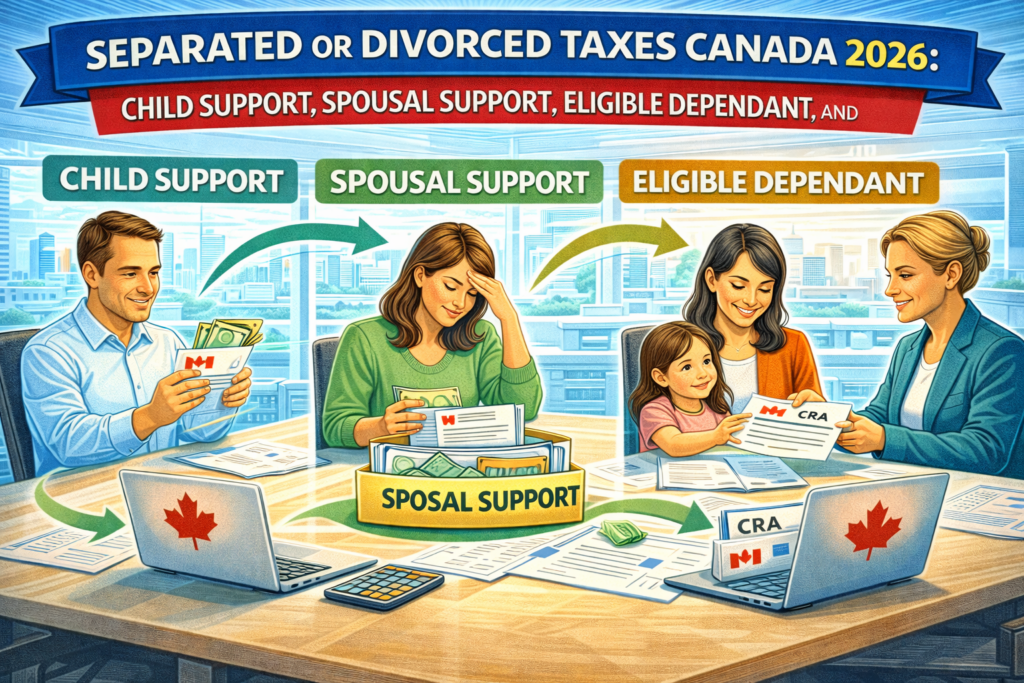
Say you finalized your separation agreement last month and now face your first tax season as a single filer. You’ll be paying spousal support, but is it deductible? And what about the child support you’re also sending? The rules aren’t intuitive, and getting them wrong can cost you thousands in missed deductions or unexpected tax bills. This guide explains how the CRA treats spousal and child support in 2026, which payments are deductible, which are taxable, and how to report everything correctly.
Quick Answer
- Spousal support is generally deductible for the payer and taxable for the recipient, if it’s paid periodically under a written agreement or court order while you live separate and apart.
- Child support under agreements or orders made on or after May 1, 1997 is neither deductible nor taxable.
- When you pay both, payments count toward child support first. You can deduct spousal support only after all child support, including arrears, is paid.
- Payers report on lines 21999 and 22000; recipients report on lines 12799 and 12800. You must also register your agreement or order with the CRA.
- Lump sums that settle future support are generally not deductible or taxable.
How Spousal Support Is Taxed in Canada
The basic tax treatment
Spousal support follows an “inclusion-deduction” system. The payer deducts the payments from income, and the recipient includes them in income. Because the recipient usually has a lower income and marginal rate, this often lowers the former couple’s combined tax bill.
For context on how this fits your wider tax picture, see how RRSP deductions work in Canada. Spousal support also affects RRSP room: support you receive counts as earned income for RRSP purposes, and deductible support you pay reduces your earned income.
Requirements for deductible spousal support
For spousal support to be deductible by the payer and taxable to the recipient, the payments generally must meet all of these conditions:
| Requirement | What it means |
|---|---|
| Payable under a court order or written agreement | Verbal arrangements don’t qualify. Payments made earlier in the same year, or the year before, can qualify only if the order or agreement says they count as payments under it. |
| Periodic | Paid on a regular schedule, such as monthly, not as a one-time lump sum |
| For maintenance, with the recipient free to use it | The recipient must have discretion over how the money is spent |
| Living separate and apart | You must be living separate and apart because of a breakdown of the relationship when the payment is made |
| Paid to a current or former spouse or common-law partner | Or, for parents who never lived together, to the other parent of your child |
If you’ve been paying support while waiting for your agreement to be signed, make sure the final agreement says those earlier payments count. Without that wording, they aren’t deductible.
What your deduction is worth
The deduction’s value depends on your marginal tax rate. The 2026 federal brackets are:
| Taxable income | Federal rate |
|---|---|
| Up to $58,523 | 14% |
| $58,523 to $117,045 | 20.5% |
| $117,045 to $181,440 | 26% |
| $181,440 to $258,482 | 29% |
| Over $258,482 | 33% |
Provincial tax is added on top. If you pay $24,000 a year in deductible spousal support and your combined federal-provincial marginal rate is 43%, the deduction saves you about $10,320 in tax. If your former spouse’s marginal rate is 30%, they pay about $7,200 in tax on it. The difference, about $3,120, is why many agreements adjust the support amount for taxes.
Spousal vs Child Support: The Tax Difference
Child support is tax-neutral
Child support paid under an agreement or court order made on or after May 1, 1997 is tax-neutral. The payer can’t deduct it, and the recipient doesn’t pay tax on it.
Before May 1997, child support followed the same inclusion-deduction system as spousal support. An older agreement that has never been changed may still follow the old rules. But if a pre-May 1997 agreement is varied to change child support, or both parties file a joint election (Form T1157), the new tax-neutral rules apply from then on.
Why the rules differ
Parliament changed the child support rules in 1997 because the old system often left the custodial parent with less after-tax support than intended. Spousal support kept the inclusion-deduction system, which shifts tax from the higher earner to the lower earner.
The priority rule: child support first
If one agreement or order covers both child and spousal support, the CRA applies payments to child support first. You can deduct spousal support only once all child support for the year, plus any overdue child support carried forward, has been paid.
Suppose your agreement requires $3,000 a month: $2,000 of child support and $1,000 of spousal support. If you pay $2,500 one month, $2,000 covers child support and only $500 counts as deductible spousal support. If you pay just $1,500, the whole amount is child support, you get no spousal support deduction, and the $500 child support shortfall carries forward. Your next payments go to that shortfall before any of them count as spousal support.
This rule doesn’t apply when child and spousal support come from different orders or agreements with different recipients.
Side-by-side comparison
| Factor | Spousal support | Child support (agreements on or after May 1, 1997) |
|---|---|---|
| Deductible for payer? | Yes, if the conditions are met | No |
| Taxable for recipient? | Yes | No |
| Lump-sum payments | Generally not deductible or taxable | Not deductible or taxable |
| Payer’s return | Line 21999 (total) and line 22000 (deductible part) | Included in total on line 21999 only |
| Recipient’s return | Line 12799 (total) and line 12800 (taxable part) | Included in total on line 12799 only |
| Affects recipient’s Canada Child Benefit? | Yes, it raises net income | No |
If you receive spousal support and the Canada Child Benefit, the support raises your net income and can reduce your CCB and other income-tested benefits. Child support doesn’t. This is worth discussing during negotiations, because a different split between spousal and child support can change both parties’ after-tax results.
Common Pitfalls and Special Cases
The lump-sum trap
A periodic payment is part of a series of payments made over time. If your agreement says you’ll pay $1,000 a month for five years, each payment is periodic and deductible.
If instead you pay $60,000 at once to settle all future spousal support, that’s generally a lump sum. It’s not deductible for you and not taxable for the recipient, even though it equals what you’d have paid over time. The CRA looks at the nature of the payment, not the math.
There’s an exception for arrears. If your agreement requires periodic payments and you later pay overdue amounts in one lump sum, those catch-up payments can still be deductible, because they relate to periodic amounts that were already owed. A recipient who receives $3,000 or more of qualifying retroactive support in one year can ask the CRA to tax it as if it had been received in the earlier years, using Form T1198.
Third-party payments
Agreements sometimes direct the payer to pay a third party, such as a mortgage lender, landlord or school, instead of the former spouse. Payments the recipient can’t freely use are generally not deductible, unless the order or agreement specifically says the payments are to be treated as support for tax purposes under the Income Tax Act. Ask your lawyer to include that wording if third-party payments are part of your arrangement.
Legal fees
| Who | Deductible? |
|---|---|
| Recipient | Legal fees to collect late support, to establish the amount of support from a current or former spouse, or to increase support can be deducted on line 22100 |
| Payer | Fees to obtain a separation or divorce, to establish, negotiate or contest support, or to settle custody or access are not deductible |
Ask your lawyer to break down invoices by purpose, because only the qualifying portion is deductible.
Pro Tip: Pay spousal support by a separate, recurring e-transfer or bank payment, not combined with child support or other expenses. A clean record of each payment, with its date and amount, makes it easy to prove the deduction and to show that child support was fully paid first.
Keep your records
The CRA can ask for proof of your payments. Keep:
- A signed copy of your separation agreement or court order
- Bank records for each payment, such as e-transfer confirmations or statements
- A log matching each payment to the amount required by the agreement
High-income earners who also make tax instalments should keep these records with their other tax files. Learn more about how income tax instalments work in Canada.
When the agreement is unclear
Ambiguity can be costly. If your agreement doesn’t clearly separate spousal support from child support, the CRA may treat the full amount as child support, which isn’t deductible. Before signing, have a tax professional review the agreement for tax wording, not only for fairness between the parties.
How to Report Support Payments on Your Return
First, register your agreement
If you’re claiming deductible support for the first time, or your agreement or order has changed, you must register it with the CRA. You do this by sending Form T1158, Registration of Family Support Payments, with a copy of the order or agreement. Without it, your deduction can be delayed or denied.
If you’re the payer
- Line 21999 – Support payments made: enter the total support you paid in the year, including child support.
- Line 22000 – Allowable deduction: enter only the deductible part, generally the spousal support. If child support wasn’t fully paid, this may be lower or zero.
For example, if you paid $18,000 in total, including $6,000 of spousal support, you’d enter $18,000 on line 21999 and $6,000 on line 22000. The amount on line 22000 reduces your net income.
Tax software such as Wealthsimple Tax or StudioTax walks you through these lines. For free filing options, see our Wealthsimple Tax review for 2026.
If you’re the recipient
- Line 12799 – Support payments received: enter the total support you received, including child support.
- Line 12800 – Taxable amount: enter only the taxable spousal support.
If you receive $18,000 of taxable spousal support and your marginal rate is 30%, you’ll owe about $5,400 more in tax. Because no tax is withheld from support, consider setting money aside or making instalment payments so the bill doesn’t surprise you in April.
Pre-1997 agreements
If you still pay child support under an agreement made before May 1997 that has never been varied, child support may still be deductible for the payer and taxable for the recipient. These agreements are now rare. Any later change to the child support amount, or a joint election on Form T1157, switches child support to the tax-neutral rules.
Quebec residents
If you live in Quebec, you file a federal return with the CRA and a provincial return with Revenu Québec. Quebec also treats spousal support as deductible for the payer and taxable for the recipient, but uses its own lines and forms. Make sure both returns are completed correctly.
Key Takeaways
- Spousal support is deductible for the payer and taxable for the recipient when paid periodically under a written agreement or court order while living separate and apart.
- Child support under agreements made on or after May 1, 1997 is tax-neutral for both parties.
- If one agreement covers both, payments go to child support first; any child support shortfall delays your spousal support deduction.
- Payers use lines 21999 and 22000; recipients use lines 12799 and 12800. Register your agreement with the CRA on Form T1158.
- Lump sums that settle future support generally aren’t deductible or taxable, but lump-sum payments of arrears can be.
- Payments before the agreement and third-party payments count only if the agreement specifically says so.
Frequently Asked Questions
Is spousal support tax deductible in Canada?
Yes, for the payer, if it’s paid periodically under a written agreement or court order while you live separate and apart, and the recipient is free to use the money. The recipient includes the payments in income. If the conditions aren’t met, the payer can’t deduct the payments and the recipient doesn’t pay tax on them.
What is the difference between spousal and child support for taxes?
Spousal support follows an inclusion-deduction model: the payer deducts it and the recipient pays tax on it. Child support under agreements made on or after May 1, 1997 is tax-neutral. If you pay both under the same agreement, payments count as child support first.
How do I report support payments on my tax return?
Payers enter the total support paid on line 21999 and the deductible spousal support on line 22000. Recipients enter the total received on line 12799 and the taxable spousal support on line 12800. Register your agreement or order with the CRA on Form T1158 and keep proof of each payment.
Are payments I made before signing the agreement deductible?
They can be. Payments made earlier in the same year, or in the year before, are deductible only if the final agreement or court order specifically says they’re considered paid under it. Ask your lawyer to include that clause.
Conclusion
Spousal and child support follow very different tax rules in Canada. Periodic spousal support under a written agreement is deductible for the payer and taxable for the recipient, while child support is tax-neutral for both. Getting the agreement wording right, registering it with the CRA, paying child support in full, keeping clear records and using the correct lines will help you claim every deduction you’re entitled to without triggering a review. For more guidance on your post-separation finances, explore the tax and planning resources at Getwealthy.
Official sources: CRA: Lines 21999 and 22000 – Support payments made; CRA: Support payments – amount you can claim or report; CRA Guide P102, Support Payments; CRA: Indexation adjustment for 2026.
Get plain-English money tips for Canadians
Join the GetWealthy newsletter and get the free Canadian Money Planner 2026 Edition (PDF). No spam, unsubscribe anytime.
Your one-stop guide to everything Canadians need to know about money. Written by the GetWealthy editorial team, based on official CRA, FINTRAC and government sources and reviewed every year.
Turn what you just read into a plan
The Canadian Money Planner keeps your budget, savings, debt and goals in one place. It's free.
Get the free 2026 Planner
Disclaimer: This article is for informational and educational purposes only and does not constitute financial, tax, or legal advice. Support arrangements and their tax treatment depend on the exact wording of your agreement or court order. Always consult a qualified family lawyer or tax professional for personalized advice.