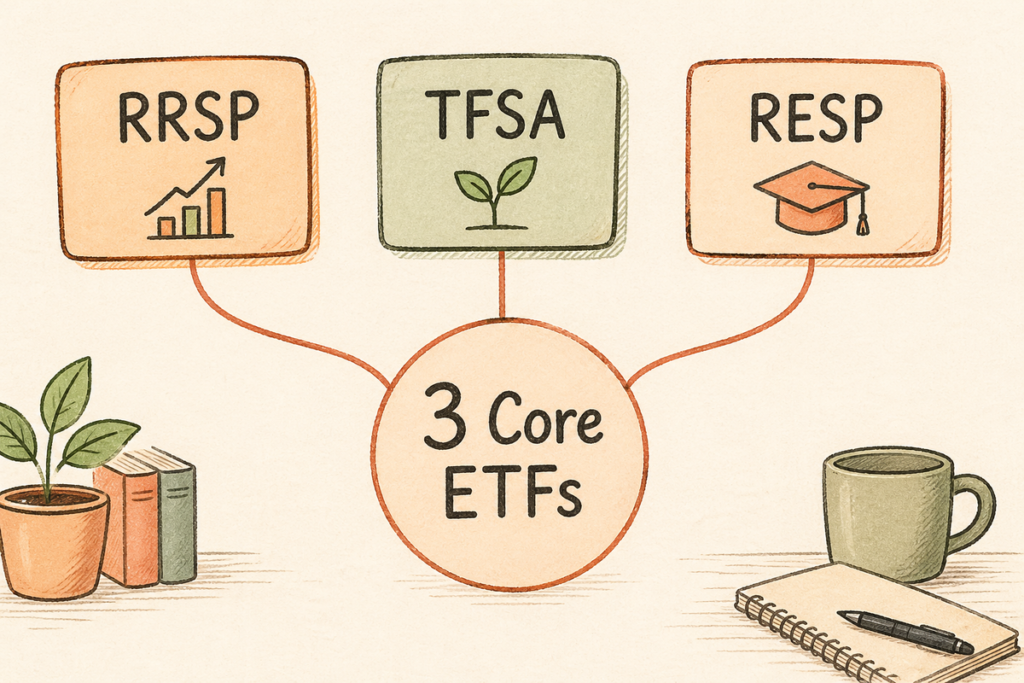
A three-fund portfolio in Canada may be the simplest serious investment plan available, and it takes about fifteen minutes to set up. While financial media obsesses over stock picks, sector rotations, and timing the next crash, decades of evidence show that most actively managed funds trail low-cost index funds after fees. A portfolio of just three broad ETFs lets you own the whole market at a tiny cost. This guide shows how to build a three-ETF portfolio with Canadian-listed funds in 2026, which funds to consider, how to set your allocation, and how to use it inside your TFSA, RRSP, or FHSA.
Quick Answer
- The structure: One Canadian equity ETF, one global ex-Canada equity ETF (U.S., international, and emerging markets), and one Canadian bond ETF.
- Popular 2026 combinations: XIC or VCN (Canadian stocks), XAW or VXC (global ex-Canada stocks), and ZAG or VAB (Canadian bonds). A typical blended cost is about 0.15% a year, or about $150 on $100,000.
- Where to hold it: TFSAs, RRSPs, and FHSAs all work, with small tweaks for account type and timeline.
- Maintenance: Rebalance once a year, or when a holding drifts more than 5 percentage points from target.
What Is a Three-Fund Portfolio and Why Does It Work in Canada?
The three-fund portfolio is exactly what it sounds like: a complete investment plan built from three broadly diversified index funds. It grew out of the low-cost indexing philosophy of Vanguard founder John Bogle and was popularized by Taylor Larimore and the Bogleheads community. The idea is simple: owning a slice of thousands of companies around the world, plus bonds for stability, captures market returns without the fees and guesswork of active management.
For Canadian investors, the classic structure is:
| Building block | What it holds | Role in the portfolio |
|---|---|---|
| Canadian equity ETF | The S&P/TSX Composite (about 210 to 220 stocks) or the S&P/TSX 60 | Home-market exposure, Canadian dollars, dividend tax credit |
| Global ex-Canada equity ETF | Thousands of U.S., international, and emerging market stocks | Most of your long-term growth and diversification |
| Canadian bond ETF | Government and investment-grade corporate bonds | Stability and income; cushions stock market drops |
The approach works because you aren’t trying to beat the market; you own it, across countries and asset classes, for a fraction of what many mutual funds charge.
Why three funds instead of one all-in-one ETF?
Asset allocation ETFs like XEQT or VBAL bundle everything into a single fund. Both approaches are valid, but the three-fund method has a few advantages:
- Customizable allocation: You decide exactly how much goes to Canadian stocks, global stocks, and bonds, instead of accepting a fund’s fixed mix.
- Tax-loss harvesting flexibility: In a taxable account, holding separate funds lets you sell one at a loss and switch to a similar, but not identical, fund.
- Slightly lower costs: A three-fund mix can cost about 0.15% a year, versus about 0.19% to 0.25% for most all-in-one ETFs.
- Account placement: You can hold bonds in your RRSP and more of your equities in your TFSA for better after-tax results.
If you want maximum simplicity and don’t mind a fixed allocation, an all-in-one ETF such as the iShares Core Equity ETF Portfolio (XEQT), which holds thousands of stocks worldwide through a handful of underlying iShares ETFs, remains an excellent choice. The three-fund approach simply gives you more control.
How to Build a Simple ETF Portfolio Canadian Beginners Can Follow
Building a three-fund portfolio comes down to four decisions: choosing your funds, setting your allocation, picking your account, and setting a rebalancing rule.
Step 1: Choose your three core ETFs
For a three-fund portfolio, you want broad coverage, low fees, and high trading volume. Here are commonly used Canadian-listed options in October 2026:
| Asset class | ETF | Index tracked | MER | Key feature |
|---|---|---|---|---|
| Canadian equity | XIC (iShares) | S&P/TSX Capped Composite | ~0.06% | Broad market, about 217 stocks |
| Canadian equity | VCN (Vanguard) | FTSE Canada All Cap Domestic | ~0.06% | Broad market, about 209 stocks |
| Canadian equity | XIU (iShares) | S&P/TSX 60 | ~0.17% | 60 largest blue chips; very liquid |
| Global ex-Canada equity | XAW (iShares) | MSCI ACWI ex Canada IMI | ~0.22% | About 8,000 stocks, including small caps and emerging markets |
| Global ex-Canada equity | VXC (Vanguard) | FTSE Global All Cap ex Canada | ~0.22% | About 10,000 stocks, including small caps and emerging markets |
| Canadian bonds | ZAG (BMO) | FTSE Canada Universe Bond | ~0.09% | Government and corporate bonds |
| Canadian bonds | VAB (Vanguard) | Bloomberg Global Aggregate Canadian Float Adjusted | ~0.09% | Similar coverage |
| Canadian bonds | XBB (iShares) | FTSE Canada Universe Bond | ~0.10% | Similar coverage |
Fees and holdings as published in fall 2026; confirm in each fund’s ETF Facts before buying.
XIC and VCN are nearly interchangeable broad-market Canadian funds, and both cost less than XIU while holding more stocks. On the global side, XAW and VXC are very similar: both cover the U.S., developed international, and emerging markets, including small caps, at the same cost. A typical combination might be XIC + XAW + ZAG or VCN + VXC + VAB.
Step 2: Set your asset allocation
Your allocation depends on your timeline and risk tolerance. Here’s a general framework:
| Investor profile | Canadian equity | Global ex-Canada equity | Bonds | Example timeline |
|---|---|---|---|---|
| Aggressive growth | 25% | 65% | 10% | 25+ years to retirement |
| Balanced growth | 25% | 50% | 25% | 15 to 25 years to retirement |
| Moderate | 20% | 40% | 40% | 10 to 15 years to retirement |
| Conservative | 15% | 25% | 60% | Under 10 years to retirement |
Even aggressive portfolios usually keep Canadian stocks to about 25% to 30% of the stock portion. Canada makes up only about 3% of global stock market value, so a heavy domestic tilt, called home bias, means missing much of the world’s growth. Some Canadian allocation still makes sense for currency matching, lower foreign withholding tax, and the dividend tax credit in taxable accounts.
If you’re unsure about your risk tolerance, an old rule of thumb is to hold your age in bonds, so a 35-year-old would hold 35% bonds. Many planners now consider that too conservative for younger investors, but it’s a reasonable starting point.
Pro Tip: Pick your allocation based on the worst drop you could live with, not the best return you hope for. In early 2020, global stocks fell more than 30% in about a month. If a 30% drop in your stock funds would make you sell, choose a mix with more bonds now, while markets are calm, so you can stay invested when they aren’t.
Step 3: Choose the right account
Where you hold your three-fund portfolio affects your taxes. A common priority order for 2026:
| Account | 2026 limit | Why it fits |
|---|---|---|
| TFSA | $7,000 new room; up to $109,000 total if eligible since 2009 | Growth and withdrawals are tax-free; ideal for higher-growth equity ETFs |
| FHSA (if buying a first home) | $8,000 a year, $40,000 lifetime | Tax-deductible contributions and tax-free withdrawals for a qualifying home |
| RRSP | 18% of 2025 earned income, up to $33,810 | Tax-deferred; a good home for bond ETFs, whose interest is taxed at your full rate |
| Non-registered | No limit | Use after registered room is full; Canadian dividends get the dividend tax credit |
Step 4: Set a rebalancing rule
Over time, your mix will drift as different assets perform differently. If stocks surge, you might end up at 80% stocks when you targeted 70%. Rebalancing means trimming what has grown and adding to what has lagged to get back to your target.
For a three-fund portfolio, rebalancing once a year is usually enough. Some investors instead rebalance whenever a holding drifts more than 5 percentage points from its target. The key is having a rule and following it, which forces you to buy low and sell high systematically.
If you’re still contributing, the easiest approach is to direct new money to whichever fund is underweight. That rebalances without selling, which avoids triggering capital gains in a taxable account.
Best Three-Fund Portfolio Canadian ETFs: A 2026 Comparison
Choosing between similar ETFs often comes down to small differences in cost and provider preference. Here are two complete combinations using a 25/50/25 balanced mix:
| Component | Option A (iShares) | Option B (Vanguard and BMO) | Difference |
|---|---|---|---|
| Canadian equity (25%) | XIC (~0.06%) | VCN (~0.06%) | Nearly identical broad-market coverage |
| Global ex-Canada equity (50%) | XAW (~0.22%) | VXC (~0.22%) | Very similar; VXC holds more stocks |
| Canadian bonds (25%) | XBB (~0.10%) | ZAG (~0.09%) | Both track the FTSE Canada Universe Bond Index |
| Blended MER | ~0.150% | ~0.148% | About $2 a year on $100,000 |
At these costs, the difference between the two is a couple of dollars a year on a $100,000 portfolio, about $150 in total fees for either. Both give excellent diversification across thousands of securities. If your brokerage offers commission-free trading on a particular provider’s ETFs, that can be a tiebreaker.
For even less maintenance, consider a hybrid: hold XEQT (an all-equity portfolio, MER about 0.19%) for your stocks and add ZAG separately for bonds. You still control your stock/bond split, while iShares handles the geographic mix inside your stock fund. The trade-off is a slightly higher cost for slightly simpler management.
Common Mistakes Canadian Beginners Should Avoid
The three-fund strategy is simple, but several pitfalls can undermine your results.
Mistake 1: Excessive home bias
Many Canadians hold 50% to 60% of their stocks in Canada. That feels comfortable, but the TSX is concentrated: in one fall 2026 breakdown of XIC, finance, materials, and energy together made up about three-quarters of the fund, and the top 10 holdings were about 38% of it. A 20% to 30% Canadian allocation provides meaningful domestic exposure without giving up global diversification. If you’re interested in dividend approaches, our comparison of dividend growth vs ETFs explores when tilting toward Canadian dividend payers makes sense.
Mistake 2: Chasing performance
Last year’s best-performing fund rarely repeats. The three-fund approach works precisely because you don’t try to predict winners; you own everything. Resist the urge to swap your global fund for a hot sector ETF.
Mistake 3: Misunderstanding foreign withholding tax
U.S. dividends face a 15% withholding tax. Holding U.S.-listed ETFs (such as VT or VTI) in an RRSP avoids that tax under the Canada–U.S. tax treaty. But Canadian-listed global funds like XAW and VXC hold U.S. stocks through underlying U.S. ETFs, so the withholding tax is lost in any account, including an RRSP. In a TFSA, the withholding tax is lost on any fund. For a diversified global ETF, this drag is roughly 0.2% to 0.4% a year, which most investors accept for the simplicity of avoiding U.S.-dollar conversions. Only optimize further if your RRSP is large.
Mistake 4: Over-rebalancing
Checking your portfolio daily and rebalancing monthly creates unnecessary trading and tax events. Set a calendar reminder once or twice a year and ignore the noise in between. The whole point of passive investing is that it’s passive.
Mistake 5: Abandoning the strategy during downturns
The 2020 crash, the 2022 bear market, and tariff-related swings in 2025 and 2026 all tested investors. Those who sold during drawdowns locked in losses; those who held, or kept contributing, benefited from the recoveries. A one-page investment policy statement that lists your allocation and rebalancing rules helps you stick to the plan when emotions run high.
Key Takeaways
- A three-fund portfolio uses one Canadian equity ETF, one global ex-Canada equity ETF, and one bond ETF to give global diversification at a blended cost of about 0.15% a year.
- Strong 2026 choices include XIC or VCN (about 0.06%) for Canada, XAW or VXC (about 0.22%) for global stocks, and ZAG, VAB, or XBB (about 0.09% to 0.10%) for bonds.
- Keep Canadian stocks to about 20% to 30% of your stock allocation, since Canada is only about 3% of world market value and the TSX is concentrated in a few sectors.
- Use registered accounts first: TFSA ($7,000 in 2026), FHSA ($8,000 if buying a first home), and RRSP (up to $33,810), with bonds often best in the RRSP.
- Canadian-listed global ETFs lose U.S. withholding tax in every account; only U.S.-listed ETFs in an RRSP avoid it.
- Rebalance annually or when a holding drifts more than 5 points, and resist adding complexity, sector bets, or market timing.
Frequently Asked Questions
What is a three-fund portfolio in Canada?
A three-fund portfolio is an investment plan built from three broadly diversified ETFs: one Canadian equity fund, one global ex-Canada equity fund covering the U.S., international, and emerging markets, and one Canadian bond fund. It captures returns across the global market at a very low cost, typically around 0.15% a year in combined fees, with no stock picking or market timing.
How do I build a three-fund ETF portfolio with Canadian ETFs?
First, choose one ETF from each category, such as XIC or VCN for Canadian stocks, XAW or VXC for global stocks, and ZAG or VAB for bonds. Second, set an allocation based on your timeline; 25% Canadian stocks, 50% global stocks, and 25% bonds is a common balanced starting point. Third, buy the ETFs through a Canadian brokerage inside your TFSA, RRSP, or FHSA. Finally, rebalance once a year or when a holding drifts more than 5 percentage points from target.
Can I use a three-fund portfolio in a TFSA or RRSP?
Yes. Both work well, and using them together is often ideal. In a TFSA, growth is tax-free, which suits higher-growth equity ETFs. An RRSP shelters bond interest that would otherwise be taxed at your full marginal rate. Many investors hold more equities in the TFSA and more bonds in the RRSP, then manage the target mix across all accounts combined.
Is a three-fund portfolio better than an all-in-one ETF like XEQT or VBAL?
Not necessarily better, just different. A three-fund portfolio costs slightly less and lets you control your mix and account placement, but it requires occasional rebalancing. An all-in-one ETF costs slightly more and rebalances automatically, which helps many investors stick with the plan. If you’re unlikely to rebalance on your own, an all-in-one ETF is usually the better choice.
Conclusion
The three-fund portfolio proves that effective investing doesn’t require complexity, expensive advice, or constant attention. Combine a Canadian equity ETF, a global ex-Canada equity ETF, and a bond ETF in the right proportions for your goals, and you capture global market returns while keeping costs low. Whether you’re making your first TFSA contribution or consolidating a larger portfolio, this approach scales well. The hardest part isn’t building the portfolio; it’s having the discipline to leave it alone and let compounding work over decades. Explore more investment strategies and Canadian guidance on GetWealthy.
Get free Canadian money tips every week
TFSA updates, CRA changes, mortgage strategies — straight to your inbox every Thursday. No spam, unsubscribe anytime.
The GetWealthy editorial team writes plain-English guides to Canadian personal finance, based on official CRA, FINTRAC and government sources and reviewed every year.
Disclaimer: This article is for informational and educational purposes only and does not constitute financial, tax, or legal advice. ETF names are examples, not recommendations; fees and holdings change. Always consult a qualified financial advisor or tax professional for personalized advice.