The Home Accessibility Tax Credit (HATC) helps seniors and people with disabilities, and the family members who support them, recover part of the cost of renovations that make a home safer and easier to live in. You can claim up to $20,000 of eligible expenses per year. At the 2026 lowest federal tax rate of 14%, that’s a credit worth up to $2,800. Timing matters: the CRA says expenses must be for work performed and goods acquired in the tax year, so to claim on your 2026 return, the work needs to be done by December 31, 2026.
Quick Answer
- The HATC is a non-refundable federal credit, claimed on line 31285, for up to $20,000 of eligible renovation expenses per year.
- For 2026, the credit is 14% of eligible expenses, so up to $2,800 in federal tax savings.
- Who it’s for: a qualifying individual who is 65 or older at the end of the year or eligible for the disability tax credit, or an eligible family member claiming for them.
- Timing: expenses must be for work performed and goods acquired in the year you claim. Work finishing in January 2027 goes on your 2027 return.
Who Can Claim the HATC?
The CRA’s line 31285 rules set out two groups:
| Group | Who it includes |
|---|---|
| Qualifying individual | Someone who is 65 or older at the end of the year, or eligible for the disability tax credit at any time in the year |
| Eligible individual (can claim for a qualifying individual) | A spouse or common-law partner, or a relative such as a parent, grandparent, child, grandchild, sibling, aunt, uncle, niece or nephew who claimed, or could have claimed, certain amounts for the qualifying individual, such as the Canada caregiver amount or the amount for an eligible dependant |
What counts as an eligible dwelling?
The home must be a housing unit in Canada that is either:
- owned, alone or jointly, by the qualifying individual and ordinarily lived in by them, or
- owned by the eligible individual and ordinarily lived in by both the eligible individual and the qualifying individual.
A share in a housing co-operative can qualify. The land the home sits on, up to half a hectare, generally counts as part of the dwelling.
What Renovations Qualify?
A qualifying renovation must be “of an enduring nature and integral to the eligible dwelling,” and must either:
- allow the qualifying individual to gain access to, or be mobile or functional within, the home, or
- reduce the risk of harm to the qualifying individual within the home or when getting into it.
| Typically eligible | Typically not eligible |
|---|---|
| Wheelchair ramps and stair lifts installed in the home | Household appliances |
| Walk-in bathtubs or wheel-in showers | Routine repairs and maintenance |
| Grab bars and handrails | Housekeeping, gardening or security monitoring services |
| Widened doorways or hallways | Electronic home-entertainment devices |
| Non-slip flooring to reduce fall risk | Financing costs |
| Lowered counters or cabinets for wheelchair use | Renovations done mainly to increase or maintain the home’s value |
An item that doesn’t become a permanent part of the home, such as a portable device, is generally not eligible.
Who does the work matters
| Who does the work | What you can claim |
|---|---|
| Professionals, such as electricians, plumbers, carpenters and architects | Their paid work generally qualifies |
| You, doing it yourself | Building materials, fixtures, equipment rentals, building plans and permits, but not the value of your own labour or tools |
| A family member | Not eligible unless that relative is registered for GST/HST |
How Much Is the Credit Worth?
You can claim up to $20,000 of eligible expenses per year for a qualifying individual. When more than one qualifying individual lives in the same home, the combined claim for that dwelling is still capped at $20,000. The claim can be split between the qualifying individual and eligible individuals, as long as the total doesn’t exceed the limit.
The HATC is calculated at the lowest federal rate, which is 14% for 2026:
| Eligible expenses in 2026 | Federal credit at 14% |
|---|---|
| $5,000 | $700 |
| $10,000 | $1,400 |
| $15,000 | $2,100 |
| $20,000 or more | $2,800 (maximum) |
Because the credit is non-refundable, it can only reduce tax you owe. If the qualifying individual has little tax payable, it may make sense for an eligible family member with more tax to claim some or all of it. There’s no provincial HATC line on the federal return, although some provinces offer their own home renovation or accessibility programs.
Combine it with other credits
If an expense also qualifies as a medical expense, the CRA says you can claim it under both the medical expense tax credit and the HATC. Government grants and forgivable loans don’t reduce the HATC claim, and reasonable vendor rebates generally don’t either.
| Example: $20,000 walk-in shower and grab bars | Federal credit |
|---|---|
| Home Accessibility Tax Credit (14% × $20,000) | $2,800 |
| Medical expense tax credit, if the items also qualify (14% × amount above the lesser of 3% of net income or $2,890) | Depends on income; up to about $2,395 if net income is $96,333 or more |
| Possible combined federal saving | Up to about $5,195, plus any provincial medical expense credit |
Illustration only. Whether an item also counts as a medical expense depends on the CRA’s medical expense rules.
Pro Tip: Ask your contractor to write the invoice so it clearly describes the accessibility purpose, such as “grab bars and wheel-in shower to reduce fall risk,” and separates it from any unrelated work, like replacing kitchen cabinets. Clear invoices make the claim easy to support and help you claim both credits where they apply.
Why Does December 31 Matter?
The CRA says eligible expenses “must be for work performed and goods acquired in the tax year.” So if your contractor finishes the work on January 10, 2027, that work belongs on your 2027 return, not your 2026 return. If you’re close to the $20,000 limit for 2026 and plan more work, splitting it across two years can let you claim more in total.
Here’s an example. Margaret, 78, lives in her own home in Regina. Her son, who claims the Canada caregiver amount for her, pays a contractor $14,000 in November 2026 to install a walk-in shower and grab bars, and the work is finished by mid-December. He can claim $14,000 on line 31285 for 2026, for a federal credit of $1,960. In spring 2027, they plan a $12,000 ramp. That work goes on the 2027 return, with its own $20,000 limit.
| Year | Work | Eligible expenses | Federal credit |
|---|---|---|---|
| 2026 | Walk-in shower and grab bars, finished in December | $14,000 | $1,960 |
| 2027 | Wheelchair ramp, built in spring | $12,000 | About $1,680, if the lowest rate stays at 14% |
| Total | $26,000 | About $3,640 |
If they had done all $26,000 of work in one year, the claim would have been capped at $20,000, for a credit of $2,800.
Keep the right documents
Don’t send receipts with your return, but keep them in case the CRA asks. Invoices and receipts should show:
- the vendor’s name, business address and GST/HST number, if applicable
- a description of the goods and work
- the date the goods were delivered or the work was done
- the address of the home
- the amount, and proof of payment such as a credit card slip or cancelled cheque
Budget 2026 proposal for future years
Budget 2026, tabled November 5, 2026, proposes an optional one-time flat claim of $1,000 under the HATC that an eligible person could use instead of itemizing expenses, as part of a wider set of simplified flat-rate options. Some documentation would still be needed. This is a proposal, and it doesn’t affect your 2026 claim, so keep your full receipts.
For other home-related help, see our guide to energy retrofit grants in Canada, and our article on retirement income planning for seniors budgeting for home changes.
Key Takeaways
- The HATC lets you claim up to $20,000 of eligible renovation expenses per year on line 31285.
- For 2026, the credit is 14%, worth up to $2,800 in federal tax savings.
- The renovation must improve access or mobility, or reduce the risk of harm, for someone 65 or older or eligible for the disability tax credit.
- Expenses must be for work performed and goods acquired in the tax year, so finish 2026 work by December 31, 2026; splitting large projects across two years can raise the total claim.
- Appliances, routine repairs, financing costs and renovations mainly to boost value don’t qualify.
- Keep detailed invoices and proof of payment; eligible items may also qualify as medical expenses.
Frequently Asked Questions
How much is the Home Accessibility Tax Credit for 2026?
It’s 14% of up to $20,000 in eligible expenses, so up to $2,800 in federal tax savings.
Can I claim the HATC for my parent’s home?
Possibly. If you’re an eligible relative who claimed, or could claim, amounts such as the Canada caregiver amount for your parent, and the home is an eligible dwelling, you may be able to claim. Check the CRA’s line 31285 rules.
Does the work have to be paid by December 31?
The CRA’s test is that expenses are made or incurred in the year, for work performed and goods acquired in that year. Keep proof of payment either way, because the CRA can ask for it.
Can I claim the HATC and the medical expense credit for the same item?
Yes. The CRA says an expense that qualifies for both can be claimed under both credits.
Can my parent and I both claim the HATC?
Yes, you can split the claim between the qualifying individual and eligible family members, but the total for the home can’t exceed $20,000 for the year. It often makes sense for the person with the most tax payable to claim it, since the credit is non-refundable.
Conclusion
The Home Accessibility Tax Credit can return up to $2,800 on $20,000 of 2026 renovations that make a home safer for a senior or a person with a disability. The key rules are simple: the work must be enduring, improve access or safety, and be performed in the year you claim. If you’re planning work now, finish it by December 31 to use 2026’s limit, think about splitting larger projects across two years, and keep detailed receipts. To budget for home changes and other big costs, try the free planner below.
Canadian Money Planner 2026 Edition (free) Budget, savings, debt and goals in one place. Get the free planner.
Official sources: CRA: Line 31285 – Home accessibility expenses; CRA: Federal income tax rates for 2026; Department of Finance Canada: Budget 2026 Tax Measures.
Get plain-English money tips for Canadians
Join the GetWealthy newsletter and get the free Canadian Money Planner 2026 Edition (PDF). No spam, unsubscribe anytime.
Your one-stop guide to everything Canadians need to know about money. Written by the GetWealthy editorial team, based on official CRA, FINTRAC and government sources and reviewed every year.
Turn what you just read into a plan
The Canadian Money Planner keeps your budget, savings, debt and goals in one place. It's free.
Get the free 2026 Planner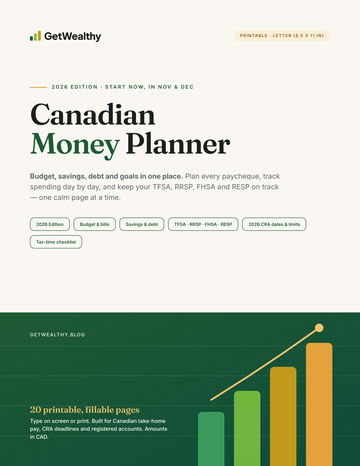
Disclaimer: This article is for informational and educational purposes only and does not constitute financial, tax, or legal advice. Always consult a qualified financial advisor or tax professional for personalized advice.