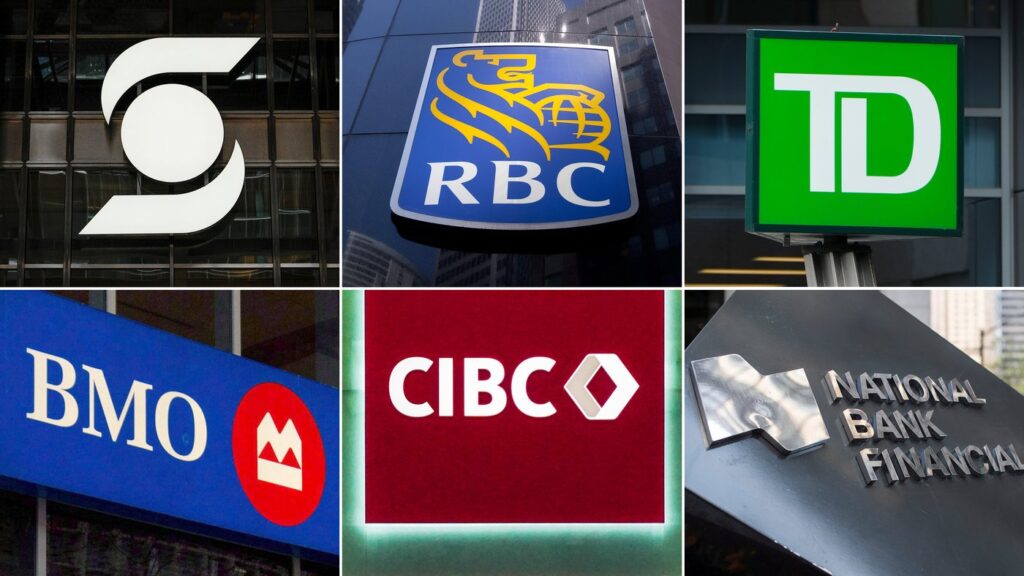
Canadian bank stocks vs bank ETFs is one of the most common choices dividend investors face, because the Big Six banks are a core holding in so many Canadian portfolios. Royal Bank, TD, Scotiabank, BMO, CIBC, and National Bank have each paid dividends for more than a century, and BMO’s record dates back to 1829. Their payouts are eligible dividends for the dividend tax credit. But owning one or two banks means betting on their specific management, regulators, and mistakes. A bank ETF spreads that risk across all six for a small annual fee. This guide compares 2026 yields, costs, taxes, and risks so you can decide which approach fits your portfolio.
Quick Answer
- Yields: In late September 2026, Big Six dividend yields ranged from about 2.5% (RBC, National Bank) to about 3.5% (Scotiabank).
- ETF option: BMO Equal Weight Banks Index ETF (ZEB) holds all six in roughly equal amounts, has a 0.28% MER, pays monthly, and showed an annualized distribution yield of about 2.4%.
- Do-it-yourself option: Buying all six banks yourself avoids the fee but takes more money, more trades, and regular rebalancing.
- Sector risk stays: Neither option removes sector risk. Banks tend to fall together in recessions and housing slowdowns, so cap your total bank exposure.
How Do the Big Six Bank Dividends Compare in 2026?
Bank yields change every day with share prices. The quarterly dividends below are the most recent declared amounts. The yields are approximate as of September 25, 2026. Check current numbers before you buy.
| Bank | Approx. yield (Sept. 25, 2026) | Quarterly dividend | Annual dividend | Implied share price |
|---|---|---|---|---|
| Scotiabank (BNS) | 3.5% | $1.14 | $4.56 | ~$130 |
| BMO (BMO) | 2.8% | $1.71 | $6.84 | ~$244 |
| TD (TD) | 2.7% | $1.12 | $4.48 | ~$166 |
| CIBC (CM) | 2.7% | $1.07 | $4.28 | ~$159 |
| Royal Bank (RY) | 2.5% | $1.76 | $7.04 | ~$282 |
| National Bank (NA) | 2.5% | $1.32 | $5.28 | ~$211 |
Implied price = annual dividend ÷ yield. The dividends come from each bank’s 2026 declarations.
Yields are lower than in recent years because bank share prices rose strongly. BMO reported a one-year return of about 53% for ZEB to August 31, 2026, and its 52-week trading range of roughly $52 to $79 per unit shows the size of the climb. When prices rise faster than dividends, yields fall.
Why bank dividends appeal to Canadians
- Dividend tax credit: In a non-registered account, eligible dividends from Canadian companies are taxed far more lightly than interest. In Ontario, an investor earning about $80,000 pays a combined marginal rate of roughly 6.39% on eligible dividends versus 29.65% on GIC interest.
- Long payment history: The Big Six did not cut their regular dividends during the 2008 financial crisis or the 2020 pandemic. OSFI did freeze dividend increases from March 2020 to November 2021.
- Regulated oligopoly: A few banks dominate Canadian banking, which supports steady profits.
For a broader look at income stocks, see our guide to TSX dividend leaders through trade war shocks.
Dividend growth matters as much as yield
The 2026 dividend round showed how much growth can differ. In May 2026, RBC raised its quarterly dividend by 12 cents (about 7%) to $1.76, National Bank by 8 cents to $1.32, and BMO and Scotiabank each by 4 cents. That is why yield alone is a poor guide.
Consider $10,000 in each of two banks:
| Year | Bank A: 2.5% yield, dividend grows 6%/yr | Bank B: 3.5% yield, no growth |
|---|---|---|
| 1 | $250 | $350 |
| 4 | $298 | $350 |
| 7 | $355 | $350 |
| 10 | $422 | $350 |
| Cumulative after 12 years | ~$4,217 | $4,200 |
Bank A’s annual payout passes Bank B’s in year seven, and its total income catches up around year twelve, before counting any share price growth that usually comes with rising dividends. When you compare banks, look at five- and ten-year dividend growth, the payout ratio (the share of earnings paid as dividends), and capital strength, not just today’s yield.
An equal-weight ETF captures the average dividend growth of all six banks. You will never own only the fastest grower, but you will never own only the laggard either. For most long-term investors, that trade-off is the point.
Pro Tip: Before buying any bank ETF, add up the bank exposure you already own. If you hold a broad TSX index fund like XIC or VCN, roughly a third of it is already in financials, mostly the Big Six. Many investors who think they need a bank ETF already have plenty of bank exposure.
What Is Single-Stock Risk in Canadian Banks?
Even strong banks can stumble alone. Single-stock risk is the chance that one company has a problem the others do not.
Recent history shows how real this is. In October 2024, TD pleaded guilty to U.S. anti-money-laundering failures, agreed to pay about US$3 billion in penalties, and accepted an asset cap on its U.S. retail banking business that limits growth there. TD’s share price lagged its peers badly afterwards. An investor holding only TD felt the full hit. An investor holding an equal-weight bank ETF felt about one-sixth of it.
Other bank-specific risks include:
- Acquisitions: Large deals, such as BMO’s purchase of Bank of the West or National Bank’s purchase of Canadian Western Bank, can take years to pay off.
- Geographic bets: Scotiabank’s large Latin American exposure and BMO’s and TD’s U.S. operations behave differently from purely Canadian banking.
- Loan books: Banks with more exposure to Canadian mortgages, commercial real estate, or specific industries can see higher credit losses in a downturn.
- Dividend policy: Banks raise dividends at different speeds, as the uneven 2026 increases above show.
Sector risk does not go away with an ETF
A bank ETF solves single-stock risk, but all six banks still share Canadian economic risk. A housing slump, rising unemployment, or a credit crisis can push every bank lower at once. In the early 2020 pandemic sell-off, Canadian bank stocks fell together by well over 20% in a matter of weeks, and an equal-weight ETF offered no shelter. That is why diversifying beyond banks matters. Our guide on what diversification means in investing explains how to spread risk across sectors and countries.
Canadian Bank Stocks vs Bank ETFs: Costs, Taxes, and Convenience
Here are the main ways to get Big Six exposure and how they compare.
| Option | Annual cost | Holdings | Best for |
|---|---|---|---|
| Own all six banks directly | No fund fee; commissions if your broker charges them | Six stocks, your weights | Larger portfolios and hands-on investors |
| BMO Equal Weight Banks (ZEB) | 0.28% MER (0.25% management fee) | Big Six, equal-weighted, rebalanced | Simple, low-cost bank exposure |
| Hamilton Canadian Bank Equal-Weight (HEB) | 0.19% management fee | Big Six, equal-weighted | Cost-focused investors |
| iShares S&P/TSX Capped Financials (XFN) | About 0.61% MER | Banks plus insurers and other financials | Broader financial sector exposure |
| BMO Covered Call Canadian Banks (ZWB) | About 0.72% MER | Banks with call options written on them | Higher monthly cash flow, capped upside |
Fees as published in fall 2026; check each fund’s latest ETF Facts before buying.
The cost of owning all six yourself
Buying the six banks directly costs nothing ongoing if your broker offers commission-free trades. But you need enough money to build meaningful positions. Based on the late-September 2026 figures, share prices ranged from roughly $130 (Scotiabank) to about $280 (Royal Bank). Buying one share of each costs about $1,190, and holding $3,000 to $5,000 in each bank means $18,000 to $30,000 in total. Keeping the weights equal also means rebalancing as prices drift apart. Fractional shares, offered by some Canadian brokers, make this easier with smaller amounts.
The fee savings are real but modest:
| Bank holding | ZEB fee at 0.28% MER |
|---|---|
| $10,000 | ~$28 a year |
| $20,000 | ~$56 a year |
| $100,000 | ~$280 a year |
For many investors, that is a fair price for automatic diversification and rebalancing.
Tax differences between stocks and ETFs
- Dividend tax credit: Both direct shares and bank ETF distributions mostly flow through as eligible Canadian dividends, so the credit applies in non-registered accounts. Your T3 slip (ETF) or T5 slip (shares) shows the amounts.
- Capital gains distributions: ETFs can distribute capital gains after rebalancing, usually in December. These are taxable in non-registered accounts even if they are reinvested.
- Return of capital: Some ETF distributions include return of capital, which lowers your adjusted cost base. Track it for tax purposes.
- Covered call ETFs: Option premiums are often taxed as capital gains and distributions are higher (ZWB’s trailing yield is above 5%), but you give up some upside when bank stocks rise quickly.
Which account should you use?
Canadian bank dividends are tax-efficient in a non-registered account thanks to the dividend tax credit. In an RRSP, the credit is lost and withdrawals are taxed as regular income. In a TFSA, dividends and growth are completely tax-free, which works well for most people. The 2026 TFSA annual limit is $7,000, and cumulative room reaches $109,000 for someone who was 18 or older and resident in Canada since 2009. If your TFSA and RRSP are full, see our guide to investing after your registered accounts are maxed out.
Which Should You Choose?
Choose a bank ETF if:
- You are investing less than about $20,000 in banks, or adding money monthly.
- You want to avoid picking winners and losers.
- You value automatic rebalancing and monthly distributions.
Choose individual bank stocks if:
- You have a large non-registered portfolio and want to avoid fund fees and year-end capital gains distributions.
- You want control over which banks you own, or want to tilt toward particular regions.
- You are comfortable rebalancing and following quarterly results.
- You want to use dividend reinvestment plans (DRIPs), which some banks offer, sometimes at a small discount to the market price.
How much bank exposure is enough?
Financials make up roughly a third of the S&P/TSX Composite, so a broad Canadian index ETF already gives you significant bank exposure. Adding a bank ETF on top can push your portfolio far into one sector. Many investors keep total bank exposure, including what sits inside their broad funds, to around 10% to 20% of the whole portfolio. Pick a target and check it once a year. If banks have run up past your target, direct new contributions to other sectors instead of selling, which avoids triggering capital gains in a taxable account.
Key Takeaways
- Big Six yields ranged from about 2.5% to 3.5% in late September 2026; check live yields before buying.
- Quarterly dividends now range from $1.07 (CIBC) to $1.76 (RBC), and 2026 increases varied widely between banks.
- ZEB holds all six banks equally for a 0.28% MER, about $28 a year per $10,000 invested.
- Single-stock risk is real: TD’s 2024 U.S. penalties and asset cap hit TD-only holders far harder than equal-weight ETF holders.
- An ETF does not protect against sector risk; all six banks fell sharply together in early 2020.
- Hold bank dividends in a TFSA for tax-free growth, or in a non-registered account to use the dividend tax credit.
- Count the bank exposure inside your broad Canadian index fund before adding more.
Frequently Asked Questions
Is it better to buy Canadian bank stocks or a bank ETF?
For most investors, a bank ETF is the simpler choice because it spreads risk across all six banks for a small fee. Individual stocks can make sense for large portfolios where avoiding fees and capital gains distributions matters more. Either way, keep banks to a reasonable share of your total portfolio.
Which Canadian bank pays the highest dividend in 2026?
By yield, Scotiabank was highest among the Big Six at about 3.5% in late September 2026. By dollar amount per share, Royal Bank pays the most at $1.76 a quarter. Yields change daily with share prices, and a higher yield can also signal that investors see more risk.
Do bank ETF distributions get the dividend tax credit?
Yes. The portion that comes from Canadian bank dividends is generally reported as eligible dividends and qualifies for the dividend tax credit in a non-registered account. Your T3 slip shows the breakdown. Any return of capital or capital gains portion is taxed differently.
Are covered call bank ETFs worth it?
They pay more monthly income, but they cap your gains when bank stocks rise and usually charge higher fees. In a strong year for banks, like the year to August 2026, a covered call ETF will typically trail a plain bank ETF. They suit investors who need cash flow now more than long-term growth. Compare total returns, not just yields.
How much money do I need to start investing in bank stocks?
You can buy a bank ETF like ZEB for the price of one unit, about $73 in early October 2026. Buying one share of each Big Six bank costs about $1,190, and a balanced position in each takes much more. Fractional shares at some brokers lower the entry point.
Should I hold bank stocks in my RRSP?
You can, but you lose the dividend tax credit, and every dollar you eventually withdraw is taxed as ordinary income. For most investors, a TFSA or non-registered account is a better home for Canadian dividend payers, while an RRSP is better for U.S. stocks and interest-paying investments.
Conclusion
Canadian bank stocks vs bank ETFs comes down to cost, control, and convenience. Owning all six banks yourself avoids fees but takes more money and effort. A low-cost equal-weight ETF like ZEB or HEB removes single-stock risk for a modest fee. Neither protects you from a broad banking downturn, so size your bank holdings within a diversified plan. Use your TFSA or a non-registered account to keep more of those dividends. Review your total bank exposure this month and choose the approach you will stick with.
Get plain-English money tips for Canadians
Join the GetWealthy newsletter and get the free Canadian Money Planner 2026 Edition (PDF). No spam, unsubscribe anytime.
Your one-stop guide to everything Canadians need to know about money. Written by the GetWealthy editorial team, based on official CRA, FINTRAC and government sources and reviewed every year.
Turn what you just read into a plan
The Canadian Money Planner keeps your budget, savings, debt and goals in one place. It's free.
Get the free 2026 Planner
Disclaimer: This article is for informational and educational purposes only and does not constitute financial, investment, or tax advice. Yields, fees, and prices change daily. Past performance does not guarantee future results. Always consult a qualified financial advisor before investing.