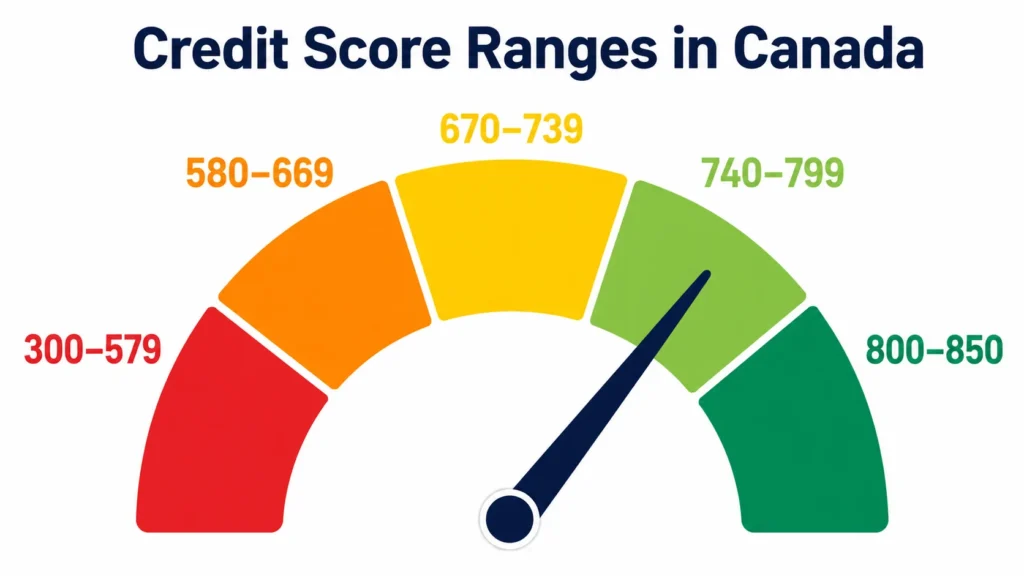
The credit score needed for a mortgage in Canada depends on which kind of lender you use. For a mortgage insured by CMHC, at least one borrower needs a score of 600 or higher, but many big banks look for 680 or more before offering their best rates. If your score is lower, alternative “B-lenders” and private lenders can still approve you, at a higher cost. Knowing where your score fits can save you thousands of dollars in interest and help you pick the right path. This guide explains the 2026 score ranges for prime, B-lender, and private mortgages, what each really costs, and how to move up a tier.
Quick Answer
- CMHC-insured mortgages (less than 20% down) require at least one borrower or guarantor with a credit score of 600 or higher.
- Big banks and other prime lenders often want 680+ for their best terms, especially on uninsured mortgages with 20% or more down.
- B-lenders often accept scores from the mid-500s to the 600s, usually with at least 20% down, rates about 1% to 3% higher, and a lender fee of 1% to 2%.
- Private lenders focus on equity, not score, but charge the highest rates (often 8% to 15%) and fees. They are a short-term bridge, not a long-term plan.
What Credit Score Do You Need for Each Type of Mortgage?
Canadian credit scores from Equifax and TransUnion range from 300 to 900. Lenders look at your score together with your income, debt ratios, down payment, and the property itself. Here is how the main lender tiers compare in 2026.
| Lender type | Typical minimum score | Down payment | Cost vs. prime-lender rates | Typical term |
|---|---|---|---|---|
| Prime (banks, credit unions, monoline lenders), insured | 600 (CMHC minimum); many lenders want 650 to 680+ | 5% on the first $500,000, 10% on the portion up to $1.5M | Best rates available | 1 to 10 years |
| Prime, uninsured | Often 680+ | 20% or more | Near the best rates | 1 to 10 years |
| B-lender (alternative lenders, many trust companies) | Often mid-500s to 600s | Usually 20% or more | About 1% to 3% higher, plus a 1% to 2% fee | 1 to 3 years |
| Private lender or MIC | Flexible; equity matters most | Often 25% to 35% or more | Often 8% to 15%, plus total fees of about 3% to 6% | 6 to 24 months |
These are typical ranges, not rules. Each lender sets its own policy, and a strong file with a slightly lower score can still be approved.
Prime lenders and CMHC rules
If you put down less than 20%, your mortgage must be insured. CMHC requires at least one borrower or guarantor to have a minimum score of 600, and can use alternative ways to show creditworthiness for borrowers with no credit history, such as newcomers. Insured mortgages are available on homes priced under $1.5 million, carry debt-service limits of 39% gross debt service (GDS) and 44% total debt service (TDS), and require you to qualify at the greater of your contract rate plus 2% or 5.25%. First-time buyers and buyers of new builds can choose a 30-year amortization on an insured mortgage.
Meeting CMHC’s minimum does not guarantee approval. Many lenders add their own “overlays” with higher score floors. A broker may find a lender that accepts 600 to 640, but your options grow a lot once you cross 680.
B-lenders
B-lenders, also called alternative lenders, serve people who do not fit bank rules: bruised credit, recent consumer proposals, self-employed income that is hard to document, or high debt ratios. Many are federally or provincially regulated trust companies. Federally regulated lenders still apply the OSFI stress test on uninsured loans, so you qualify at the greater of your contract rate plus 2% or 5.25%. Most cap the loan at 80% of the home’s value on a primary residence.
B-lender mortgages typically use one- to three-year terms. The idea is to repair your credit, then move to a prime lender at renewal.
Private lenders
Private lenders, including mortgage investment corporations (MICs), care most about the equity in the property and your exit plan. They are not bound by the OSFI stress test. Industry pricing in 2026 commonly puts private mortgage rates at about 8% to 15%, with second mortgages at the higher end. Lender fees of 1% to 4% and broker fees of 1% to 2%, plus legal and appraisal costs, can push one-time costs to roughly 3% to 6% of the loan. Terms are usually 6 to 24 months and often interest-only.
How Much Does a Lower Credit Score Really Cost?
Your score affects more than approval. It decides your rate, your fees, and how much you can borrow. Consider a $500,000 mortgage with a 25-year amortization:
| Tier | Example rate | Monthly payment | Upfront fees | Interest paid over 2 years |
|---|---|---|---|---|
| Prime lender | 4.2% | ~$2,685 | Usually none | ~$40,700 |
| B-lender | 6.0% | ~$3,199 | ~$5,000 to $10,000 (1% to 2%) | ~$58,200 |
| Private lender (interest-only) | 8.5% | ~$3,542 | ~$15,000 to $30,000 (3% to 6%) | ~$85,000, with no principal repaid |
Payments for prime and B-lender examples use Canadian semi-annual compounding. Example rates are for illustration only.
The jump from prime to B-lender in this example costs about $514 a month, or more than $6,100 a year. Over a two-year B-lender term, that is over $12,300 in extra payments plus the lender fee, and about $17,500 more of your payments go to interest. This is why moving up even one tier is worth real effort.
Pro Tip: Card issuers usually report your balance to the bureaus on your statement date, not your payment due date. If you are a few points below a cutoff like 600 or 680, pay your cards down a few days before the statement date, wait for the new balance to appear on your Equifax and TransUnion reports, then ask your lender or broker to pull your credit again. Lower reported utilization can be enough to move you into a better tier.
Rate context in 2026
With the Bank of Canada’s policy rate at 2.25% after its September 2, 2026 hold, the prime rate at major banks is 4.45%, which drives variable-rate pricing. Fixed mortgage rates follow Government of Canada bond yields instead, so they can change between Bank of Canada announcements. The Bank’s next decisions are on October 28 and December 9, 2026. Rates at every tier move with these markets, so get current quotes rather than relying on any example.
Other factors that matter as much as your score
- Payment history: Recent missed payments, collections, or a bankruptcy weigh heavily, even with a decent score.
- Credit depth: Lenders often like to see at least two trade lines, such as a credit card and a loan, with two years of history.
- Debt ratios: A big car loan or credit card balances can block approval even with a 750 score.
- Down payment source: Lenders verify where your down payment came from, usually over the past 90 days.
- Employment stability: Most lenders prefer at least two years in the same field. Self-employed borrowers usually need two years of tax returns and Notices of Assessment.
How to Raise Your Credit Score Before Applying
If you are close to a tier cutoff, a few months of focused work can pay off. These steps usually help most:
- Check both credit reports. Get your free reports from Equifax Canada and TransUnion Canada. Dispute errors, such as accounts that are not yours or paid debts still showing as owing. The Financial Consumer Agency of Canada explains how to order and correct your reports.
- Pay every bill on time. Payment history is the biggest factor. Set up automatic minimum payments so nothing slips.
- Lower your credit utilization. Keep balances below 30% of each card’s limit, and ideally below 10% before you apply. Paying down a $4,000 balance on a $5,000 limit can lift your score noticeably within a billing cycle or two.
- Avoid new credit. Each hard inquiry can dip your score slightly and stays on your report for up to three years. New accounts also lower your average account age. Hold off on car loans and new cards until after closing.
- Keep old accounts open. Closing your oldest card can shorten your credit history and raise utilization.
- Build credit if you are new. A secured credit card or small credit-builder loan, used lightly and paid in full, can establish a score within months.
Paying down debt can cut into your savings, so balance credit repair with a cushion. Our guide on building an emergency fund explains how to keep a safety net while you work on your score.
How long serious credit issues stay on your report
| Item | Equifax | TransUnion |
|---|---|---|
| Late payments | Up to 6 years from the date reported | 6 years from the date of default |
| Collections | 6 years from first delinquency | About 6 years |
| First bankruptcy | 6 years after discharge (7 years from filing if not discharged) | 6 or 7 years after discharge, depending on province |
| Second bankruptcy | 14 years after discharge | 14 years after discharge |
| Consumer proposal | 3 years after completion or 6 years from filing, whichever is first | 3 years after completion or 6 years from filing, whichever is first |
| Hard inquiries | Up to 3 years | Up to 3 years |
Many prime lenders will consider you about two years after a discharged bankruptcy or completed proposal if you have rebuilt your credit since. Paying a consumer proposal off early can shorten how long it stays on your report.
Which Mortgage Option Fits Your Situation?
Use your score and situation to decide where to start.
| Your score | Where to start | What to watch |
|---|---|---|
| 680 or higher | Prime lenders: banks, credit unions, monolines via a broker | You have negotiating power; ask for rate matches |
| 600 to 679 | Insured prime mortgage through a lender with lower overlays | Fewer lender choices; a strong co-borrower can help |
| Below 600 | B-lender with 20%+ down, or 6 to 12 months of credit repair first | Insured mortgages need a co-borrower or guarantor at 600+ |
| Urgent need, weak credit | Short-term private mortgage | Get a written exit plan and full fee breakdown |
Score of 680 or higher: Shop prime lenders and compare banks, credit unions, and monoline lenders through a broker.
Score of 600 to 679: You can likely get an insured mortgage, but your lender choice may be narrower. A mortgage broker can find lenders with lower score overlays, and a co-signer or guarantor with strong credit may help.
Score below 600: Insured mortgages are generally out of reach unless a co-borrower or guarantor meets the 600 minimum. Look at B-lenders with 20% or more down, or spend six to twelve months raising your score first. If you are a newcomer with little Canadian history, read our guide on newcomer mortgage down payment rules, since some programs accept foreign credit reports or alternative proof of credit.
Urgent need with weak credit: A private mortgage can solve a short-term problem, such as stopping a power of sale or bridging until credit repair is done. Only take one with a clear, written exit plan and a full breakdown of fees. Ask whether there is a prepayment penalty and what happens at maturity.
Using a co-signer or guarantor
Because CMHC needs only one borrower or guarantor at 600 or higher, adding a parent or partner with strong credit can open insured options. A guarantor is fully responsible for the debt if you miss payments, and the mortgage appears on their credit report and affects their own borrowing. Make sure everyone gets independent legal advice and understands how to remove the guarantor later, usually at renewal once your credit improves.
Official sources: FCAC: Mortgages. Rules, limits and rates can change, so confirm current details with the source or your financial institution.
Key Takeaways
- CMHC-insured mortgages need at least one borrower or guarantor with a credit score of 600 or more.
- Many prime lenders want 680+ for their best rates, so aim for that before applying if you can.
- B-lenders often accept scores in the mid-500s to 600s with 20% down, but expect rates 1% to 3% higher and a 1% to 2% fee.
- Private mortgages commonly cost 8% to 15% plus 3% to 6% in fees; use them only as a short bridge.
- On a $500,000 mortgage, moving from 4.2% to 6.0% costs about $514 a month.
- Lower card balances below 30% of limits and dispute report errors to lift your score fastest.
- A completed consumer proposal drops off 3 years after completion (or 6 years from filing, if sooner).
Frequently Asked Questions
What is the minimum credit score for a mortgage in Canada?
For an insured mortgage, CMHC requires at least one borrower or guarantor to have a score of 600. Many lenders set their own minimums higher, often around 680. B-lenders and private lenders may approve lower scores with a larger down payment.
Can I get a mortgage with a 550 credit score in Canada?
Possibly, but usually not from a big bank. B-lenders and private lenders may approve a 550 score if you have at least 20% down, stable income, and a good explanation for past credit problems. Expect a higher rate and fees.
Which credit score do Canadian mortgage lenders use?
Most lenders pull reports from Equifax, TransUnion, or both. The score in a free app may differ slightly from the one a lender sees. Check both bureaus before you apply.
Does getting pre-approved hurt my credit score?
A pre-approval usually involves a hard inquiry, which can lower your score by a few points for a short time. Mortgage inquiries made within a short window are often treated as one. Avoid applying for other credit at the same time.
How long should I wait after a consumer proposal to apply?
Many prime lenders want about two years of re-established credit after a proposal is completed. B-lenders may consider you sooner, sometimes while the proposal is still being paid. Rebuilding with a secured card and on-time payments shortens the wait.
Are B-lender mortgages bad?
Not necessarily. Many B-lenders are regulated trust companies, and a one- to three-year B-lender mortgage can be a sensible stepping stone. The cost is the higher rate and fee, so treat it as temporary and work on your credit so you can move to a prime lender at renewal.
Conclusion
The credit score needed for a mortgage in Canada starts at 600 for CMHC-insured loans, but 680 or more unlocks the best rates. Below that, B-lenders and private lenders can help, at a price that can add thousands each year. Check both credit reports, lower your card balances, and pay every bill on time to move up a tier. If you use a B or private lender, plan your path back to prime from day one. Talk to a licensed mortgage broker to see which lenders fit your score.
Get free Canadian money tips every week
TFSA updates, CRA changes, mortgage strategies — straight to your inbox every Thursday. No spam, unsubscribe anytime.
The GetWealthy editorial team writes plain-English guides to Canadian personal finance, based on official CRA, FINTRAC and government sources and reviewed every year.
Disclaimer: This article is for informational and educational purposes only and does not constitute financial, mortgage, or legal advice. Lender policies and rates change often. Always consult a licensed mortgage professional for advice about your situation.