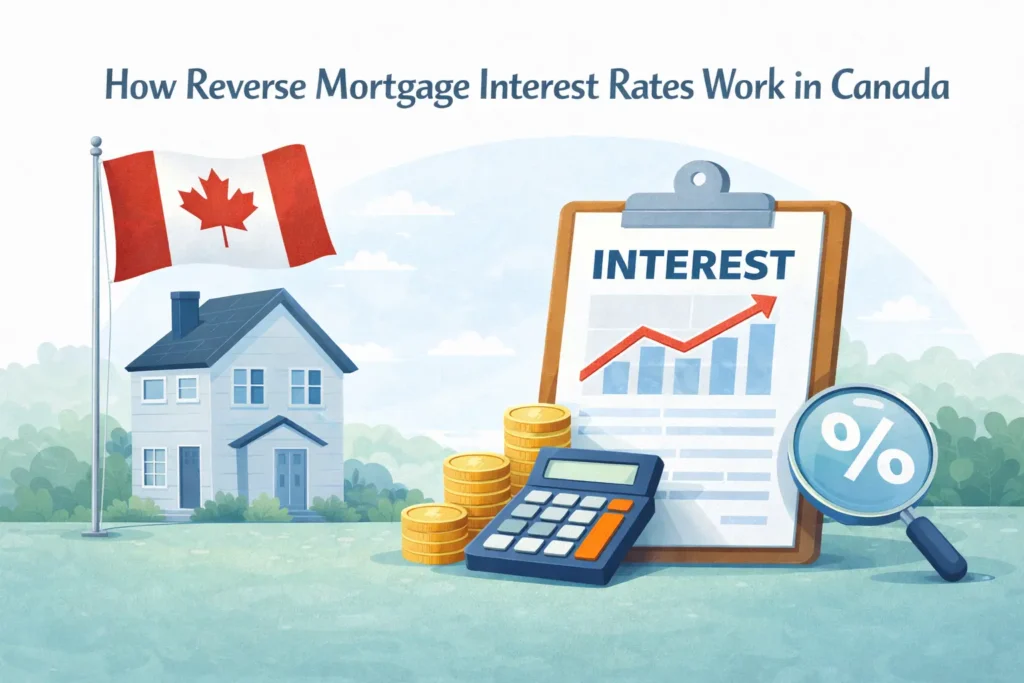
A reverse mortgage in Canada lets homeowners aged 55 and older turn part of their home equity into tax-free cash without making monthly payments. The best-known option is the CHIP Reverse Mortgage from HomeEquity Bank, but it is not cheap. In October 2026, CHIP’s posted five-year fixed rate is 7.54%, compared with a bank prime rate of 4.45%. Interest compounds on a balance you never pay down, so the loan can grow quickly. This guide explains what CHIP really costs, the risks to your estate, and the alternatives seniors should compare first.
Quick Answer
- How it works: Canadians 55+ can borrow up to 55% of their home’s appraised value with the standard CHIP product, with no monthly payments. The loan is repaid when you sell, move out permanently, or die.
- Cost in October 2026: CHIP’s posted 5-year fixed rate is 7.54% (CHIP Max is 8.54%), plus a setup fee of about $1,795 to $2,995, an appraisal, and independent legal advice.
- Compounding is the big risk: A $200,000 balance at 7.54% roughly doubles in about 10 years, so compare a HELOC, downsizing, property tax deferral, and government benefits before signing.
How Does a Reverse Mortgage Work in Canada?
A reverse mortgage is a loan secured by your home. Unlike a regular mortgage, you do not make monthly payments. Interest is added to the balance, and the full amount comes due when the last borrower sells the home, moves out permanently, or passes away. You keep ownership and title of your home the whole time, and you remain responsible for property taxes, home insurance, and keeping the home in good repair.
The money you receive is a loan, not income. It is not taxable, and it does not reduce Old Age Security (OAS) or the Guaranteed Income Supplement (GIS). That is one reason reverse mortgages appeal to retirees who are “house rich and cash poor.”
Who qualifies
To qualify for a CHIP Reverse Mortgage, every person on title must be at least 55 years old, and the home must be your principal residence. Lenders look mainly at your age (older borrowers can access more), the appraised value of your home, and its location and type. Your income and credit score matter far less than with a regular mortgage, because no payments are required.
HomeEquity Bank says the standard CHIP product lends up to 55% of the home’s appraised value, with a minimum home value of $250,000. CHIP Max can go higher, up to about 59% (and more through some brokers), with a $300,000 minimum home value and a higher rate. In practice, a 55- or 60-year-old will usually qualify for much less than the maximum, often around 15% to 30% of the home’s value, while borrowers in their mid-70s and older can approach the upper limits.
How you can take the money
You can take the funds as a lump sum, as scheduled advances, or as a mix. HomeEquity Bank’s Income Advantage product, for example, is built around regular monthly advances. Taking money only as you need it keeps the balance smaller and reduces total interest. If you have an existing mortgage, it must be paid off from the first advance.
The other reverse mortgage lenders
CHIP is not the only choice. Equitable Bank, Home Trust, and Bloom Finance also offer reverse mortgages in Canada. In July 2026, published five-year fixed rates from competing lenders started around 6.23%, while CHIP’s advertised new-client rate was 6.39%. Rates have since moved higher with bond yields, and lenders adjust them often, so compare at least two or three written quotes, ideally through a broker who works with several lenders.
What Does a CHIP Reverse Mortgage Really Cost in 2026?
The full cost comes from three places: the interest rate, the one-time fees, and the penalty if you repay early.
Interest rates
Reverse mortgage rates are higher than regular mortgage rates because the lender gets no payments for years and carries the risk that the loan could exceed the home’s value. Posted CHIP rates in October 2026:
| Product | Posted 5-year fixed rate (Oct 2026) | Key features |
|---|---|---|
| CHIP Reverse Mortgage | 7.54% | Up to 55% of home value; minimum home value $250,000 |
| CHIP Max | 8.54% | Higher borrowing limit; minimum home value $300,000 |
| CHIP Open | Variable; rate on request | No prepayment penalty; higher setup fee; short-term bridge use |
| Income Advantage | 7.54% on the lump-sum portion | Designed for regular monthly advances |
For comparison, the Bank of Canada policy rate is 2.25% and big-bank prime is 4.45% in October 2026. CHIP’s posted 5-year rate is about 3.09 percentage points above prime, which is the price of not making payments. Brokers can sometimes get lower special rates than the posted ones.
One-time fees
Expect these costs before you receive a dollar:
| Fee | Typical amount | Notes |
|---|---|---|
| Setup / closing fee | $1,795 for standard CHIP and CHIP Max; at least $2,995 for CHIP Open | Usually deducted from your first advance |
| Home appraisal | About $300 to $600 | Depends on your area |
| Independent legal advice | About $300 to $700 | A lawyer must explain the contract to you without the lender present |
| Total | About $2,500 to $4,000 | On a small loan, this can be a large share of the money you receive |
Compounding: the biggest cost
Because you make no payments, interest is charged on interest. The figures below assume a $200,000 lump sum at 7.54%, compounded annually, with no payments. Real contracts compound differently and rates reset every term, so treat these as illustrations.
| Years | Loan balance | Home value (if $800,000 grows 3%/yr) | Your remaining equity |
|---|---|---|---|
| Today | $200,000 | $800,000 | $600,000 |
| 5 | ~$288,000 | ~$927,000 | ~$640,000 |
| 10 | ~$414,000 | ~$1,075,000 | ~$661,000 |
| 15 | ~$595,000 | ~$1,246,000 | ~$651,000 |
| 20 | ~$856,000 | ~$1,445,000 | ~$589,000 |
Whether equity is left for your heirs depends on how fast your home’s value rises compared with the loan. In this example, equity holds up for about 15 years, then starts shrinking because the loan is growing faster than the house. If home prices are flat, the picture is much worse. HomeEquity Bank includes a guarantee that you will not owe more than the fair market value of the home when it is sold, as long as you meet the mortgage terms, such as paying property taxes and insurance. The guarantee excludes administrative costs and interest that builds up after the loan becomes due.
Pro Tip: Ask about making voluntary interest payments. Even paying part of the monthly interest when you can afford it slows compounding dramatically, and it keeps the reverse mortgage closer to a flexible credit line than a debt that snowballs. Confirm in writing how much you can prepay each year without a penalty.
Prepayment penalties
Standard CHIP, CHIP Max, and Income Advantage products charge a penalty if you repay the loan within the term, based on the time remaining and current rates. Ask exactly what annual prepayment privileges your contract allows. If there is any chance you will sell or move within three to five years, a reverse mortgage may be the wrong tool, or you should consider an open product with no penalty and accept the higher setup fee.
What Are the Biggest Risks for Seniors?
A reverse mortgage can be a useful tool, but it is a big decision. Make sure you understand these risks before you sign.
Shrinking equity and a smaller estate
The most obvious risk is that the balance grows faster than your home’s value. If you plan to leave your home to your children, a reverse mortgage could leave them much less than you expect. Talk with your family before you apply. Many disputes come from heirs who learn about the loan only after a parent dies.
Less flexibility to move
If you later need to move into long-term care or a retirement residence, the loan comes due. Selling the home will repay the balance, but there may be less money left for care costs. If one spouse is not on the title, that person could face problems when the borrower dies. Every person living in the home long-term should be on the title and understand the contract.
Ongoing obligations still apply
You must keep paying property taxes, home insurance, and maintenance. If you fall behind, the lender can treat the loan as in default. A reverse mortgage does not remove these costs, so make sure your budget can still handle them. Keep a cash buffer, similar to the approach in our guide to building an emergency fund in Canada.
Pressure sales and poor advice
Some seniors are pushed into a reverse mortgage to pay for things they do not need, or to help family members. Be cautious if anyone other than you is urging the decision. The Financial Consumer Agency of Canada offers plain-language guidance on reverse mortgages and borrowing against your home, and it is worth reading before any meeting with a lender.
Which Alternatives Should You Compare First?
A reverse mortgage is one way to unlock home equity. It is rarely the only way.
| Option | Typical cost (Oct 2026) | Monthly payments? | Best for |
|---|---|---|---|
| CHIP reverse mortgage | 7.54% posted 5-year fixed, plus about $2,500 to $4,000 setup | No | Seniors 55+ with low income who want to stay home for many years |
| Home equity line of credit (HELOC) | Often prime (4.45%) plus 0.5% to 1% | Yes, at least interest | Seniors with enough income to qualify and make payments |
| Downsizing | Real estate commission, land transfer tax, moving costs | No | Seniors who no longer need a large home |
| Provincial property tax deferral | Low, set by the province | No | Seniors whose main squeeze is the property tax bill |
| Government benefits (GIS and credits) | Free | No | Low-income seniors who may be missing benefits |
Home equity line of credit
A HELOC is usually much cheaper than a reverse mortgage, because the rate is tied to prime. The catch is that you must qualify based on income and credit, and you must make at least interest payments. If you have a pension and can afford the payments, a HELOC can save tens of thousands of dollars over time. Banks can reduce or freeze a HELOC limit, so it is less certain than a reverse mortgage.
Downsizing
Selling and moving to a smaller home or a rental can free up far more money than a reverse mortgage, with no interest at all. Any gain on your principal residence is generally tax-free. The downsides are emotional and practical: leaving your neighbourhood, paying selling costs, and possibly paying land transfer tax on a new purchase.
Property tax deferral programs
Some provinces, including British Columbia, let seniors defer their property taxes at a low interest rate until the home is sold. If property tax is the main cash squeeze, this is often a much cheaper fix. Check your province’s or municipality’s rules.
Maximize government benefits first
Make sure you receive every benefit you are entitled to. Low-income seniors may qualify for the Guaranteed Income Supplement on top of OAS. You may also be able to claim tax credits you have missed, such as those covered in our guide to medical expense tax deductions in Canada. A few hundred dollars a month in extra benefits can remove the need to borrow at all.
When a reverse mortgage makes sense
A reverse mortgage can be the right tool if you are in your 70s or older, plan to stay in your home for many years, have too little income to qualify for a HELOC, and are comfortable leaving a smaller estate. It can also work as a planned part of retirement income, for example to help you delay CPP or cover in-home care. It is a poor fit if you may move soon, want to protect your estate, or need only a small amount of money.
Official sources: FCAC: Mortgages. Rules, limits and rates can change, so confirm current details with the source or your financial institution.
Key Takeaways
- Reverse mortgages in Canada are available to homeowners 55+, with the standard CHIP product lending up to 55% of the home’s value (minimum home value $250,000).
- CHIP’s posted 5-year fixed rate is 7.54% in October 2026, about 3.09 percentage points above the 4.45% prime rate; CHIP Max is 8.54%.
- Budget about $2,500 to $4,000 for the setup fee, appraisal, and independent legal advice.
- At 7.54%, a $200,000 balance roughly doubles in about 10 years, so borrow only what you need and take advances over time.
- Compare a HELOC, downsizing, and provincial property tax deferral, and confirm you receive OAS, GIS, and every credit you qualify for.
- Get at least two written quotes from different lenders and involve your family early.
Frequently Asked Questions
Can I lose my home with a reverse mortgage in Canada?
Not if you keep up with the loan terms. You keep ownership of your home, and you cannot be forced to sell because the balance grows. However, if you stop paying property taxes or insurance, or let the home fall into serious disrepair, the lender can call the loan.
Does a reverse mortgage affect my OAS or GIS?
No. The money you receive is a loan, not income, so it is not taxed and does not reduce OAS or GIS. If you invest the money and earn interest or dividends, that investment income could count toward income-tested benefits.
What happens to a reverse mortgage when I die?
The loan becomes due when the last borrower dies or moves out. Your estate usually sells the home and repays the balance, and any remaining equity goes to your heirs. Lenders generally give the estate a set period to sell, so ask about the exact timeline before you sign.
Is CHIP the cheapest reverse mortgage in Canada?
Not always. CHIP is the largest provider, but competing lenders such as Equitable Bank and Home Trust have often posted lower five-year rates; in July 2026 they started around 6.23%. Brokers can sometimes get specials from any lender, so compare written quotes.
How much can I borrow with a reverse mortgage?
It depends mainly on your age, your home’s appraised value, and its location. The standard CHIP product goes up to 55% of the appraised value, but younger borrowers usually get much less. A 55-year-old might qualify for 15% to 20%, while someone in their late 70s may approach the maximum.
Conclusion
A reverse mortgage in Canada can give seniors tax-free cash and the freedom to stay at home, but the cost is real. With CHIP’s posted rate at 7.54% and interest compounding year after year, the loan can eat a large share of your equity. Before you apply, price out a HELOC, consider downsizing, check property tax deferral, and make sure you receive every government benefit. If a reverse mortgage still fits, borrow only what you need and bring your family into the conversation. Explore more retirement and home equity guides on Getwealthy to plan your next step.
Get free Canadian money tips every week
TFSA updates, CRA changes, mortgage strategies — straight to your inbox every Thursday. No spam, unsubscribe anytime.
The GetWealthy editorial team writes plain-English guides to Canadian personal finance, based on official CRA, FINTRAC and government sources and reviewed every year.
Disclaimer: This article is for informational and educational purposes only and does not constitute financial, tax, or legal advice. Rates and fees change often; confirm current terms with the lender. Always consult a qualified financial advisor, lawyer, or tax professional for personalized advice.