Employee stock purchase plans in Canada often come with an attractive line in the benefits package: put part of your pay into company shares, and your employer adds extra shares on top. A company match can be one of the best returns available to you. But it isn’t quite free money. The match is taxed as employment income, the shares can drop, and the plan quietly ties your savings to the same company that pays your salary. This guide explains how Canadian ESPPs usually work in 2026, how the CRA taxes them, how to calculate your real return, and when to sell.
Quick Answer
- How it works: In a typical Canadian ESPP, you buy company shares through payroll deductions from your after-tax pay, and your employer adds a match, such as 50 cents of shares for every dollar you contribute.
- Tax on the match: The employer’s contribution is a taxable employment benefit. Its value is added to your employment income, included in box 14 of your T4, and tax is withheld through payroll.
- The real return: Even after tax, a 50% match is an instant gain of about 35% at a 30% marginal tax rate, before any change in the share price.
- The real risk: Concentration. Many investors keep company stock to 10% or less of their portfolio and sell matched shares once vesting or holding rules allow.
How an ESPP Works in Canada
Plan rules differ from company to company, so always read your plan document. Most Canadian employee share purchase plans follow a similar pattern:
- You choose a contribution, usually a percentage of base salary, up to a cap set by the plan.
- Money comes off each paycheque from after-tax pay, so it doesn’t lower your taxable income.
- Shares are bought on a schedule, each pay period, month, or quarter, by the plan administrator.
- Your employer adds a match, for example $1 of shares for every $2 you contribute, sometimes after a vesting or holding period.
- Shares land in a plan account. You can usually sell them or transfer them to your own brokerage account once any restriction ends.
Match plans vs discount plans
| Plan type | How you benefit | How the benefit is generally taxed |
|---|---|---|
| Employer match | Employer buys extra shares for you | Value of the employer’s contribution is employment income |
| Discount purchase | You buy shares below market price (often 10% to 15% off) | The discount is generally a taxable employment benefit when you acquire the shares |
| Both | Discount plus match | Both benefits are generally taxable as employment income |
Plans run by U.S. parent companies, such as U.S. “Section 423” plans, are often discount plans. Their U.S. tax advantages generally don’t apply to Canadian residents, and the discount is usually taxed as employment income in Canada. If your plan is unusual, ask payroll or HR how it’s reported on your T4.
Vesting and holding periods
Many plans give you the employer’s shares only if you stay employed for a set time, such as 12 or 24 months after purchase. If you leave early, you may forfeit the unvested match. Some plans also require you to hold your own shares for a period before selling. These rules affect how quickly you can diversify, and they affect your real return, because a match that takes two years to vest is a two-year return, not an instant one.
How the CRA Taxes Your ESPP
There are three tax events to understand.
1. Your contributions
Your own contributions come from pay you’ve already been taxed on. There’s no deduction for buying company shares in a regular, non-registered plan. (Some employers offer group RRSPs or TFSAs instead, which have different rules.)
2. The employer match
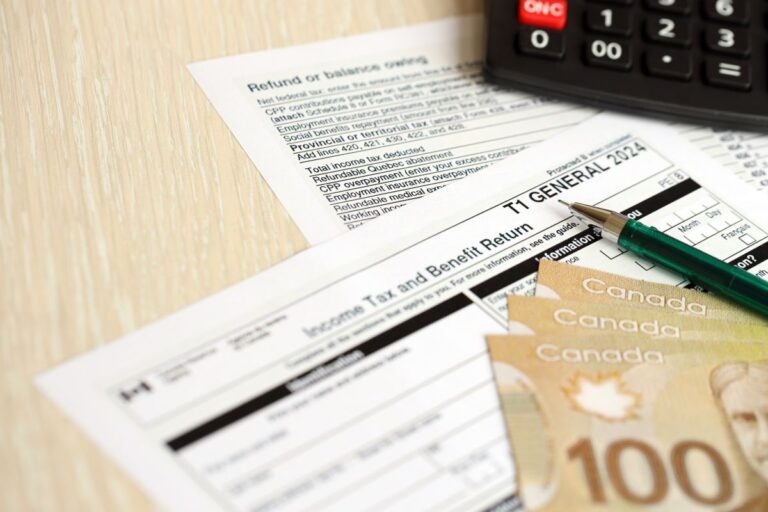
The CRA’s Employers’ Guide to Taxable Benefits and Allowances (T4130) treats securities and stocks given to employees as near-cash benefits, which are taxable. In general, the value of the shares your employer contributes is added to your employment income and included in box 14 of your T4. Your employer withholds tax at source, so your take-home pay may dip slightly in pay periods when matched shares are credited.
That means the match is taxed at your marginal rate. Our guide to the marginal tax rate in Canada explains how to find yours.
3. Selling your shares
When you sell, you report a capital gain or loss on Schedule 3. Your adjusted cost base (ACB) generally includes what you paid plus the value of the match that was already taxed as employment income, so you aren’t taxed twice on the same amount. The CRA’s capital gains guide (T4037) explains that when you buy identical shares at different times, you must average the cost of all of them to find your ACB per share. Only 50% of a capital gain is taxable; the proposed increase in the inclusion rate was cancelled in March 2025.
Keep every plan statement and T4. Many people over-report their gains because they forget to add the taxed match to their ACB.
Pro Tip: Watch the superficial loss rule. Because your ESPP keeps buying the same company’s shares every pay period, selling shares at a loss can easily fall within 30 days of a new plan purchase. If you (or your spouse) acquire identical shares within 30 days before or after the sale and still hold them, the loss is denied and added to the cost of the new shares. To claim a loss, pause contributions long enough to clear the 30-day window on both sides of the sale.
Is the Company Match Free Money?
It’s a strong return, but it comes with tax and risk attached. Here’s a simple illustration using a 50% match and a 30% marginal tax rate:
| Step | Amount |
|---|---|
| You contribute from after-tax pay | $1,000 |
| Employer match (50%) | $500 of shares |
| Tax on the match at 30% | About $150 |
| Net value of the match after tax | About $350 |
| Instant return on your $1,000 | About 35%, before any share price change |
A 35% head start is hard to beat anywhere else. That’s why most people should contribute at least enough to get the full match, as long as they can afford the payroll deduction and don’t need the money for high-interest debt or an emergency fund.
What happens when the share price moves
The match only holds its value if the share price does. Here’s a fuller example: you contribute $6,000 in a year, your employer adds a $3,000 match, and you’re in Ontario’s 29.65% bracket, so the match costs about $890 in tax.
| Share price when you can sell | Shares worth | What you keep vs. your $6,000 + $890 tax | Tax on sale |
|---|---|---|---|
| Up 10% | $9,900 | About $3,010 ahead | About $133 (half of a $900 gain at 29.65%) |
| Unchanged | $9,000 | About $2,110 ahead | None |
| Down 35% | $5,850 | About $1,040 behind | You have a $3,150 capital loss to use against other gains |
Illustrative only. Taxes vary by province and income; this ignores dividends and fees.
A drop of about 23% wipes out the after-tax value of the match. And if you must stay employed for two years to receive it, the return is spread over those two years.
How an ESPP fits your budget
Payroll deductions are easy to forget, which is both their strength and their danger. Count your ESPP contribution as part of your savings rate, not as extra money. If you use the 50/30/20 budget rule, the ESPP belongs in the 20% savings bucket, alongside your TFSA and RRSP contributions.
The Concentration Risk Problem
The biggest danger of an ESPP isn’t tax. It’s putting too many eggs in one basket. Your job already depends on your employer’s success. If the company struggles, you could face a pay freeze or layoff at the same time your shares fall. Holding a large amount of company stock doubles that exposure.
Single stocks are also far more volatile than a diversified fund. Even large, well-run companies can fall 50% or more and take years to recover. Our guide on whether to buy individual stocks in Canada explains why one company should rarely dominate a portfolio.
A practical sell-and-diversify plan
Many investors use a simple routine to collect the match without building a risky position:
- Join the plan at the level needed for the full match.
- Sell matched shares once vesting or holding rules allow. If they’ve risen, only half of the gain is taxable.
- Move the cash into registered accounts, using the proceeds to fund your TFSA, RRSP, or FHSA with diversified ETFs.
- Set a cap, such as keeping company stock at 10% or less of your total investments.
- Plan around blackout periods. If you’re considered an insider, trading windows may limit when you can sell.
Should you move ESPP shares into your TFSA?
Many brokerages let you transfer shares into a TFSA in kind, but the CRA treats the transfer as a sale at current market value, and the contribution counts against your TFSA room at that value. If the shares have risen, you’ll owe tax on the gain. If they’ve fallen, the CRA does not let you claim the loss on a transfer into a TFSA. It’s often simpler to sell in the non-registered account, claim any loss (watching the superficial loss rule), and contribute cash.
Related reading: what diversification really means for Canadian investors.
Key Takeaways
- In a typical Canadian ESPP, you buy shares with after-tax pay and your employer adds a match.
- The CRA treats shares your employer contributes as a taxable near-cash benefit, included in box 14 of your T4; discounts on share purchases are generally taxable too.
- A 50% match taxed at a 30% marginal rate still gives about a 35% head start on each dollar you contribute, but a share price drop of about 23% can erase it.
- Add the taxed value of the match to your ACB so you don’t pay tax twice when you sell, and average the cost across all identical shares.
- Ongoing plan purchases can trigger the superficial loss rule if you sell at a loss; time sales carefully.
- Keep company stock to a small share of your portfolio, such as 10% or less, because your salary already depends on the same company.
Frequently Asked Questions
Should I join my company’s employee stock purchase plan?
If there’s a match or discount and you can afford the payroll deduction, joining is usually worthwhile, because the benefit is an immediate return even after tax. Just plan to diversify instead of letting company stock pile up, and make sure your emergency fund and high-interest debt are handled first.
Is the employer match taxable in Canada?
Yes. The value of shares your employer contributes is generally a taxable employment benefit. It’s added to your income, included on your T4, and tax is withheld through payroll.
How do I calculate the ACB of my ESPP shares?
Generally, add what you paid to the value of any match or discount that was already taxed as employment income, then average the cost across all identical shares you hold, including shares bought outside the plan. Your plan statements and T4 slips provide the numbers. Keep a running spreadsheet each time shares are bought or sold.
What happens to my ESPP if I quit?
Shares you bought with your own money are yours. Unvested employer shares are often forfeited, depending on your plan’s rules. Check the plan document before you give notice, since waiting a few weeks for a vesting date could be worth thousands of dollars.
Can I hold ESPP shares in my TFSA or RRSP?
Usually not directly through the plan, since most ESPPs are held in a non-registered account. You can sell the shares and contribute the cash, or transfer them in kind to a TFSA or RRSP if your brokerage allows. An in-kind transfer counts as a sale at market value, any gain is taxable, and a loss can’t be claimed.
Conclusion
Employee stock purchase plans in Canada can be a valuable benefit, but the company match isn’t truly free money. It’s taxed as employment income, its value depends on one stock, and it ties your savings to your employer. For most people, the best approach is to contribute enough to get the full match, track your ACB carefully, and sell matched shares once you’re allowed. Then move the money into diversified investments so your future doesn’t rest on a single company.
Official sources: CRA Guide T4130, Employers’ Guide to Taxable Benefits and Allowances; CRA Guide T4037, Capital Gains.
Get plain-English money tips for Canadians
Join the GetWealthy newsletter and get the free Canadian Money Planner 2026 Edition (PDF). No spam, unsubscribe anytime.
Your one-stop guide to everything Canadians need to know about money. Written by the GetWealthy editorial team, based on official CRA, FINTRAC and government sources and reviewed every year.
Turn what you just read into a plan
The Canadian Money Planner keeps your budget, savings, debt and goals in one place. It's free.
Get the free 2026 Planner
Disclaimer: This article is for informational and educational purposes only and does not constitute financial, tax, or investment advice. ESPP rules and tax treatment vary by plan. Past performance does not guarantee future results. Always consult a qualified tax professional or financial advisor for personalized advice.