Buying US stocks in Canada comes with a hidden cost most DIY investors don’t notice until they’ve already lost hundreds of dollars: currency conversion fees. Every time you buy shares of Apple, Amazon, or a US-listed S&P 500 ETF through a Canadian brokerage, you’re likely paying around 1.5% just to convert your loonies into greenbacks — and often again when you convert back. On a $50,000 conversion, that’s about $750 gone before your investment has a chance to grow. In this guide, you’ll learn how Norbert’s Gambit works, which brokerages make it easiest in 2026, and how to structure your US holdings to minimize both conversion fees and withholding taxes.
Quick Answer
- Norbert’s Gambit lets you convert CAD to USD for a small, mostly fixed cost — typically a journaling fee or commissions of roughly $10 to $25 plus a small bid-ask spread — instead of a 1.5% conversion fee.
- Use DLR / DLR.U (the Global X US Dollar Currency ETF, formerly Horizons) for the lowest price risk, or inter-listed stocks like RY where your brokerage journals them faster.
- 2026 changes matter: Wealthsimple now supports Norbert’s Gambit, BMO InvestorLine went commission-free on September 14, 2026, and Questrade charges $9.95 per online journal request.
- Hold US-listed dividend payers in your RRSP, not your TFSA, to avoid the 15% US withholding tax on dividends.
Pro Tip: Check your brokerage’s tiered FX pricing before you bother with the gambit. Wealthsimple, for example, now charges 1.5% under $10,000 but 0.5% on conversions of $25,000 to $99,999 and 0% above $100,000. If you’re converting a large lump sum there, the direct conversion may already be cheap — the gambit’s biggest payoff is at brokerages with a flat 1.5% fee.
Why Currency Conversion Fees Cost Canadians Buying US Stocks So Much
When you buy US stocks through a standard Canadian brokerage account, you’re not getting the mid-market exchange rate you see on Google or XE.com. Your brokerage adds a spread — commonly about 1.5%, sometimes up to 2% or more at some institutions — on top of the actual exchange rate. This is how they make money on currency conversion, and it applies both when you buy (converting CAD to USD) and when you sell (converting USD back to CAD).
Let’s put real numbers to this. Say the actual exchange rate is 1.40, meaning one US dollar costs $1.40 Canadian. With a 1.5% spread, your brokerage might charge about $1.42 per USD when buying. On a $25,000 CAD investment, that 1.5% spread costs you $375. If you later sell and convert back to CAD, you lose another 1.5%. Round-trip, you’ve paid $750 in hidden fees on a single investment.
Many Canadians hold 30% to 50% of their portfolio in US equities — and for good reason. US markets offer exposure to sectors like big tech that are thin on the Toronto Stock Exchange. If you’re building a diversified portfolio, you’ll be converting currency repeatedly over your investing lifetime.
The math gets worse with regular contributions. If you’re adding $1,000 a month to US holdings at a brokerage that charges 1.5% per conversion, that’s $180 a year in conversion fees alone — before any trading commission or management fee.
How the spread actually works
Brokerages don’t typically show you the spread as a separate line item. Instead, they quote an “all-in” exchange rate that looks reasonable until you compare it to the actual market rate. The spread is baked into the price you see when you confirm your trade.
Some brokerages advertise “no commission” trading, which sounds great until you realize the money is being made on the currency spread instead. BMO InvestorLine’s new commission-free pricing, for example, states plainly that foreign exchange fees continue to apply. A 1.5% spread on a $10,000 conversion is $150 — far more than you’d pay in commissions for most trades.
How Does Norbert’s Gambit Work for Buying US Stocks in Canada?
Norbert’s Gambit is a legal technique that lets Canadian investors convert CAD to USD (or vice versa) at close to the actual exchange rate, paying only small fixed costs instead of a percentage-based conversion fee. The strategy is named after Norbert Schlenker, a B.C. financial advisor who popularized it.
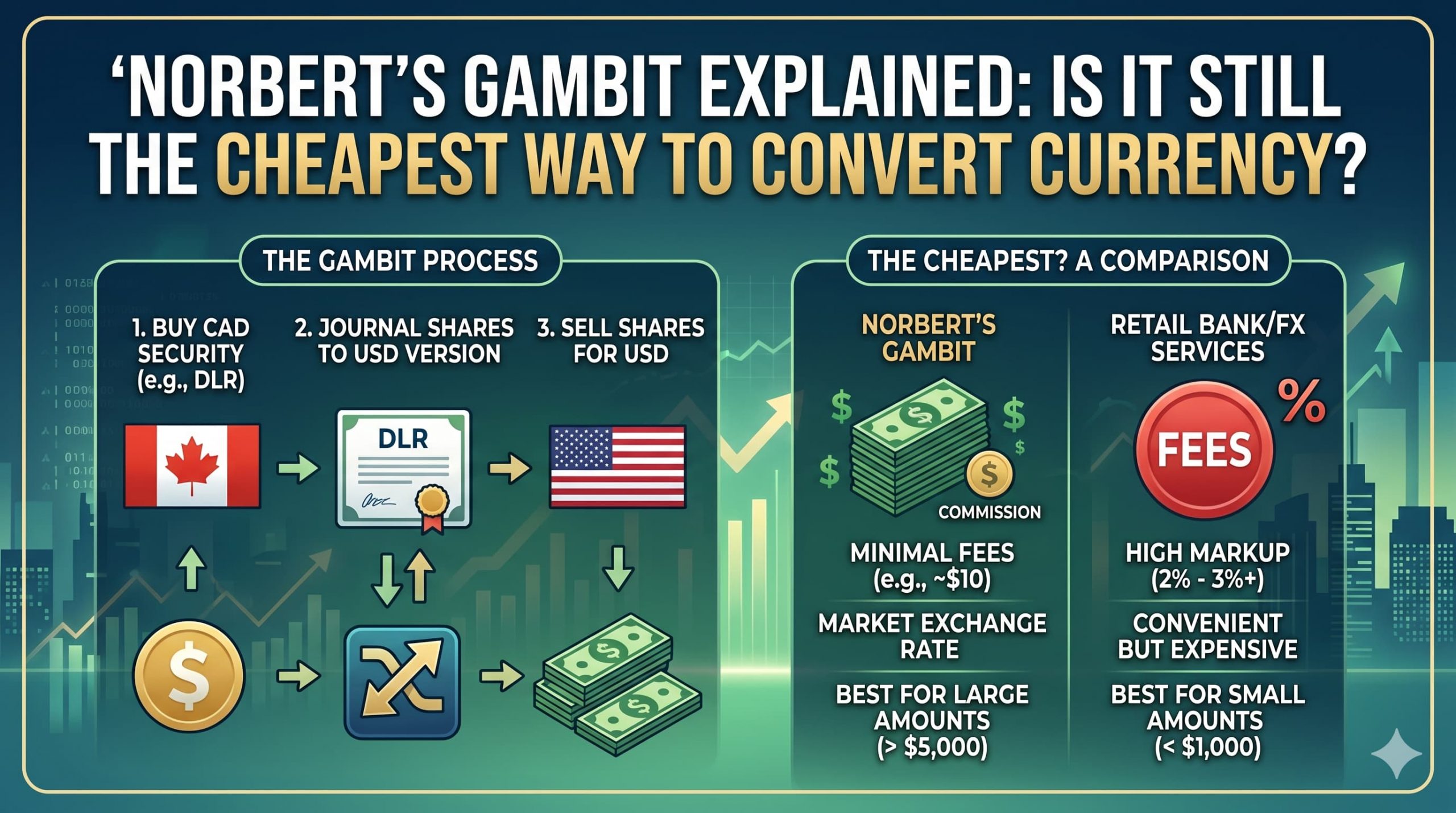
The core concept is simple: instead of converting currency directly, you buy a security that trades in both CAD and USD, then “journal” (transfer) your shares from the Canadian side to the US side, where you sell them for US dollars. Since you’re buying and selling the same underlying asset, your only costs are fees, commissions, the bid-ask spread, and any small price movement during the process.
Step-by-step: the DLR/DLR.U method
The most common way to execute Norbert’s Gambit uses the Global X US Dollar Currency ETF (formerly the Horizons US Dollar Currency ETF), which trades as DLR on the TSX in Canadian dollars and as DLR.U in US dollars.
- Buy DLR in your CAD account. Purchase DLR using your Canadian dollars. The ETF simply holds US dollars, so its price moves with the exchange rate.
- Wait for settlement. Canadian trades settle one business day after the trade (T+1). Most brokerages want your purchase settled before journaling.
- Journal shares to the USD side. Request that your DLR shares be journaled to DLR.U in your USD account. Depending on your brokerage, this is an online request, a secure message, or a phone call.
- Sell DLR.U for USD. Once the journal is complete, sell your DLR.U shares. The proceeds settle in US dollars in your USD account, ready to buy US stocks.
The same steps work in reverse when you want to convert USD back to CAD.
The inter-listed stock method (RY, TD, etc.)
An alternative uses inter-listed stocks — Canadian companies that trade on both the TSX and a US exchange, such as Royal Bank (RY), TD Bank (TD), and Shopify (SHOP).
The process is similar: buy on the TSX in CAD, journal to the US side, sell on the NYSE or Nasdaq for USD. The advantage is that some brokerages process these journals faster, and the stocks are highly liquid with tight bid-ask spreads.
The disadvantage is price risk. DLR holds US dollars, so its price moves only with the exchange rate. An inter-listed stock can move for any reason — earnings, market volatility, sector news. If the stock drops 2% while you wait for the journal, you’ve wiped out your savings. For most investors, DLR/DLR.U is the safer choice unless your brokerage journals inter-listed shares significantly faster.
Which Canadian Brokerages Make Norbert’s Gambit Easiest in 2026?
The brokerage landscape has shifted noticeably this year. Two changes stand out: Wealthsimple now supports Norbert’s Gambit with DLR and DLR.U, and BMO InvestorLine eliminated commissions on stock and ETF trades for self-directed clients effective September 14, 2026. Here’s how the main options compare. Fees change often, so confirm current pricing before you trade.
| Brokerage | Direct FX conversion cost | Norbert’s Gambit | Stock/ETF commissions | Notes |
|---|---|---|---|---|
| Interactive Brokers (IBKR) | About 0.002% of the amount, minimum US$2 per conversion | Not needed | US$0.005/share (US), $0.01/share (Canada), $1 minimum | Direct conversion is already near spot |
| Wealthsimple | 1.5% under $10,000; 1.0% to $24,999; 0.5% to $99,999; 0% at $100,000+ | Supported (DLR/DLR.U) | $0 | Needs a USD account of the same type — free for Premium/Generation, $10/month for Core |
| Questrade | 1.5% | Supported; self-serve online journal request | $0 online (ECN fees only in limited cases) | $9.95 per online journal request; journals take about 3–5 business days |
| BMO InvestorLine | Spread applies (FX fees continue) | Possible; request journal | $0 since Sept 14, 2026 | Commission-free removes the gambit’s trading costs |
| TD Direct Investing | Spread applies | Possible (usually phone) | $9.99 per trade | Two trades ≈ $20 per gambit |
| RBC Direct Investing | Spread applies | Possible (usually phone) | $9.95 per trade | Two trades ≈ $20 per gambit |
Interactive Brokers stands apart because its standard currency conversion is priced near the spot rate — about 0.002% of the amount, with a minimum of US$2 per conversion. Running Norbert’s Gambit through IBKR doesn’t make sense; use its direct currency conversion instead.
Wealthsimple is now a real option. You need both a CAD and a USD account of the same type (TFSA to TFSA, RRSP to RRSP). USD accounts are free for Premium and Generation clients but cost $10 a month on the Core tier, which can outweigh the savings if you convert only occasionally. And because Wealthsimple’s FX fee drops as the amount rises, the gambit matters most for conversions under $25,000.
Questrade is commission-free on online stock and ETF trades, and since early 2025 journal requests have been self-serve through the online portal. The main cost of the gambit there is the $9.95 journal fee per request, plus the bid-ask spread on DLR and DLR.U — not “a few dollars” as some older guides suggest, but still far below 1.5% on any meaningful amount. Some Questrade plans may waive the journal fee; check your account’s fee schedule.
The other big banks still charge per-trade commissions and generally require a phone call for journaling. The process is doable, but the friction means it’s best saved for larger conversions.
When the gambit isn’t worth it
The gambit has a mostly fixed cost; the conversion fee is a percentage. So the break-even depends on your brokerage:
| Your gambit cost | Break-even vs a 1.5% fee | Comfortably worth it from |
|---|---|---|
| About $10 (e.g. $9.95 journal fee, $0 commissions) | About $700 | $1,500+ |
| About $20 (two $9.95–$9.99 trades) | About $1,350 | $2,500+ |
Those break-evens exclude the bid-ask spread on DLR/DLR.U and the value of your time, which is why a practical threshold sits higher. For smaller regular contributions, consider batching your conversions quarterly rather than monthly, or using a brokerage like IBKR where direct conversion is already cheap.
RRSP vs TFSA: Where Should Canadians Hold US Stocks?

Currency conversion fees aren’t the only cost to watch. The US charges a 15% withholding tax on dividends paid by American companies to Canadian investors (under the Canada-US tax treaty). Where you hold those stocks determines whether you can avoid it.
RRSP: the tax-sheltered choice for US dividends
Under the Canada-US tax treaty, dividends from US-listed securities held directly in an RRSP or RRIF are exempt from the 15% withholding tax. That makes your RRSP the ideal home for US dividend-paying stocks and US-listed ETFs.
If you hold a US-listed ETF like VTI (Vanguard Total Stock Market) or VOO (Vanguard S&P 500) in your RRSP, you receive the full dividend. Hold the same ETF in your TFSA, and 15% is withheld at source before you ever see it. On a $50,000 holding yielding 1.5%, that’s $112.50 a year lost in a TFSA that you’d keep in an RRSP.
One important nuance: the RRSP exemption applies to US-listed securities you hold directly. A Canadian-listed ETF that holds US stocks (VFV or XUS, for example) still suffers the 15% withholding inside the fund, even in your RRSP. If you want to avoid it entirely, your RRSP needs to hold the US-listed version — which means converting to USD, which is where Norbert’s Gambit pays off.
For 2026, the RRSP contribution limit is the lesser of 18% of your previous year’s earned income or $33,810, up from $32,490 for 2025.
TFSA: better for Canadian stocks and growth
Your TFSA is still excellent for investing — just not ideal for US dividend payers. Consider holding Canadian dividend stocks, Canadian-listed ETFs that hold US stocks (accepting that withholding applies inside the fund), or US stocks that pay little or no dividend. The 15% is lost permanently in a TFSA; there’s no foreign tax credit to recover it.
The 2026 TFSA limit is $7,000, with cumulative room around $109,000 for anyone who was 18 or older in 2009 and has never contributed.
Non-registered accounts: the withholding tax offset
If you hold US stocks in a non-registered account, the 15% withholding still applies, but you can generally claim a foreign tax credit on your Canadian return to offset it. That makes non-registered accounts roughly neutral on the withholding tax specifically — you pay the 15% to the US and get credit for it in Canada.
The catch is that US dividends are taxed as ordinary foreign income in Canada, without the dividend tax credit that applies to Canadian dividends, and capital gains are taxable when you sell. For most investors, maximizing registered accounts first is still the priority.
Common Norbert’s Gambit Mistakes (and How to Avoid Them)
Selling before the journal completes. If you sell DLR.U before your shares have been journaled, some brokerages treat it as a short sale and may charge borrowing fees or reject the trade. Always confirm the journal is complete before selling.
Forgetting about settlement. After buying DLR, wait for T+1 settlement before requesting the journal. Starting too early just means delays.
Using volatile inter-listed stocks. If you use an inter-listed stock instead of DLR, pick one with low volatility and high liquidity. Journaling can take several days. A 3% drop during that window wipes out your savings.
Doing the gambit for small amounts. If you’re converting $500, even a 1.5% fee is only $7.50 — less than a single journal fee. Save the gambit for larger conversions.
Not holding USD in a USD account. Make sure your account can hold US dollars without automatic conversion. Some accounts will convert US proceeds back to CAD, defeating the purpose. At Questrade you need a USD sub-account; at Wealthsimple, a USD account of the same type; at the banks, confirm your registered accounts allow you to hold USD.
Forgetting the tax paperwork in a taxable account. In a non-registered account, buying DLR and selling DLR.U is a disposition. The gain or loss is usually tiny, but it’s still reportable, calculated in Canadian dollars using the exchange rates on the trade dates. Keep your trade confirmations. In a TFSA or RRSP, there’s nothing to report.
Key Takeaways
- Standard brokerage currency conversion fees of around 1.5% cost about $375 on a $25,000 conversion each way; Norbert’s Gambit typically costs $10 to $25 in fees plus a small spread.
- The DLR/DLR.U method — using the Global X US Dollar Currency ETF, formerly Horizons — is the safest approach: buy DLR, wait for settlement, journal to DLR.U, sell for USD.
- Wealthsimple now supports Norbert’s Gambit, BMO InvestorLine went commission-free on September 14, 2026, and Questrade charges $9.95 per online journal request.
- Interactive Brokers offers near-spot conversion (about 0.002%, US$2 minimum), making the gambit unnecessary there.
- Hold US-listed dividend payers in your RRSP to avoid the 15% US withholding tax — the treaty exemption doesn’t cover TFSAs or Canadian-listed ETFs holding US stocks.
- The gambit is generally worth it from about $1,500 to $2,500 per conversion, depending on your brokerage’s fixed costs.
Frequently Asked Questions
What is Norbert’s Gambit and how does it save money on US stocks?
Norbert’s Gambit is a currency conversion technique where you buy a dual-listed security (like DLR) in Canadian dollars, journal the shares to the US-dollar version (DLR.U), and sell for US dollars. Instead of paying about 1.5% to convert, you pay a small fixed cost — typically $10 to $25 in journal fees or commissions plus the bid-ask spread. On a $20,000 conversion, that can save roughly $275 compared with a 1.5% fee.
Can I do Norbert’s Gambit on Wealthsimple?
Yes, as of 2026. Wealthsimple supports the gambit using DLR and DLR.U, but you need a USD account of the same type as your CAD account. USD accounts are free on the Premium and Generation tiers and cost $10 a month on Core. Because Wealthsimple’s direct FX fee drops to 0.5% on $25,000 to $99,999 and 0% above $100,000, the gambit saves the most there on conversions under $25,000.
Should I hold US stocks in a TFSA or RRSP to avoid withholding tax?
Hold US-listed dividend payers in your RRSP whenever possible. The Canada-US tax treaty exempts US-listed securities held directly in an RRSP or RRIF from the 15% withholding tax, but the exemption doesn’t cover TFSAs, and it doesn’t help with Canadian-listed ETFs that hold US stocks. In a TFSA, the 15% is withheld and can’t be recovered.
Which Canadian brokerages have the lowest USD conversion costs?
Interactive Brokers is the cheapest for direct conversion, at about 0.002% of the amount with a US$2 minimum. Among mainstream platforms, Questrade (self-serve online journaling, $9.95 per request) and now Wealthsimple support Norbert’s Gambit; BMO InvestorLine’s move to $0 commissions also lowers the cost of doing it there. The other big bank brokerages still charge per-trade commissions and usually require a phone call to journal.
Buying US stocks in Canada doesn’t have to mean handing over hundreds or thousands of dollars in currency conversion fees. By learning Norbert’s Gambit and checking how your brokerage prices it in 2026, you can invest in the full range of US opportunities while keeping more of your money working for you. Pair that with smart account placement — US-listed dividend payers in your RRSP, Canadian stocks in your TFSA — and you’ve cut two of the biggest hidden costs facing Canadian investors. For more strategies on building your portfolio efficiently, explore our other guides on Getwealthy.
Get plain-English money tips for Canadians
Join the GetWealthy newsletter and get the free Canadian Money Planner 2026 Edition (PDF). No spam, unsubscribe anytime.
Your one-stop guide to everything Canadians need to know about money. Written by the GetWealthy editorial team, based on official CRA, FINTRAC and government sources and reviewed every year.
Turn what you just read into a plan
The Canadian Money Planner keeps your budget, savings, debt and goals in one place. It's free.
Get the free 2026 Planner
Disclaimer: This article is for informational and educational purposes only and does not constitute financial, tax, or legal advice. Brokerage fees, FX pricing, and account features change frequently — figures here reflect publicly available information as of early October 2026. Confirm current pricing with your brokerage, and consult a qualified financial or tax professional for personalized advice.