Monthly income ETFs in Canada are popular with retirees and anyone who likes the idea of a steady deposit that looks like a paycheque. These funds pay distributions every month, often at yields well above a standard index fund. But a high, smooth payout is not the same as a high return. Part of each payment may simply be your own money handed back, labelled “return of capital,” and some strategies give up future growth to fund today’s cheque. This guide explains how monthly distributions work, what return of capital really means for your taxes, and the hidden costs to check before you buy.
- Monthly income ETFs pay distributions every month from dividends, interest, option premiums, capital gains, or return of capital (ROC), and the mix changes from year to year.
- ROC is not taxed when you receive it, but it lowers your adjusted cost base (ACB), so you pay more capital gains tax when you sell; if your ACB falls below zero, the CRA treats the negative amount as a capital gain.
- Check the total return, not the yield: covered-call ETFs can cap your upside and often charge more, for example ZWC’s 0.72% MER compared with 0.17% for a plain TSX 60 index fund such as XIU.
How Monthly Distributions Work
An ETF collects income from the investments it holds and passes it on to you as distributions. A monthly income ETF simply pays on a monthly schedule, usually a fixed amount per unit that the fund adjusts from time to time.
The money can come from several sources:
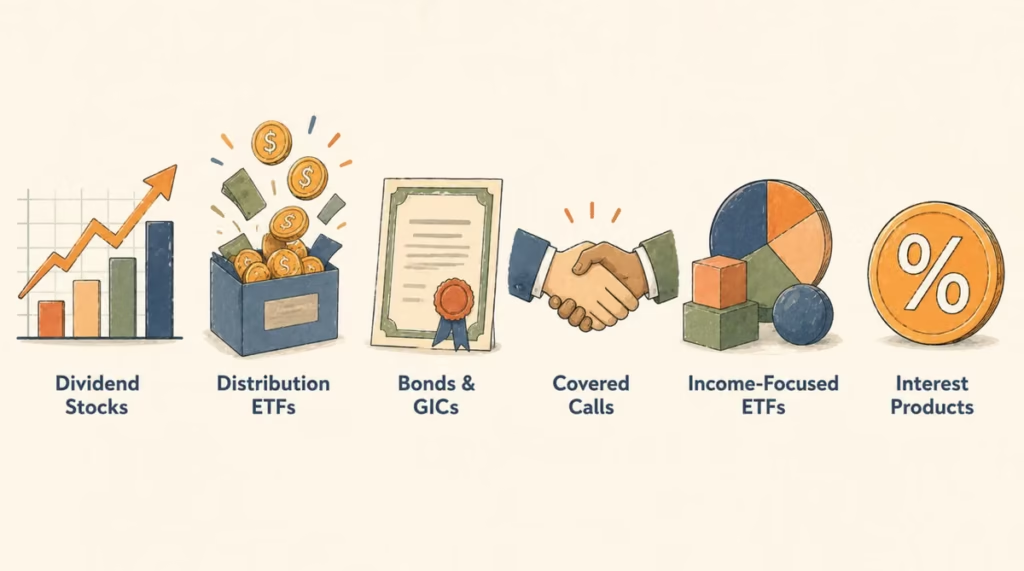
- Dividends from Canadian or foreign companies
- Interest from bonds or cash holdings
- Option premiums from selling covered calls on the stocks in the fund
- Capital gains realized when the fund sells holdings at a profit
- Return of capital, which is a payout of part of your investment rather than income
Because many funds aim to keep the monthly amount stable, they may pay out more than they earn in a given month and make up the gap with ROC. The final breakdown for each year is reported on your T3 slip, usually issued in the spring after year-end.
Common types of monthly income ETFs
| Type | Main income source | Key trade-off |
|---|---|---|
| Dividend ETFs | Dividends from mature companies like banks, utilities, and pipelines | Concentrated in a few high-yield sectors |
| Covered-call ETFs | Dividends plus option premiums | Upside is capped when markets rally |
| Bond ETFs | Interest | Prices fall when rates rise; interest is fully taxable |
| Balanced income ETFs | Mix of dividends and interest | Lower growth than all-equity funds |
| Enhanced or leveraged income ETFs | Borrowing to boost yield | Higher risk and borrowing costs |
Dividend-focused funds usually lean heavily on Canadian banks and energy companies. Our comparison of bank stocks and bank ETFs explains why that concentration matters.
What Return of Capital Means
Return of capital is the most misunderstood part of monthly income ETFs. It is not a scam, and it is not always bad. But you need to know what it is.
ROC is your money coming back
When an ETF pays ROC, it is returning part of the money you invested, not paying you a profit. If you invest $10,000 and receive $600 in a year, of which $200 is ROC, only $400 is true income. The other $200 was already yours.
How ROC affects your taxes
ROC is not taxed in the year you receive it. Instead, it reduces your adjusted cost base. The CRA’s capital gains guide explains that your ACB is the starting cost of your investment, and the capital gain is what you receive on sale minus your ACB. A lower ACB means a bigger capital gain when you eventually sell.
In the example above, your $10,000 ACB drops to $9,800 after $200 of ROC. If you sell later for $10,000, you report a $200 capital gain even though the price did not change. Only 50% of a capital gain is taxable in Canada, so ROC is usually a tax deferral, not a tax loss. If your ACB ever drops below zero, the negative amount is treated as a capital gain in that year.
When ROC is a warning sign
ROC is fine when it comes from tax-efficient structures, such as certain option strategies or funds that hold assets with tax deductions. It is a concern when a fund pays more than its holdings earn year after year. Watch for:
- A falling unit price over several years while the payout stays flat
- Regular cuts to the monthly distribution
- A large ROC share on the T3 slip every year
Those signs suggest the fund is shrinking your capital to maintain the cheque. For a deeper look at how Canadian dividends are taxed differently from ROC, see our dividend tax credit guide.
The Hidden Costs of High Yield
A high yield can hide costs that lower your long-term wealth.
Higher fees
Income strategies cost more to run. For example, the BMO Canadian High Dividend Covered Call ETF (ZWC) has a 0.72% MER, according to BMO, while the iShares S&P/TSX 60 Index ETF (XIU) has a 0.17% MER, according to BlackRock. On $100,000, that gap is about $550 a year.
Capped upside
Covered-call funds sell the right to buy their stocks at a set price. They earn option premiums, which boost the monthly payout, but they give up some of the gain when markets rise quickly. In strong bull markets, covered-call ETFs often trail plain index funds by a wide margin. In flat or falling markets, the premiums can help.
Tax drag in a non-registered account
The type of income matters. Eligible Canadian dividends receive the dividend tax credit. Interest and foreign income are taxed at your full marginal rate. Option premiums and gains are often taxed as capital gains. Holding the wrong fund in the wrong account can cost more than the fee. Bond-heavy income ETFs often fit best in an RRSP, while Canadian dividend funds can be efficient in a non-registered account or TFSA. Our guide to TFSA qualified investments confirms that listed ETFs are eligible for a TFSA.
Yield-chasing risk
The highest yields often come from the riskiest strategies, such as leverage or concentrated sectors. A yield of 10% or more should prompt questions about where the money really comes from.
Using Monthly ETFs for Income
Monthly income ETFs can work well when you use them deliberately.
- Match payments to bills. Retirees who want a predictable monthly deposit can line up distributions with rent, groceries, or utilities.
- Focus on total return. Compare a fund’s distributions plus price change over five or 10 years with a plain index fund. If the index fund did better, you could sell a few units each month instead.
- Keep a cash buffer. Hold a few months of spending in cash so a distribution cut does not force you to sell during a downturn.
- Track your ACB. Record ROC every year from your T3 slips, or ask your brokerage to report adjusted ACB.
- Diversify sources. Mix dividend, bond, and global funds so one sector does not drive all your income.
Selling a small number of units each month from a low-cost index fund, sometimes called a “homemade dividend,” can produce a similar paycheque with lower fees. It just requires a little more effort. Our guide to retirement income planning in Canada shows how ETFs fit alongside CPP, OAS, and RRIF withdrawals.
Key Takeaways
- Monthly income ETFs pay from dividends, interest, option premiums, capital gains, and return of capital; your T3 slip shows the yearly mix.
- ROC is not taxed when received but lowers your ACB, which raises the capital gain when you sell.
- Only 50% of a capital gain is taxable in Canada, so ROC is usually a tax deferral rather than a tax loss.
- Covered-call ETFs can cost much more, such as ZWC’s 0.72% MER versus XIU’s 0.17%, and they cap gains in strong markets.
- Judge any income fund by total return over five to 10 years, not by its yield.
- Place bond-heavy income ETFs in an RRSP and Canadian dividend funds in a TFSA or non-registered account where it fits your plan.
Frequently Asked Questions
Are monthly income ETFs good for retirement?
They can be useful for steady cash flow, especially when payments are matched to monthly bills. But they should be judged on total return and fees. A mix of income funds and low-cost index funds often works better than relying on high-yield funds alone.
Is return of capital taxable in Canada?
Not when you receive it. ROC reduces your adjusted cost base, so it increases your capital gain when you sell. If your ACB falls below zero, the excess is treated as a capital gain in that year.
Why do covered-call ETFs pay such high yields?
They collect option premiums on top of dividends by selling the right to buy their stocks at set prices. The premiums raise the payout, but the fund gives up some gains when markets rise quickly.
Should I hold monthly income ETFs in a TFSA?
A TFSA can work well because distributions grow tax-free and you do not need to track ROC for tax. Foreign dividends may still face withholding tax inside a TFSA, so Canadian-focused income funds are often a better fit there.
Conclusion
Monthly income ETFs in Canada can deliver a dependable, paycheque-style deposit, but the payout tells only part of the story. Return of capital lowers your cost base and raises future capital gains, covered-call strategies trade growth for income, and higher fees quietly reduce your returns. Look past the yield to the total return, check the T3 breakdown each year, and hold each fund in the account where its income is taxed most efficiently. Used that way, monthly income ETFs can support your plan without draining it.
Official sources: CRA Guide T4037, Capital Gains; CRA: Contributing to a TFSA.
Get plain-English money tips for Canadians
Join the GetWealthy newsletter and get the free Canadian Money Planner 2026 Edition (PDF). No spam, unsubscribe anytime.
Your one-stop guide to everything Canadians need to know about money. Written by the GetWealthy editorial team, based on official CRA, FINTRAC and government sources and reviewed every year.
Turn what you just read into a plan
The Canadian Money Planner keeps your budget, savings, debt and goals in one place. It's free.
Get the free 2026 Planner
Disclaimer: This article is for informational and educational purposes only and does not constitute financial, tax, or investment advice. ETF names are examples, not recommendations; fees, yields, and distributions change. Past performance does not guarantee future results. Always consult a qualified financial advisor or tax professional for personalized advice.